


Building a healthcare app usually starts with a great idea. This could be improving patient care or making health services more accessible. Even though dreaming is fun and shows a lot of potential, the budget says something else.
The questions follow, like How much is this actually going to cost? You think you have some idea, but the estimates seem to change the moment features or scalability enter the conversation.
If you’ve ever worked on an app, this might feel familiar. What begins as a simple idea quickly grows into technical things like data security and integrations. Healthcare apps follow a similar path, just with much higher stakes. Every decision directly impacts the cost.
Understanding healthcare app development cost is about knowing where your money goes and how to plan it smartly. In this blog, we’ll break down the factors that influence costs and how to budget without unpleasant surprises along the way.
A General Breakdown of The Healthcare App Development Costs
It’s important to understand that healthcare app development costs vary a lot depending on the type of your project. The budget depends heavily on the app’s complexity and other requirements. To make this easier, let’s break development costs into three broad categories: simple, medium-complexity, and enterprise.
| App Type | Description | Estimated Cost | Timeline |
| Simple App | Basic features like appointment booking, user profiles, reminders, and limited integrations | $25,000 – $50,000 | 3–4 months |
| Medium-Complexity App | Telemedicine features, EHR/EMR integration, payment gateways, advanced UI/UX | $50,000 – $120,000 | 5–7 months |
| Enterprise App | AI features, multi-system integrations, high-level security, scalability, compliance (HIPAA/GDPR) | $120,000 – $300,000+ | 8–12+ months |
What are the Types of Healthcare Apps and How Do They Affect Cost?
Healthcare apps come in many forms, and each type brings its own level of scope and features. A simple wellness app won’t cost the same as a telemedicine platform, and that difference shows up quickly in development time and budget. Understanding the types of healthcare apps helps set realistic cost expectations.
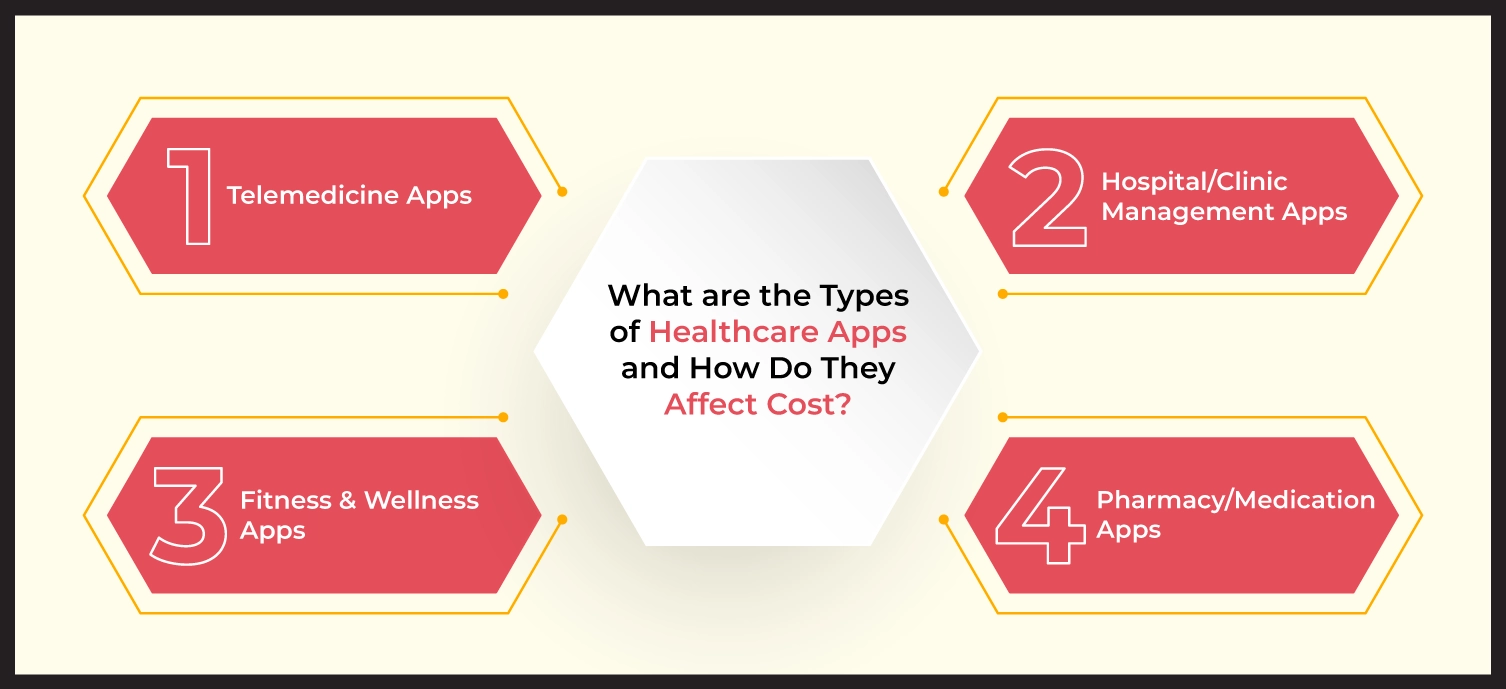
Telemedicine Apps
Telemedicine apps basically bring the doctor’s clinic onto your phone. They allow patients to book appointments and sometimes even chat with doctors in real time. Many telemedicine apps also support follow-ups and patient history, so doctors don’t have to start from scratch every time.
Now, when it comes to cost, telemedicine apps sit on the higher end of the spectrum. Why? Because you’re dealing with things like:
- Real-time communication
- Secure video calling
- Patient data storage
- Strict healthcare compliance
- Payment integration
- Appointment scheduling
- Electronic health records
The more “hospital-like” the experience, the more time and budget it takes to build it properly and safely.
Hospital/Clinic Management Apps
Hospital and clinic management apps help staff manage appointments and patient records, and even more, all in one system. They’re designed for doctors and front-desk teams to keep everything organized. This lets them focus on providing healthcare instead of being confused by spreadsheets and paperwork.
From a cost perspective, these apps can be quite expensive to develop, mainly because they’re complex and role-based. You’re not building one simple interface; you’re creating:
- Multiple user roles
- Centralized patient record management
- Billing and invoicing systems
- Inventory and staff management
- System integrations with labs or existing software
- High-level data security requirements
The more workflows the app supports, the more time and budget it takes to build everything.
Fitness & Wellness Apps
Fitness and wellness apps are designed for everyday users who want to stay active or build healthier habits. These apps can track workouts or even stress levels. Some keep things simple, while others offer personalized fitness plans and integration with smartwatches or fitness bands.
If you’re planning to create one, understanding the cost to build a fitness app can help you plan your budget. These apps usually start on the lower end in terms of cost. A basic app with basic features doesn’t need a big budget. However, costs can increase depending on features like:
- Wearable device integration
- Real-time activity tracking
- Personalized workout or diet plans
- Data visualization dashboards
- AI health recommendations
While fitness apps can be affordable to build, adding advanced features quickly increases the costs.
Pharmacy/Medication Apps
Pharmacy and medication apps help users manage their medicines more easily. These apps allow users to upload prescriptions and get alerts for dosage timings. Some apps also provide basic drug information. This makes it easier for users to understand what they’re taking and when.
When considering the costs, these apps usually fall somewhere in the middle. Factors that affect pricing include:
- Online medicine ordering
- Payment gateway integration
- Prescription uploads and verification
- Inventory management for pharmacies
- Medication reminders and alerts
- Compliance with healthcare regulations
A simple, reminder-based app is fairly affordable, but once real pharmacies and deliveries are involved, costs can increase.
What Key Factors Influence Healthcare App Development Cost?
When it comes to healthcare app development, there’s no fixed price. The final cost depends on a mix of technical decisions and compliance requirements. Some of them are obvious, but some add up in the background.
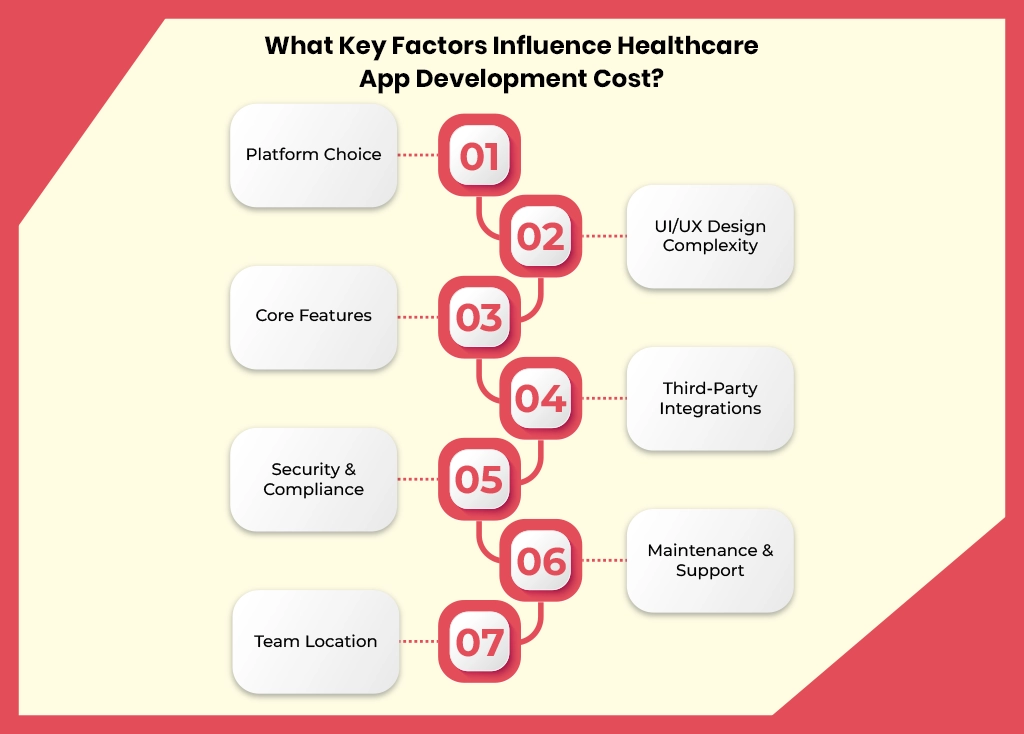
Platform Choice
Choosing between iOS, Android, or both directly affects development cost. Building for a single platform is more affordable, while supporting multiple platforms increases time and maintenance efforts. Cross-platform development can help optimize costs, but it still depends on the complexity of the app.
UI/UX Design Complexity
Healthcare apps need an intuitive and accessible design. The more personalized dashboards and user roles you add, the more time design and development take. Simple layouts cost less, but the advanced user experiences increase the budget.
Core Features
Features are what make up your app. They’re also responsible for your budget very heavily. The more advanced and interconnected these features are, the higher the development cost due to added testing and security needs.
Third-Party Integrations
Integrating APIs for EHR systems or wearables can speed up the development, but it also adds integration and maintenance costs. Each external service requires testing and continuous monitoring. Additionally, sometimes it even adds licensing fees.
Security & Compliance
Healthcare apps must follow strict regulations like HIPAA or GDPR. Implementing encryption and audit logs really tends to impact the cost, but at the same time, they are very important for patient safety and legal compliance.
Maintenance & Support
Development doesn’t end at launch. Things like ongoing updates and performance improvements require a regular budget. Regular maintenance ensures the app stays compliant and secure. This helps the app scale as the user demand grows.
Team Location
So, where your development team is located plays a major role in overall cost. Hiring teams in places like North America or Western Europe usually come with higher hourly rates, while skilled teams in regions like Eastern Europe or Southern Asia can deliver the same quality at a lower cost.
How To Optimize The Costs To Build A Healthcare App?
Building a healthcare app doesn’t have to mean you have to plan a budget beyond your affordability. With the right planning and technical choices, it’s possible to reduce development costs without sacrificing the quality or compliance.
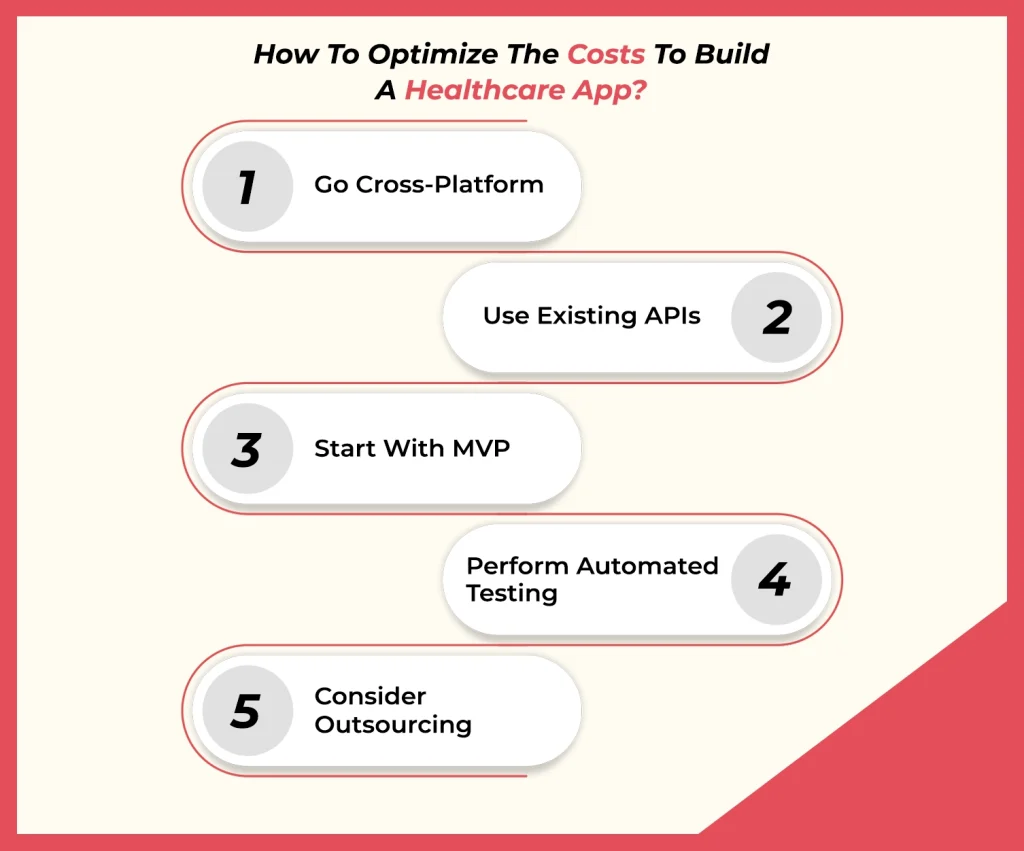
Go Cross-Platform
Instead of building separate apps for iOS and Android, going cross-platform allows you to develop one app that works on both. This means less development time and easier maintenance down the line. For startups and growing healthcare businesses, this approach can greatly reduce costs without affecting the core features or the user experience.
Use Existing APIs
There’s no need to build new Application Programming Interfaces when reliable healthcare APIs already exist. Using third-party APIs for things like video calling or EHR integration can save a lot of development time. Fewer custom features means faster development and fewer bugs to worry about later. Your app will do just fine without custom APIs.
Start With MVP
An MVP is basically a Minimum Viable Product that focuses only on essential features. Instead of building a fully loaded healthcare app from day one, you launch with what users actually need and improve based on real feedback. This approach reduces the initial costs and helps you avoid spending on features that may never even be used.
Perform Automated Testing
Manual testing can quickly become expensive, especially for healthcare apps that require high accuracy and security. Automated testing helps catch bugs early and reduces long-term maintenance costs. While there’s an initial setup cost, it saves money in the long run by preventing costly fixes after launch.
Consider Outsourcing
Outsourcing development to experienced healthcare app developers can be far more affordable than building an in-house team. You save on hiring and infrastructure while still getting access to skilled professionals. The key is choosing a team that understands healthcare compliance and security because fixing mistakes later is always more expensive than doing it right the first time.
Conclusion
Healthcare app development can feel overwhelming at first, especially when the numbers start changing every time you add a new feature. One moment, it’s a simple idea; the next, you’re thinking about data security and long-term maintenance.
What really matters is knowing why the cost looks the way it does. Once you understand how each thing affects the budget, planning becomes much easier.