

Cross-platform software development is increasingly shaping how modern software is built and scaled across platforms. As businesses look for faster development cycles with controlled costs and consistent user experiences, this approach has gained strong momentum.
In this blog, we’ll break down what cross-platform software development actually means, why it matters, and how it fits into today’s product and business decisions.
What does “Cross-Platform” Really Mean?
“Cross-platform” refers to a single product or system that functions consistently across environments or platforms without requiring separate versions for each. Instead of being limited to one specific platform, a cross-platform approach is designed for compatibility and reuse. It helps ensure that the same core experience or functionality operates across multiple platforms with minimal variation.
How does Cross-Platform Software Differ from Native Software?
Cross-platform software is built using a shared codebase that runs across multiple platforms. The goal here is to maximize code reuse while maintaining consistent functionality and design across the different environments. This approach prioritizes development speed and faster updates. It also allows easier maintenance, which makes it a practical choice when scalability and cost control are key considerations.
Native software is developed specifically for a single platform, using platform-specific languages and frameworks. Because it is made just for one environment, it typically delivers highly optimized performance and deeper integration with platform features. However, this also means separate development efforts are required for each platform, which increases the cost and long-term maintenance complexity.
How does Cross-Platform Software work?
The main solution that cross-platform software provides is that businesses don’t have to build separate software for individual platforms. They can simply develop one and launch on all platforms. This is how Cross-platform software works:
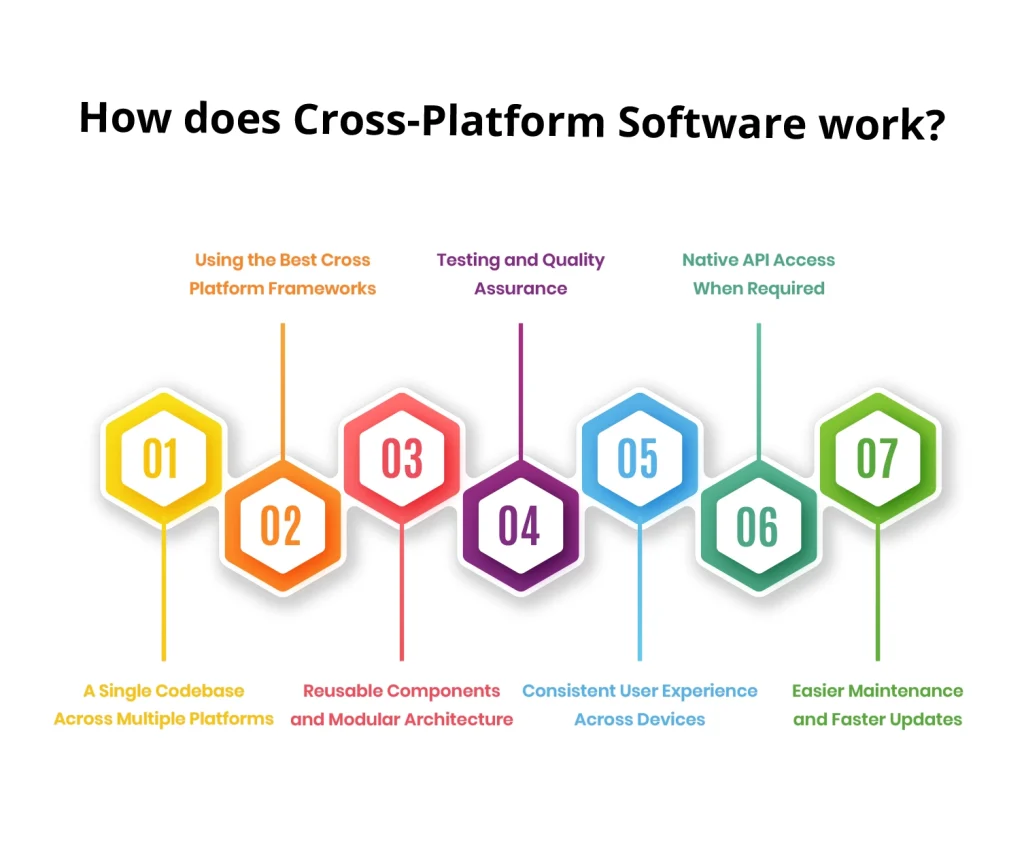
A Single Codebase Across Multiple Platforms
Cross-platform software works by relying on just one codebase. It can run on multiple platforms. Instead of writing separate code for each operating system, developers build the core logic only once. This code adapts to work across different environments.
Using the Best Cross-Platform Frameworks
Specialized frameworks are what help create the shared code for different platforms. These frameworks handle platform-specific differences internally. It allows the same code to function properly across systems. Choosing the right framework is critical, according to the nature of your software.
Reusable Components and Modular Architecture
Cross-platform software is typically designed using reusable components and modular structures. Features are built as independent modules that can be reused or replaced without affecting the entire system. This approach improves developer productivity and makes future updates easier to manage.
Testing and Quality Assurance
Testing focuses on ensuring consistent behavior across all supported platforms. Automated testing tools are often used to validate the functionality and stability in different environments. This helps identify platform-specific issues early and ensures the software meets quality standards everywhere it runs.
Consistent User Experience Across Devices
A fundamental goal of cross-platform software is to deliver a uniform user experience across devices. While minor adjustments may be made to align with platform guidelines, the overall interface and interactions remain consistent. This helps maintain brand identity and usability across platforms.
Native API Access When Required
When platform-specific features are needed, cross-platform solutions can access native APIs directly. This allows the software to use device capabilities such as cameras or sensors without sacrificing the benefits of shared code. It provides flexibility without fully switching to native development.
Easier Maintenance and Faster Updates
When there is only one codebase, updates and fixes only need to be implemented once. Plus point: They can be deployed across all platforms simultaneously. This reduces downtime and allows businesses to roll out improvements for the software faster while keeping all platform versions in sync.
What Benefits do businesses get from Cross-Platform Software?
It offers clear business advantages for companies that want to move fast without overextending their resources. By reducing development duplication and simplifying long-term maintenance, it enables organizations to focus on growth and market responsiveness.
Below are some of the benefits businesses gain from adopting a cross-platform approach.
- Perfect for Creating MVPs: It allows businesses to validate ideas quickly using a single build. Teams can test features, gather user feedback, and improve the product without investing in multiple versions.
- Wider Audience Reach: With one solution running across multiple platforms, businesses can reach users on different devices at the same time.
- Rapid Time-to-Market: Since development happens once rather than separately for each platform, products can be launched faster.
- Lower Costs: A shared codebase reduces development and maintenance expenses. This makes cross-platform development an affordable choice for many businesses.
- Near Native Performance: Modern cross-platform frameworks can deliver performance that closely matches native apps. For most business use cases, the difference is minimal, while still benefiting from faster development and easier scalability.
What are Some Reliable Technologies for Cross-Platform Software Development?
With so many tools and technologies, it’s hard to select the perfect one for your cross-platform software. The nature of your software, your user and industry needs, and project scope will help you make the ultimate decision. However, here are some popular and modern cross-platform frameworks:
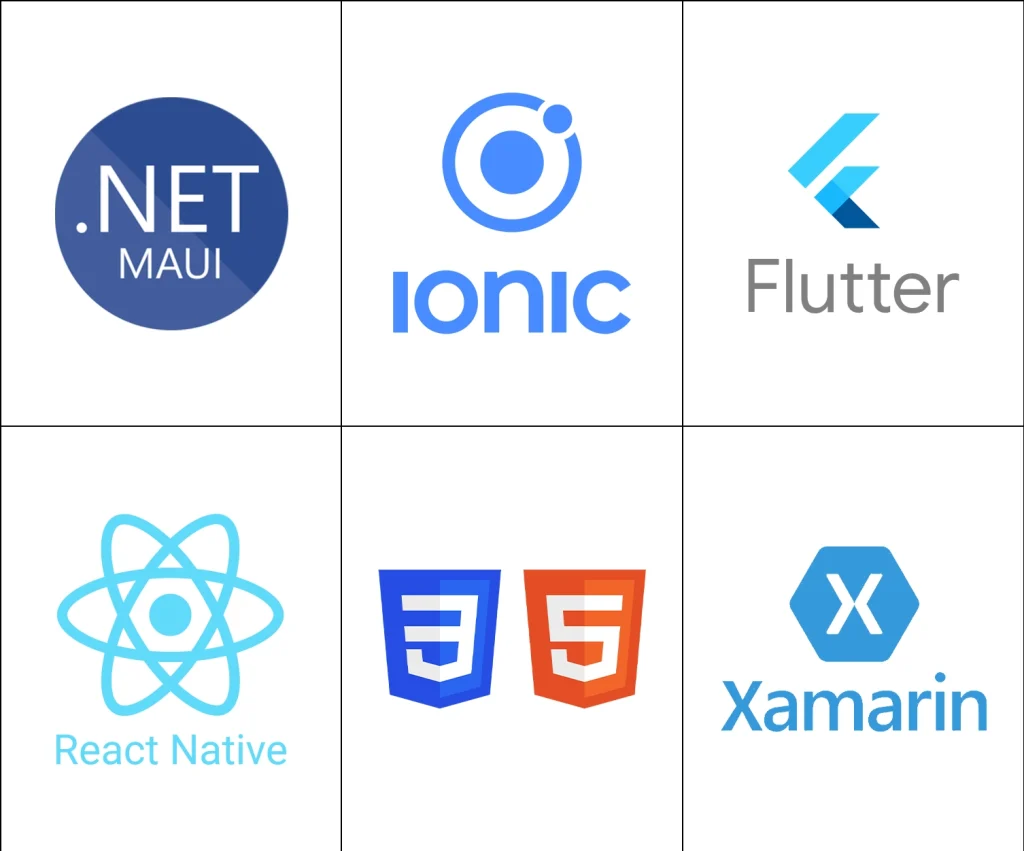
.NET MAUI
.NET MAUI (Multi-platform App UI) is Microsoft’s modern framework. It helps build cross-platform apps using a single project structure. It’s designed for businesses that are already invested in the Microsoft ecosystem and looking for long-term scalability.
Essential facts:
- Built using C# and .NET
- Single project structure replaces older multi-project setups
- Strong integration with Microsoft tools like Visual Studio
Works on: Android, iOS, Windows, macOS
Ionic
Ionic is a hybrid framework focused on building cross-platform apps using web technologies. It’s commonly used for apps where fast development and UI consistency are more important than heavy native processing.
Essential facts:
- Uses HTML, CSS, and JavaScript
- Built on top of web frameworks like Angular or Vue
- Relies on WebView with optional native plugin access
Works on: Android, iOS, Web
Flutter
Flutter is a UI-focused framework that has been developed by Google. It is known for its performance and visually consistent interfaces. It’s often chosen for products that prioritize design precision and smooth animations.
Essential facts:
- Uses Dart programming language
- Renders its own UI components instead of relying on native ones
- Strong performance due to direct compilation to native code
Works on: Android, iOS, Web, Desktop
React Native
React Native allows developers to build cross-platform mobile apps. It uses JavaScript while delivering outstanding near-native performance. It has been widely adopted and backed by a strong developer community.
Essential facts:
- Built using JavaScript and React
- Uses native components under the hood
- Large ecosystem and community support
Works on: Android, iOS
HTML/CSS
HTML and CSS form the foundation of web-based cross-platform software. While not a framework on their own, they are essential for building responsive apps that run consistently across browsers and devices.
Essential facts:
- Core web technologies used with JavaScript
- Highly flexible and easy to maintain
- Often combined with frameworks or wrappers for app deployment
Works on: Web (accessible across all platforms via browsers)
Xamarin
Xamarin is another cross-platform framework that allows developers to build mobile apps using shared C# code. It does so while maintaining access to native APIs. It has been widely used in enterprise-level apps.
Essential facts:
- Uses C# and .NET
- Provides strong native API access
- Being gradually replaced by .NET MAUI for newer projects
Works on: Android, iOS
Cost Breakdown: Cross-Platform Software vs Native Software
Here is a cost breakdown that clearly shows how cross-platform software development is more cost-effective compared to native software in many cases.
| Development Stage | Cross-Platform Software Cost Breakdown | Native Software Cost Breakdown |
| Planning & Architecture | Lower cost due to single architecture planning | Higher cost as each platform requires separate planning |
| UI/UX Design | One primary design system adapted for all platforms | Separate UI/UX designs needed for each platform |
| Development | One shared codebase reduces engineering hours | Multiple codebases significantly increase development hours |
| Platform-Specific Customization | Minimal customization required | Extensive platform-specific coding required |
| Testing & Quality Assurance | Centralized testing with fewer variations | Separate testing cycles for each platform |
| Bug Fixing | Fix once, apply everywhere | Bugs must be fixed separately on each platform |
| Maintenance & Updates | Smaller teams can often handle the entire project | Often, larger or multiple teams are needed |
| Overall Development Cost | $20,000 to $200,000 | $50,000 – $500,000+ |
Conclusion
Cross-platform software development reduces duplicate work by using a single codebase for multiple devices. It enables quicker development and simplifies updates without requiring separate teams for each platform.
While it’s not the ideal choice for every project, it’s highly effective when fast delivery and shared functionality are priorities. For many businesses, ensuring consistency and simplicity across mobile and desktop platforms is a smart way to drive innovation.
Frequently Asked Questions
Is Cross-Platform Software Perfect For All Types Of Projects?
No. Cross-platform development works well for many apps. However, it still may not suit projects with high performance demands or deep platform-specific requirements.
Is Cross-Platform Software Development Entirely Risk-Free?
No. While it reduces development effort, risks such as performance trade-offs and framework limitations still exist and require careful planning.
When Should I Choose Native Development Instead of Cross-Platform Development?
Choose native development when an application requires maximum performance, advanced platform-specific features, or highly customized user experiences.