

React Native app development can cost approximately $4,000 to $250,000+ in 2026, depending on the application’s scope, features, backend complexity, integrations, UI/UX requirements, security needs, development team, and post-launch support.
A basic React Native application with fewer screens and straightforward functionality can start around $4,000. More advanced applications with payments, real-time functionality, complex backend systems, custom integrations, multiple user roles, or enterprise requirements can cost considerably more and may reach $250,000+.
The framework itself does not determine the final price. The biggest cost driver is what the product actually needs to do.
“Pricing varies by scope. Entry-level projects may start at the figures shown on individual service pages, while production applications with broader features, integrations and backend requirements require a project-specific estimate.”
React Native App Development Cost at a Glance
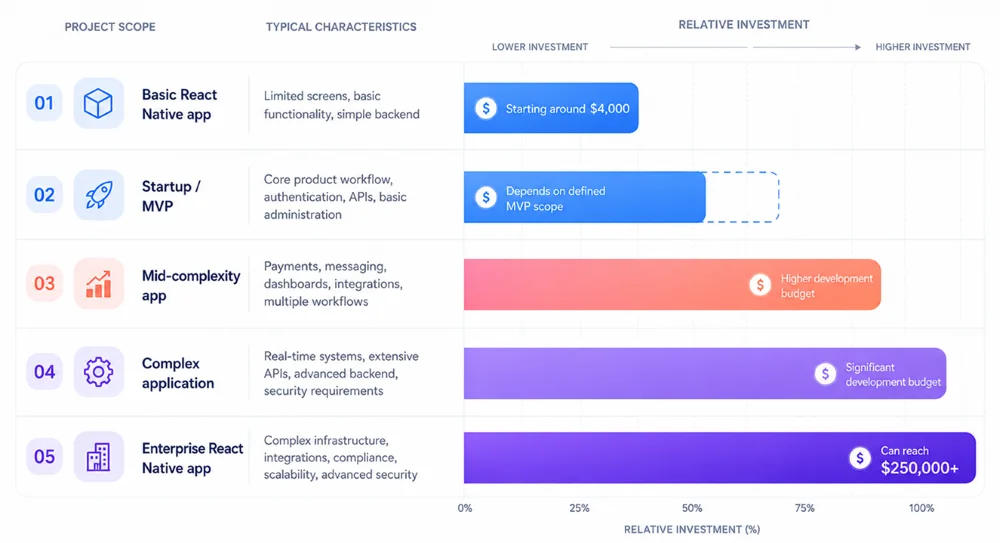
These figures are planning references rather than fixed quotations. An accurate React Native development estimate requires a defined feature list and technical scope.
What Determines React Native App Development Cost?
React Native allows developers to build applications for iOS and Android while sharing a substantial amount of application code.
That can reduce duplicated development effort compared with maintaining two entirely separate applications.
However, React Native does not eliminate the work involved in product planning, UI/UX design, backend engineering, API development, testing, deployment, security, infrastructure, or maintenance.
The final price therefore depends much more on the product requirements than on the framework itself.
1. App Features and Functionality
Features are one of the most important factors affecting React Native development cost.
A simple application containing login, profiles, basic navigation, content and a limited backend requires much less development effort than an application containing:
- Online payments
- Subscriptions
- Real-time messaging
- GPS and maps
- Live tracking
- Push notifications
- Video or audio
- Offline functionality
- Multiple user roles
- Advanced search
- Social login
- Complex dashboards
- AI functionality
- Third-party integrations
- Custom native functionality
Every additional feature can affect frontend development, backend engineering, testing, security and maintenance.
That is why pricing an app based only on its number of screens can produce an inaccurate estimate.
2. Backend Complexity
React Native handles the mobile application interface, but many applications also require a substantial backend.
The backend may need to manage:
- Users
- Authentication
- Databases
- Business logic
- Payments
- Notifications
- Files
- Analytics
- Administration
- APIs
- Integrations
For some projects, backend development can represent a major part of the overall development effort.
An application that looks simple to the user can therefore still be technically complex behind the scenes.
3. Third-Party Integrations
Integrations can have a major impact on the budget.
A React Native application might need to connect with payment processors, mapping systems, CRMs, ERPs, analytics platforms, communication providers, shipping systems, authentication services, cloud platforms or external business APIs.
Each integration needs to be implemented, secured, tested and monitored.
The quality of the third-party API matters too. A clear, reliable and well-documented API generally requires less integration work than an incomplete or inconsistent one.
4. UI/UX Design
A basic interface costs less to design and implement than a highly customized product experience.
Design scope can include user research, information architecture, user flows, wireframes, prototypes, visual design, responsive layouts, animations, accessibility and design systems.
Complex animations and highly customized user interactions can also require additional React Native development work.
Good design should therefore be included in the project scope rather than treated as an afterthought.
5. iOS and Android Requirements
One of React Native’s main advantages is that developers can share code between iOS and Android.
However, this does not mean every part of an application will behave identically on both platforms.
Developers may still need to account for:
- Platform-specific permissions
- Navigation behavior
- Device capabilities
- Push-notification configuration
- App-store requirements
- Payment rules
- Platform-specific UI
- Native SDKs
- Testing across different devices
The more platform-specific behavior the application requires, the greater the development effort may become.
6. Custom Native Modules
React Native can handle many common mobile requirements through its existing ecosystem.
Some applications, however, need functionality that requires native iOS or Android code.
Examples can include specialized hardware access, unusual SDK integrations, advanced background processing or functionality not adequately supported by an existing React Native package.
Custom native modules increase complexity because the team needs expertise beyond the shared JavaScript or TypeScript application layer.
7. Security and Compliance
Applications that handle sensitive information generally require additional security planning and testing.
Depending on the industry, this can affect:
- Authentication
- Authorization
- Encryption
- Data storage
- API security
- Logging
- Session handling
- Infrastructure
- Security testing
Financial, healthcare, enterprise and other sensitive applications may also have regulatory or organizational compliance requirements.
Security requirements should be established during project planning because adding them late can increase development effort substantially.
8. Development Team
The type of development team also affects total cost.
A project might be developed by freelancers, an internal team, a dedicated external team or a software development company.
Comparing teams only by hourly rate can be misleading.
The total cost also depends on development speed, experience, communication, QA processes, project management, architecture decisions and the amount of rework required.
The cheapest hourly rate is therefore not necessarily the cheapest completed product.
Does React Native Reduce Mobile App Development Costs?
React Native can reduce development duplication when the same product needs to be available on both iOS and Android.
With fully native development, businesses commonly maintain separate platform-specific development work.
React Native makes it possible to share a significant portion of the application logic and interface between platforms.
This can reduce duplication across development and maintenance, which may also help control the overall mobile app development cost.
However, React Native should not be interpreted as a way to cut every mobile-app expense.
You still need to budget for:
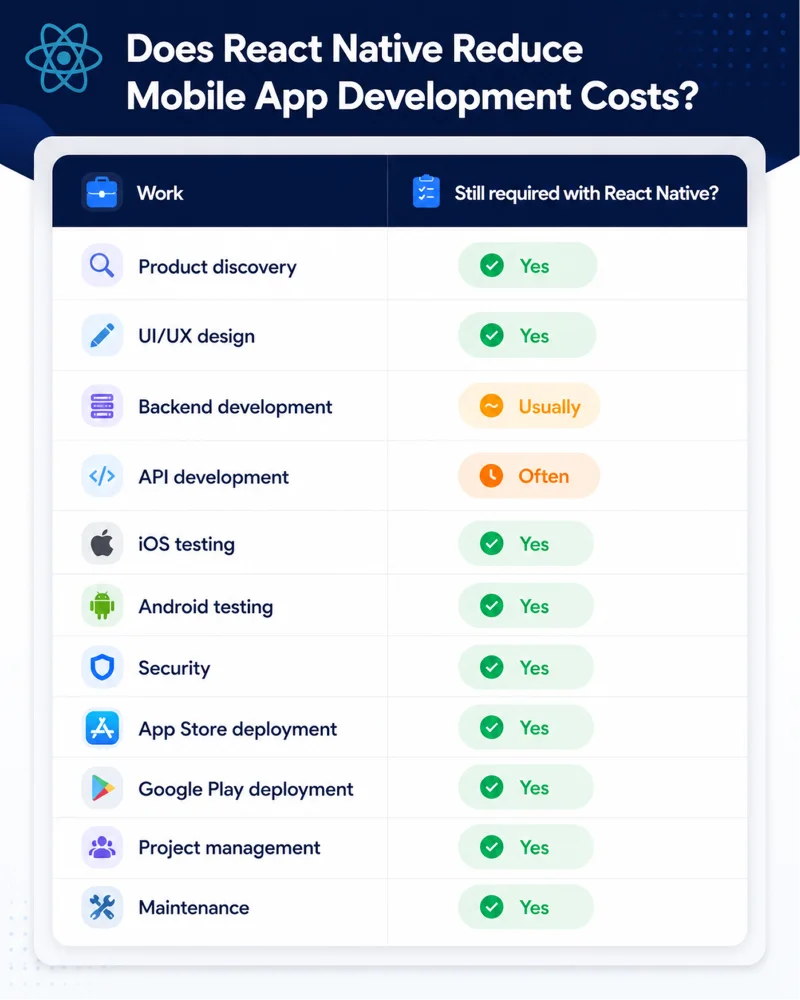
The savings generally come from reducing duplicated mobile development rather than eliminating the rest of the software-development lifecycle.
React Native Projects Built by Linkitsoft
React Native development costs are easier to understand when they are connected to real product requirements. Linkitsoft has worked on React Native applications across food delivery, vending technology, retail, and e-commerce, where the development scope varies according to users, integrations, backend requirements, hardware connectivity, and business workflows.
Here are some examples of React Native projects built by Linkitsoft.



React Native vs Native App Development Cost
Cost differences become particularly important when a business needs both iOS and Android applications.
Native development typically uses platform-specific technologies and codebases.
React Native can share a significant portion of the application’s code between the two platforms.
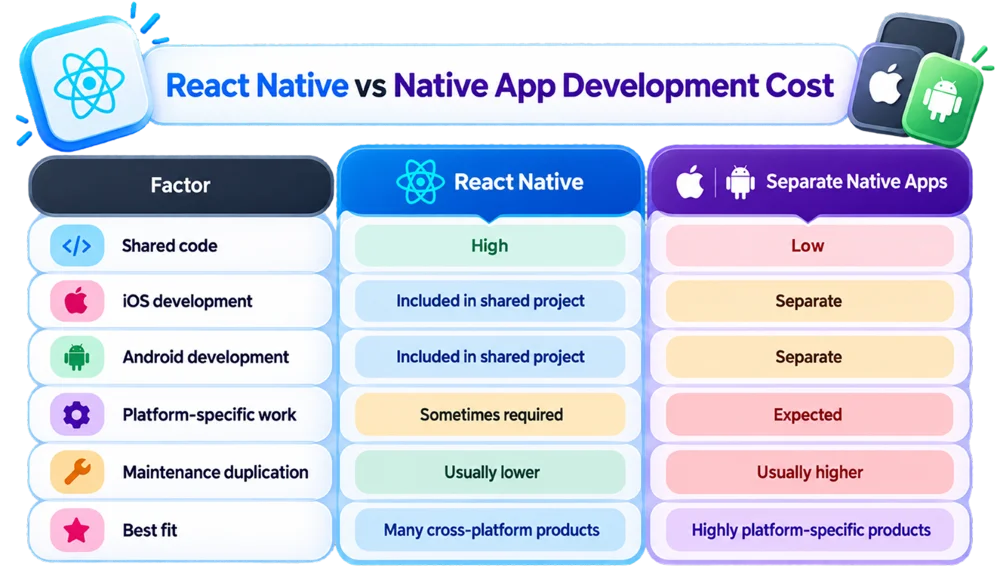
React Native can therefore be financially attractive when the same product experience is required across both operating systems.
Native development can still be preferable for projects that rely heavily on specialized platform functionality or requirements where platform-specific engineering provides a meaningful advantage.
The technology decision should therefore be based on product requirements rather than cost alone.
How Much Does a React Native MVP Cost?
An MVP should contain the smallest practical set of features needed to test the core product idea.
There is no universal React Native MVP price because one company’s “minimum product” may contain considerably more functionality than another company’s complete application.
An MVP might include:
- Registration and authentication
- User profiles
- One core user workflow
- Basic backend functionality
- Essential integrations
- Simple administration
- Analytics
- Basic notification functionality
The most effective way to control an MVP budget is to prioritize the functionality necessary for validation and postpone optional features until there is real user feedback.
At Linkitsoft, basic React Native applications can start around $4,000, while a production MVP with additional backend or integration requirements needs to be estimated according to its actual scope.
How Much Does a Complex React Native App Cost?
Complex React Native applications can require a much larger budget.
Complexity commonly comes from functionality such as:
- Real-time communication
- Live location tracking
- Advanced payments
- Large backend systems
- Complex APIs
- Multiple user roles
- Enterprise integrations
- Custom native modules
- AI features
- Advanced security
- High scalability requirements
Linkitsoft’s published React Native development range can extend to $250,000+ for projects with extensive requirements.
The exact budget should be calculated after the architecture and feature requirements have been defined.
React Native Development Cost by App Type
Different application categories create different technical requirements.
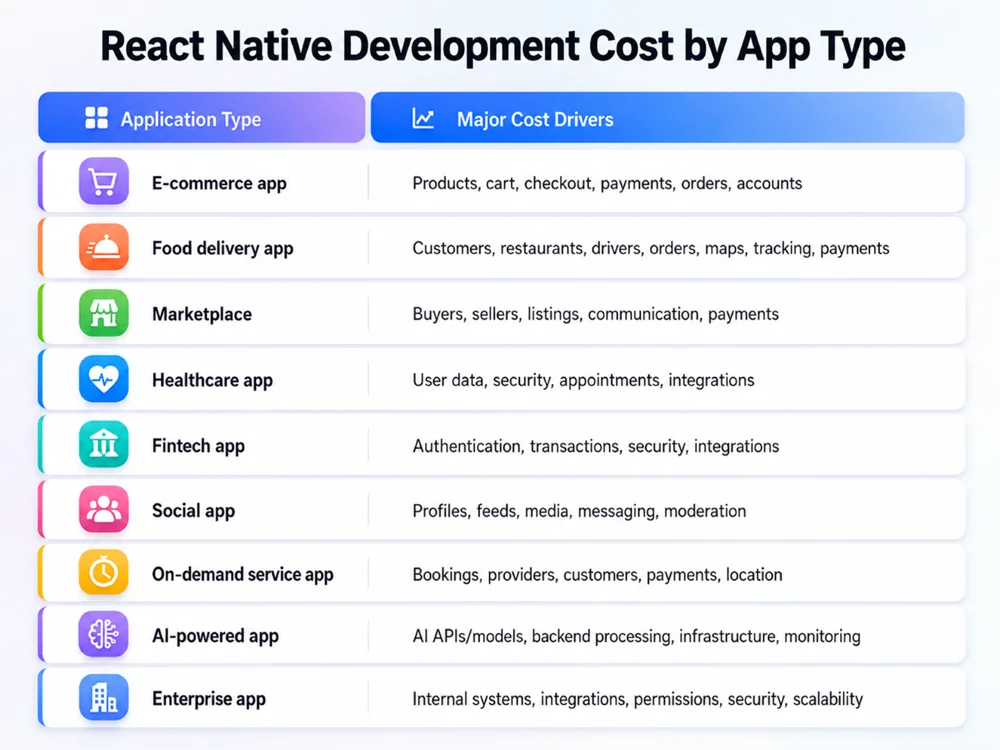
These categories should not be treated as fixed price packages.
Two e-commerce applications, for example, can have very different development costs if one has a straightforward catalog and checkout while another requires complex inventory systems, multiple warehouses, loyalty programs and ERP integrations.
How Long Does It Take to Build a React Native App?
Development time depends on scope.
A focused application with limited functionality can potentially be developed within a relatively short project cycle, while a complex product may require several months or longer.
A React Native development project commonly includes:
- Discovery and requirements
- Product planning
- UI/UX design
- Technical architecture
- React Native development
- Backend development
- API integration
- Testing
- Store preparation
- Deployment
- Post-launch support
The timeline increases when requirements change frequently, integrations are unclear, backend systems need to be created from scratch or substantial platform-specific functionality is required.
What Additional Costs Come After Development?
The initial application build is not necessarily the total cost of ownership.
Businesses should also consider ongoing expenses such as cloud hosting, database infrastructure, analytics platforms, third-party APIs, payment processing, communication services, monitoring, security, maintenance and future features.
External services can also charge according to usage, which means operating costs can increase as the application gains more users.
A realistic budget therefore includes both initial development and ongoing operation.
How Much Does React Native App Maintenance Cost?
Maintenance requirements differ by project.
Typical maintenance work can include bug fixes, React Native upgrades, dependency updates, Android and iOS compatibility updates, security updates, backend changes, performance improvements and new features.
Applications that depend on many external APIs or native SDKs may require more maintenance because those external systems can also change.
This is another reason good architecture matters: a well-structured application is generally easier to maintain than one built entirely around short-term shortcuts.
What Can Increase React Native Development Costs Unexpectedly?
Several issues can cause a project to exceed its original estimate.
One common cause is incomplete requirements. If important workflows are discovered only after development starts, new functionality needs to be designed, developed and tested.
Another cause is unreliable third-party APIs.
Other examples include substantial design revisions, new platform requirements, unexpectedly complex native integrations, backend changes and additional security requirements.
A detailed discovery and scoping process helps identify these issues before they become expensive changes.
How Linkitsoft Estimates React Native App Development Cost
Linkitsoft estimates React Native projects according to their actual requirements instead of assigning the same package price to every application.
Step 1: Define the product
We identify the users, business goals and main workflows the application needs to support.
Step 2: Break down the features
The idea is converted into specific functionality rather than being estimated simply as an “e-commerce app,” “delivery app” or “social app.”
Step 3: Review the backend
We determine whether the application requires a new backend or needs to connect with an existing platform.
Step 4: Identify integrations
Third-party systems, APIs, payment services and other external dependencies are identified.
Step 5: Review platform requirements
We identify what can be shared between iOS and Android and whether any functionality requires platform-specific development.
Step 6: Define UI/UX requirements
Screens, workflows, prototypes and design complexity are reviewed.
Step 7: Estimate development and testing
The defined scope is translated into development, QA, project-management and deployment requirements.
Step 8: Plan post-launch support
Maintenance, upgrades and future development requirements are considered separately from the initial build.
This produces a project-specific estimate rather than a generic React Native price.
How to Reduce React Native App Development Cost
The best way to reduce development cost is usually to control product scope rather than simply choosing the lowest hourly rate.
Start with the core user journey and identify which features must exist at launch.
Features that are useful but not essential can be moved into a later development phase.
Using proven libraries where appropriate can also reduce unnecessary custom development.
Existing backend systems and APIs should be reviewed before development begins so integration problems can be identified early.
Cross-platform development itself can reduce duplication when both iOS and Android are required.
Testing should not be treated as an optional expense. Cutting QA may reduce the initial invoice but can increase the cost of fixing problems after launch.
Is React Native Worth It in 2026?
React Native can be a strong choice when a business wants to launch on both iOS and Android without maintaining completely separate application codebases.
It is particularly attractive when:
- The product needs both mobile platforms
- The majority of functionality can be shared
- Faster cross-platform development is valuable
- Long-term maintenance efficiency matters
- The application does not depend heavily on highly specialized native functionality
React Native is not automatically the best technology for every project.
The right framework depends on performance requirements, integrations, existing technology, product roadmap, internal skills and platform-specific needs.
The correct decision is therefore the technology that creates the best long-term product—not simply the framework with the lowest initial estimate.