Building an IoT product in 2026 is about creating a complete ecosystem that’s capable of working with each other seamlessly. Several components, like hardware integration, firmware, cloud architecture, security layers, data processing pipelines, and multi-platform interfaces, must work in real time.
Success depends on clear architectural planning. Scalability and long-term infrastructure design determine whether an IoT initiative becomes a sustainable, high-performing system.
This guide breaks down the strategic factors that shape IoT development. It will help organizations plan cost-effectively and develop IoT systems for growth.
What Are the IoT App Development Costs in 2026?
Several technological shifts have pushed IoT development budgets higher than they were previously. This is why in 2026, businesses need to budget carefully.
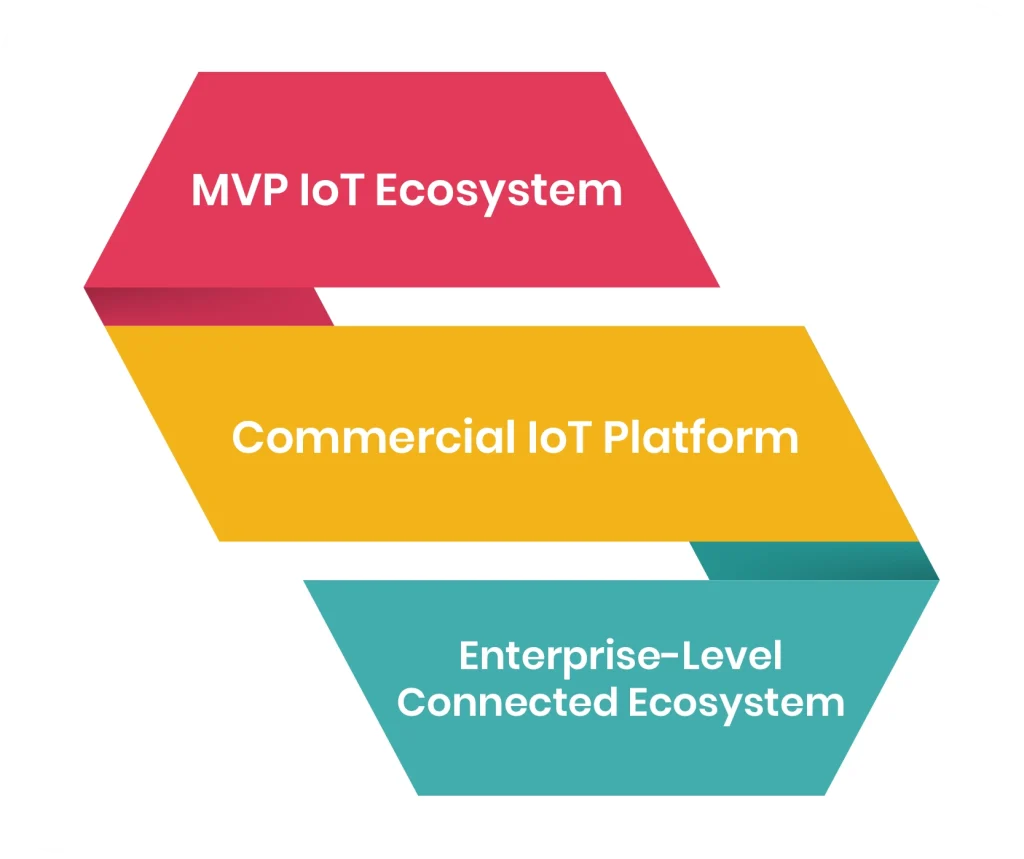
MVP IoT Ecosystem
This budget range covers a proof-of-concept system with limited device support and basic backend infrastructure. You can get a simple mobile or web interface. It’s typically used by startups validating a product idea or preparing for investor demos.
Expected budget at this stage: $40,000 – $90,000
Commercial IoT Platform
At this stage, the system supports multiple devices and has a stable cloud architecture. Moreover, it consists of features such as user authentication, dashboards, and real-time data processing. Most SMEs that are launching real-world IoT products fall into this bracket.
Expected budget at this stage: $100,000 – $250,000
Enterprise-Level Connected Ecosystem
Large organizations require multi-location deployment and enterprise integrations. Their IoT systems are expected to give advanced analytics with compliance layers and highly scalable infrastructure. Costs can exceed $1 million when custom hardware and AI modules are included.
Expected budget at this stage: $250,000 – $800,000+
Why Are IoT Costs Higher Than Traditional Apps?
Traditional software products rely mainly on frontend and backend development. IoT solutions must handle a broader technology stack.
- Hardware dependency: Physical devices require design, testing, firmware, and manufacturing coordination.
- Real-time data architecture: Systems must process streams of live sensor data without delays.
- Security overhead: Encryption, authentication, and monitoring systems must operate continuously.
- Long-term infrastructure costs: Cloud storage, device management, and analytics engines generate ongoing expenses.
In short, IoT development is more than just software engineering… It’s actually systems engineering.
What are some Essential Stats for Decision-Makers?
To plan realistically, leaders should understand the scale and trajectory of IoT adoption because it’s more of an infrastructure investment than just app development. Here are some verified industry stats:
- Analysts estimate 20+ billion active IoT devices worldwide today, with projections exceeding 40+ billion by 2034.
- Research indicates 70% of enterprises already use IoT in at least one operational process.
- Studies show that businesses that are using IoT solutions have seen their logistics costs drop by up to 20–30%.
- Nearly 60% of IoT projects exceed initial budgets due to underestimated infrastructure needs. These projects often don’t pass the Proof of Concept stage.
- Reports suggest that within 5 years, 5% of the total cybersecurity spend will automatically be dedicated to IoT.
The 7 Primary Factors That Determine Your IoT Budget
In IoT, the factors that affect development costs are slightly diferent than those that affect general app development costs.
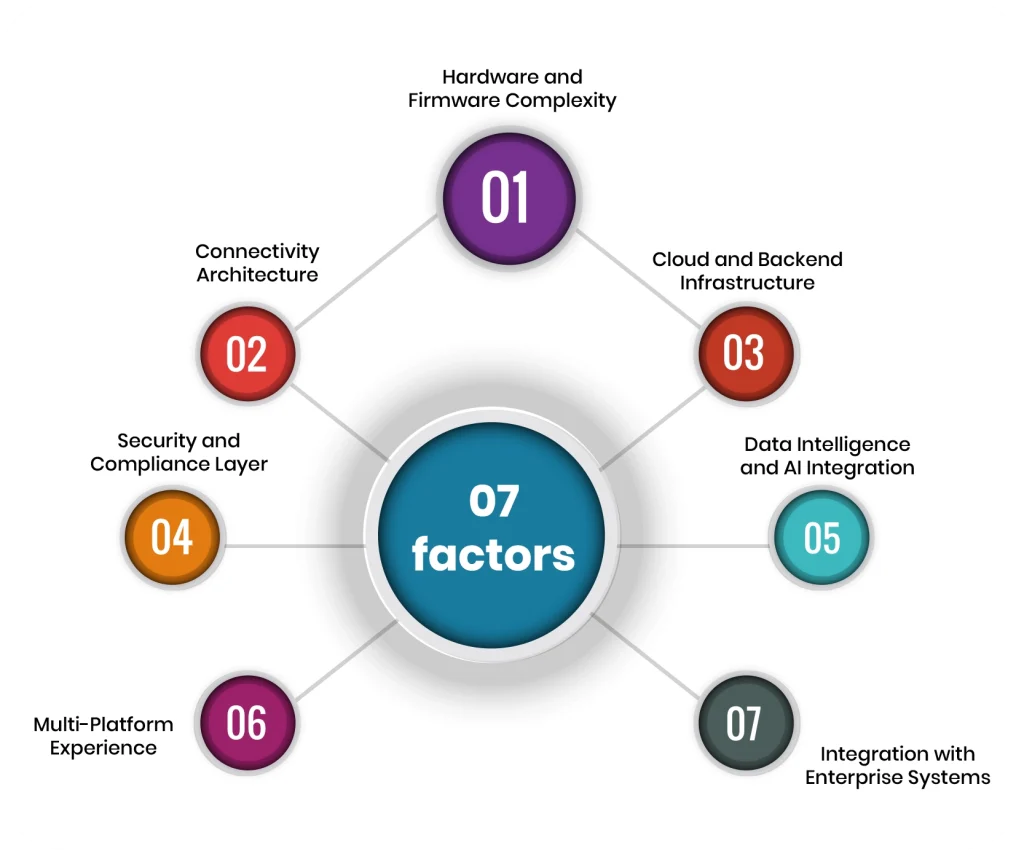
Hardware and Firmware Complexity
Hardware decisions often determine the largest cost variations.
- Custom boards offer flexibility but require design, testing, and certification.
- Regulatory approvals, such as FCC or CE testing, can cost thousands per device model.
- Remote firmware updates demand secure delivery pipelines and fail-safe rollback mechanisms.
- Local processing chips increase hardware cost but reduce latency.
- Unlike software-only products, IoT systems absolutely need to be tested in real environments.
Impact on budget: +$15,000 to $150,000 depending on hardware complexity.
Connectivity Architecture
Connectivity choices affect both development and long-term operating expenses.
- WiFi is inexpensive, but it is intensive when it comes to power.
- BLE is efficient for short-range communication.
- LPWAN works for long-range low-data scenarios.
- 5G supports real-time apps but increases the infrastructure costs.
Protocol selection also matters. MQTT is lightweight for IoT messaging. HTTPS provides standard web compatibility but uses more bandwidth.
Cloud and Backend Infrastructure
Backend architecture is often the most expensive part of IoT development.
- Event-driven systems for real-time data
- Microservices or serverless architecture
- Data ingestion pipelines
- Real-time analytics engines
- Device management platforms
- DevOps and CI/CD automation
The development needs to be done very carefully to avoid costly code rewrites later.
Security and Compliance Layer
Security is a significant aspect in IoT, which can never be negotiable as an investment.
- Device authentication mechanisms
- End-to-end encrypted communication
- Secure firmware update pipelines
- Role-based access control
- Industry compliance frameworks
Retrofitting security after the launch can increase development costs by 3–5x.
Data Intelligence and AI Integration
Modern IoT platforms collect data to properly interpret it. They do this by using AI and machine Learning to constantly improve.
- Predictive maintenance models
- Anomaly detection algorithms
- AI automation logic
- Custom analytics dashboards
Adding intelligent data capabilities usually increases development budgets. This depends on the model’s complexity.
Multi-Platform Experience
IoT platforms rarely serve a single user type. Instead, they serve multiple ones.
- Mobile apps for customers
- Web dashboards for administrators
- Control panels for technicians
- Partner APIs for integrations
More stakeholders mean more interfaces, and more interfaces obviously mean higher development costs.
Integration with Enterprise Systems
Integration is one of the most underestimated cost drivers.
- ERP systems
- CRM platforms
- Supply chain software
- Payment gateways
- Legacy machinery interfaces
This phase alone can add $20,000–$100,000+, depending on the number of systems involved.
Here’s a Cost Breakdown by Development Phase
A clear budget allocation strategy ensures that each stage receives the right investment.
Discovery and Architecture — 5–10%
This phase defines the technical foundation.
- Feasibility analysis
- System architecture blueprint
- Risk assessment
- Scalability modeling
Skipping this step often leads to redesign costs later. It can easily make the project significantly more expensive.
UI/UX and Product Engineering — 10–15%
Design in IoT platforms goes beyond visual elements.
- Dashboard visualization logic
- Device management workflows
- Enterprise-grade usability systems
Well-designed interfaces reduce support costs and improve adoption rates.
Core Development — 45–60%
This is where most of the capital is invested.
- Firmware development
- Mobile applications
- Backend architecture
- Cloud infrastructure
- API layers
Because this phase builds the entire ecosystem, it typically consumes more than half of the project budget.
QA, Field Testing, and Device Validation — 10–15%
Testing IoT products requires real-world validation.
- Multi-device testing environments
- Load testing for scale
- Security penetration testing
- Hardware-software synchronization validation
Field testing often reveals unique issues that even simulations cannot detect.
Deployment and DevOps Setup — 5–10%
Launching an IoT system requires production-level infrastructure.
- Cloud optimization
- Monitoring systems
- Logging architecture
- Backup and failover systems
This stage ensures reliability and uptime once devices are deployed.
Ongoing Maintenance — 15–25% Annually
IoT ecosystems require continuous and ongoing support.
- Infrastructure scaling
- Firmware updates
- Security patches
- Feature upgrades
- Customer support systems
IoT is the kind of technology that goes far beyond a one-time investment. It’s an evolving technology product.
What are the Hidden Costs Involved with IoT App Development
Despite careful planning, several IoT projects tend to fail or get into delays. This is all because most organizations are unaware of the hidden costs involved.
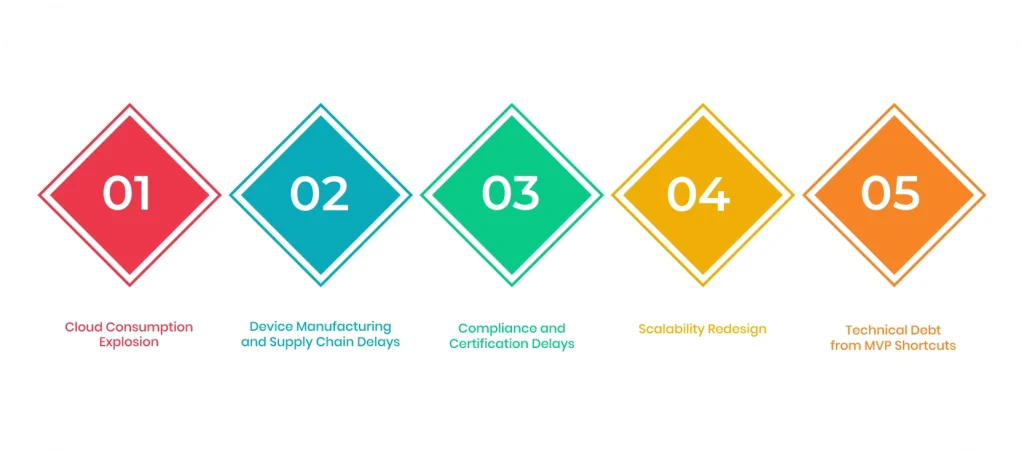
Cloud Consumption Explosion
Data-heavy apps generate massive volumes of sensor data. Storage, processing, and analytics can multiply hosting costs faster than anticipated.
Device Manufacturing and Supply Chain Delays
Prototyping costs differ significantly from mass production pricing. Component shortages or logistics disruptions can increase budgets unexpectedly. And yes, it does happen overnight.
Compliance and Certification Delays
Testing labs, documentation requirements, and recertification cycles can delay launches and increase expenses.
Scalability Redesign
The architecture needs to be designed for large-scale deployment. If it isn’t, then expanding to thousands of devices may require rebuilding backend systems.
Technical Debt from MVP Shortcuts
Early shortcuts often double the costs later on. Rushed architecture decisions tend to surface as expensive redesign requirements.
Example Budgeting Scenarios for Realistic IoT Business Models
Here are some example cases that explain how budgeting works with IoT:
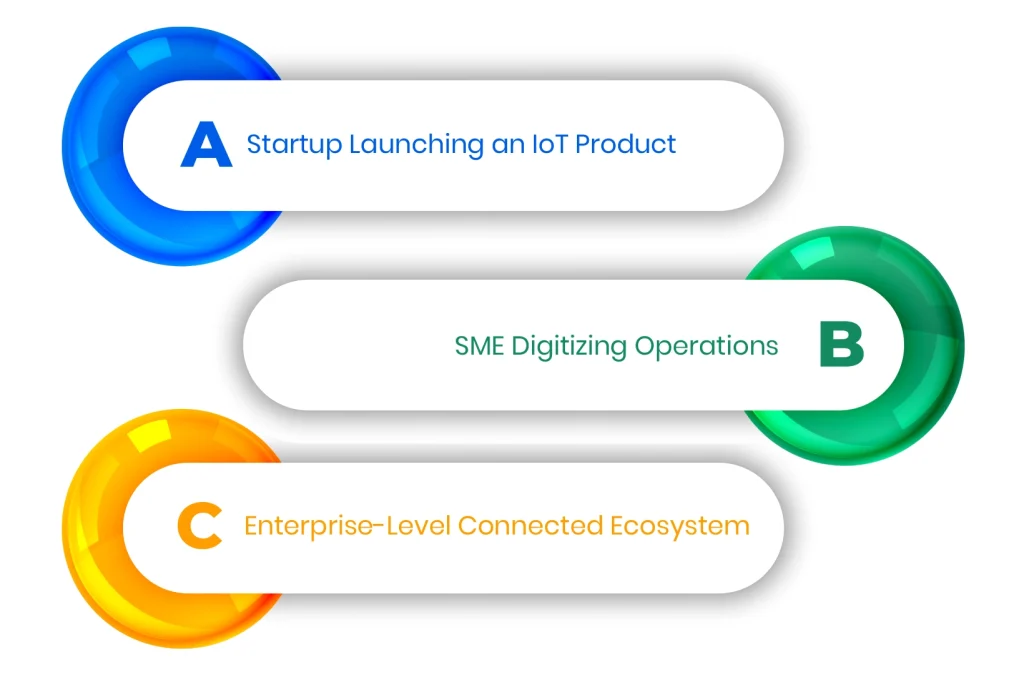
Scenario A: Startup Launching an IoT Product
- Focus: Rapid market validation and proof-of-concept
- Scope: Lean architecture with minimal hardware integration. There will be a cloud backend for essential functionality and a simple mobile interface
- Team Size: Small cross-functional team (2–5 engineers + product lead)
- Budget Estimate: $60,000–$120,000
- Key Considerations:
- Prioritize speed-to-market over long-term scalability
- Use off-the-shelf IoT modules and pre-built cloud services to reduce development time
- Limit integrations to essential systems to validate product value
- Outcome: Startup demonstrates proof of concept. Then, it gathers user feedback. Based on this, it validates the business model before scaling.
Scenario B: SME Digitizing Operations
- Focus: Process optimization, monitoring, and moderate automation
- Scope: Systems with heavy integrations connecting IoT devices to ERP and internal dashboards. This includes real-time monitoring and moderate data analytics
- Team Size: Medium-sized team (5–10 engineers + project manager + business analyst)
- Budget Estimate: $120,000–$300,000
- Key Considerations:
- Integration with existing enterprise systems increases development complexity
- Prioritize reliability and moderate scalability rather than advanced AI
- Security and compliance measures are critical, but not as tough as enterprise-grade systems
- Outcome: Optimized operations with much better data visibility. The workflow improvements are excellent without over-investing.
Scenario C: Enterprise-Level Connected Ecosystem
- Focus: Multi-location deployment, high reliability, AI analytics, and strict compliance
- Scope: Full-scale IoT ecosystem that includes custom hardware, real-time data processing, predictive analytics, AI modules, multi-platform apps, and integration with multiple enterprise systems
- Team Size: Large cross-functional team (15–30 engineers + DevOps + data scientists + compliance specialists + project managers)
- Budget Estimate: $300,000–$800,000+
- Key Considerations:
- Downtime or security breaches can cause significant financial and reputational damage
- Enterprise-grade compliance (HIPAA, GDPR) adds overhead to architecture and QA
- AI analytics and predictive maintenance features require additional development and cloud infrastructure
- Scalability planning is essential to support thousands of devices and concurrent users
- Outcome: Highly reliable, secure, and scalable IoT ecosystem delivering actionable insights and long-term ROI
Should You Build a Custom IoT Platform or Use an Existing One?
Here is a simple and quick comparison table that can help you finalize your decision:
| Factor | Custom Platform | Managed Platform |
| Upfront Cost | High | Low |
| Long-Term Cost | Lower | Higher |
| Flexibility | Full | Limited |
| Ownership | Complete | Vendor-dependent |
| Scalability | Fully customizable | Platform-restricted |
3-Year Total Cost Comparison Model
| Year | Custom Build | Managed Platform |
| Year 1 | High development investment | Lower setup cost |
| Year 2 | Maintenance only | Subscription + scaling fees |
| Year 3 | Optimized infrastructure cost | Rising operational expenses |
Managed platforms reduce initial development time but often become expensive as device numbers grow. Custom platforms require greater investment in the beginning but provide long-term cost control.
How to Reduce IoT App Development Costs Without Risking Scalability?
Organizations can optimize budgets without compromising performance. They can do this by following strategic practices:
- Start with modular architecture so components can scale independently.
- Use certified hardware modules instead of designing from scratch.
- Validate system architecture before writing production code.
- Avoid adding advanced AI features during early product stages.
- Partner with an experienced IoT app development company who understands infrastructure planning.
What Queries Should Founders Evaluate Before Committing to IoT Development?
Before approving the budget, leadership teams should answer some critical and strategic questions:
- What is our three-year scalability projection?
- How many devices will we manage at full scale?
- What data volume will the system generate daily?
- Which compliance standards apply to our industry?
- What is our expected return-on-investment timeline?
Clear answers to these questions reduce uncertainty and prevent overspending.
Conclusion
IoT development cost is directly tied to ecosystem complexity. The more devices and security layers involved, the higher the investment needed. Unlike traditional apps, IoT platforms must function as complete technology infrastructures.
Underestimating hardware and security requirements remains the biggest financial risk organizations face. When approached with proper planning that involves a realistic budget and scalable architecture, IoT can deliver measurable operational improvement with new revenue streams and long-term competitive advantage.