
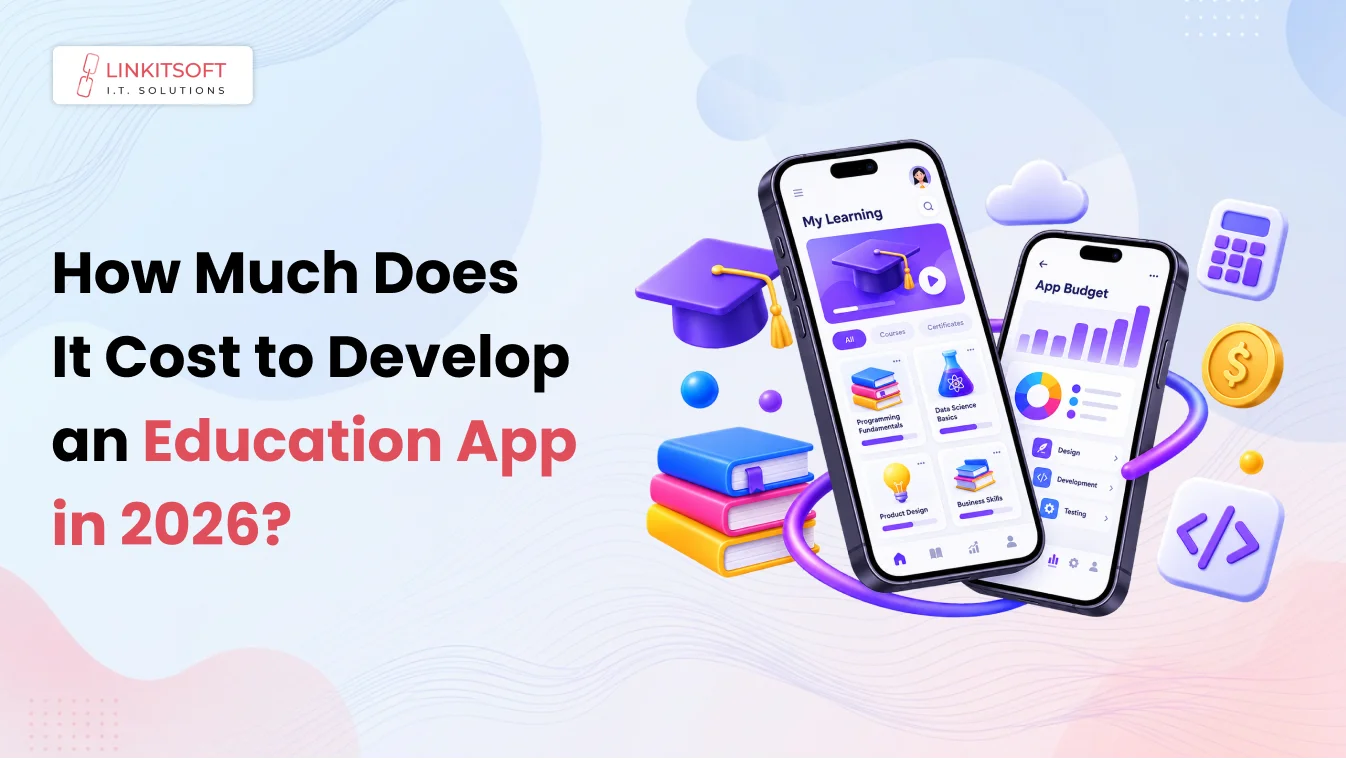
If you’re planning to build an education app in 2026, you should budget approximately $15,000 to $500,000+ for professional development, depending on the app’s complexity, features, platforms, backend requirements, integrations, security, design, and development approach.
A simple education app can cost around $15,000–$40,000, while a mid-complexity application may cost $40,000–$120,000. More advanced education applications can range from $120,000–$250,000+, while enterprise-level solutions can reach $150,000–$500,000+.
These are planning ranges rather than fixed quotations. The actual cost depends on your app’s requirements, user roles, technical architecture, integrations, and overall development scope.
Education App Development Cost at a Glance
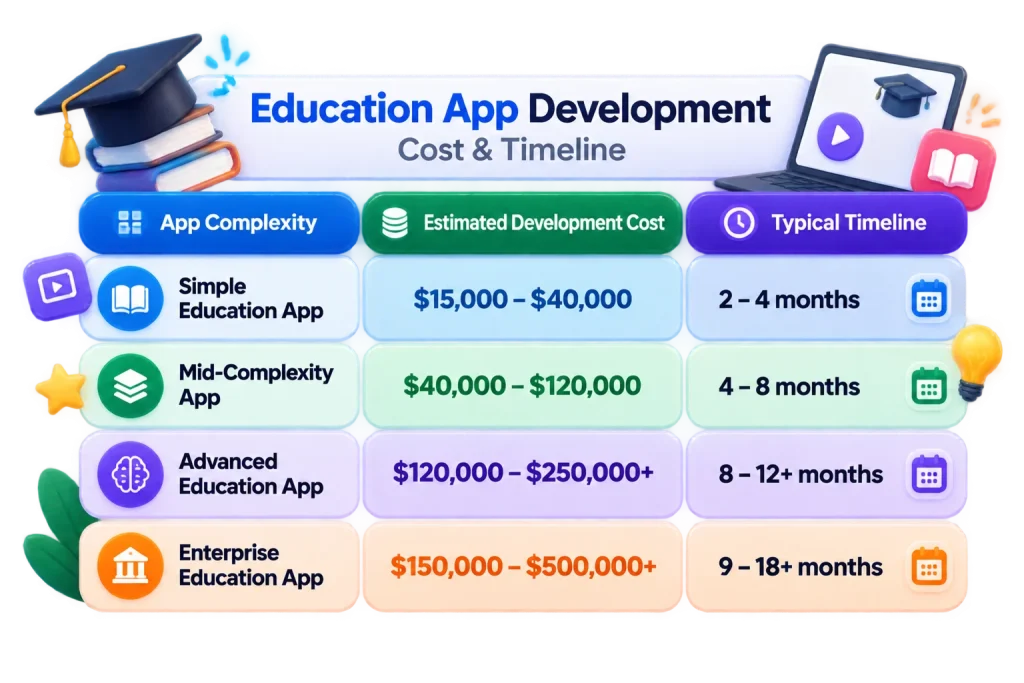
The ranges above are useful for initial budgeting. A proper estimate should be prepared after defining the application’s features, users, platforms, integrations, design requirements, backend architecture, security requirements, and launch scope.
Pricing varies by project scope. The ranges below are general planning estimates and should not be interpreted as fixed quotations.
Real Education Technology Project We Built


What Determines the Cost of an Education App?
There is no universal price for education app development because education apps can serve very different purposes.
A basic app may simply provide recorded lessons and quizzes, while another may include live classrooms, teacher dashboards, student management, payments, assessments, analytics, messaging, and integrations with existing school or university systems.
The most important cost factors are:
- Features and functionality
- Number of user roles
- Target platforms
- Native or cross-platform development
- UI/UX design
- Backend development
- APIs and third-party integrations
- Security requirements
- Data storage and video delivery
- Testing requirements
- Development team
- Project scope
- LMS functionality
- AI or personalization features
- Post-launch maintenance and support
1. Features and Functionality
Features are one of the biggest factors affecting education app development cost.
A basic application with student registration, course listings, video lessons, quizzes, and progress tracking requires less development work than an application with live classes, assignments, payments, messaging, advanced analytics, and multiple dashboards.
Common education app features include:
- Student registration and login
- User profiles
- Course catalog
- Video and audio lessons
- Digital learning materials
- Quizzes and assessments
- Assignments
- Progress tracking
- Certificates
- Push notifications
- Search and filtering
- Student dashboards
- Teacher dashboards
- Admin dashboards
- Payments and subscriptions
- Live classes
- Chat and discussions
- Gamification
- Offline learning
- Analytics and reporting
- AI-powered recommendations
The more functionality an app includes, the more development, backend work, testing, and project coordination it generally requires.
For organizations that need more than a mobile learning app, such as student management, institutional workflows, or connected education systems, custom education software development can become part of the overall project.
2. Number of User Roles
Education applications often have more than one type of user.
A basic learning app may only need students and an administrator. A larger education system may require separate access for students, teachers, parents, instructors, content managers, and administrators.
Each role can require its own:
- Dashboard
- Permissions
- User journey
- Content access
- Reports
- Management functions
- Notifications
For example, a teacher may need to create assignments and review results, while a student needs to complete those assignments and view their progress.
Adding more user roles does not simply mean creating more login screens. Each role can introduce additional backend rules, dashboards, workflows, testing scenarios, and security requirements.
3. Number of Platforms
The platforms you want to support also affect the development budget.
You may need:
- iOS
- Android
- Web application
- Admin portal
- Teacher portal
- Student portal
Building for one mobile platform can keep the initial scope smaller. Supporting both iOS and Android requires an appropriate development strategy.
You can choose between:
- Native iOS development
- Native Android development
- Native development for both platforms
- Cross-platform development using Flutter or React Native
For projects that need both iOS and Android, cross-platform app development can be considered when the application requirements allow code sharing between platforms.
The right option depends on your users, required features, device capabilities, performance requirements, and long-term product plans.
4. Native vs. Cross-Platform Development
Cross-platform frameworks such as Flutter and React Native can reduce duplicated development work when an education app needs to support both iOS and Android.
This can be useful for education products where the core functionality is similar across platforms, such as course access, quizzes, progress tracking, notifications, and user accounts.
For example, React Native app development can be considered when a project needs a shared mobile codebase while still supporting both major mobile platforms.
Native development may be more appropriate when the application needs platform-specific functionality or deeper integration with device capabilities.
The question is not simply:
“Which option is cheaper?”
The better question is:
“Which development approach provides the right balance of cost, performance, functionality, and long-term maintenance for the app?”
5. UI/UX Design
Education apps need to be easy to understand because users may have very different levels of technical experience.
A student should be able to find a course, open a lesson, complete an assessment, and check progress without unnecessary steps. Teachers and administrators may need more complex dashboards and management workflows.
A simple education app may require straightforward screens and navigation. A larger application may need:
- Custom user flows
- Interactive dashboards
- Prototypes
- Design systems
- Custom illustrations
- Animations
- Accessibility considerations
- Separate experiences for different user roles
Good UI/UX planning also helps identify usability problems before development begins. For more complex education products, UI/UX design services can be part of the overall project scope.
6. Backend Development
The mobile application is only one part of an education product.
The backend may need to manage:
- Student accounts
- Teacher accounts
- Course data
- User permissions
- Assessments
- Progress records
- Payments
- Notifications
- Video and document storage
- Certificates
- Analytics
- APIs
- Administration
- Third-party integrations
A simple course application may require a relatively straightforward backend. A complete education system with multiple roles, real-time communication, reporting, and institutional integrations requires more backend engineering.
For projects that involve custom workflows, APIs, databases, dashboards, and connected business systems, custom application development may be part of the wider technical scope.
This is why two apps with a similar number of screens can still have very different development costs.
7. Learning Management System Requirements
LMS functionality can significantly increase the scope of an education application.
An LMS-based solution may include:
- Course creation
- Lesson management
- Student enrollment
- Instructor management
- Assignments
- Assessments
- Grading
- Progress tracking
- Certificates
- Learning reports
- Content management
- User permissions
If your product requires these functions, custom LMS development may become an important part of the project rather than simply adding a few course screens to a mobile app.
A custom LMS can also connect with systems such as student information systems, CRM, ERP, HR software, payment services, video conferencing tools, and SSO providers.
The more advanced the LMS requirements, the more backend logic, administration, reporting, integrations, and testing the project usually needs.
8. Third-Party Integrations
Integrations can add considerable development work to an education application.
Depending on the product, developers may need to integrate:
- Payment gateways
- Video conferencing services
- Cloud storage
- Email services
- Push notification services
- Analytics tools
- Authentication providers
- CRM systems
- Existing LMS systems
- Calendar services
- School management systems
- Student information systems
Each integration needs to be reviewed for API availability, authentication, data flow, error handling, security, testing, and ongoing maintenance.
For example, adding a payment gateway is not only about connecting the API. The application also needs to handle successful payments, failed transactions, refunds, subscription status, and access to paid content.
9. Security Requirements
Education apps can handle student profiles, academic records, assessments, payments, and other sensitive information.
Security requirements may include:
- Secure authentication
- Role-based access
- Data encryption
- Secure APIs
- Access controls
- Backup systems
- Monitoring
- Audit logs
- Security testing
The requirements become more important when an application is used by schools, universities, businesses, or large groups of learners.
Security should be considered during architecture and development rather than being treated as a final step before launch.
10. Development Team and Location
Development team location can affect project pricing because software development rates vary between markets.
However, hourly rate should not be the only factor when comparing development teams.
A lower hourly rate does not necessarily mean a lower total project cost if the project takes longer or requires substantial rework.
Consider:
- Relevant education technology experience
- Technical expertise
- Communication
- Project management
- QA processes
- Portfolio
- Security practices
- Post-launch support
- Overall project scope
The total development effort matters more than the hourly rate alone.
11. Project Scope
Project scope is one of the most important factors in determining the final budget.
Before development begins, define:
- Target users
- User roles
- Core features
- Platforms
- Screens
- Backend requirements
- Admin functionality
- Integrations
- Content types
- Security requirements
- Payment requirements
- Launch requirements
Unclear requirements often lead to scope changes during development.
For example, an education app may initially be planned as a simple course application, but later require teacher dashboards, live classes, subscriptions, parent accounts, and detailed reporting.
Defining the scope early makes it easier to estimate both cost and timeline.
12. AI and Personalization Features
AI can add another layer of development requirements to an education application.
Depending on the use case, AI functionality may include:
- AI tutoring
- Personalized learning recommendations
- Automated feedback
- AI-generated questions
- Content recommendations
- Student performance analysis
- Chat-based learning assistants
The technical requirements can include AI APIs, data processing, backend infrastructure, prompt or workflow design, evaluation, monitoring, security, and additional testing.
A simple AI API integration and a custom AI-powered learning system are very different projects, so the cost depends heavily on what the AI feature actually needs to do.
Education App Development Cost Breakdown
A useful way to understand an education app budget is to divide it into major development areas.
The following figures are general planning ranges and should not be treated as fixed quotations.
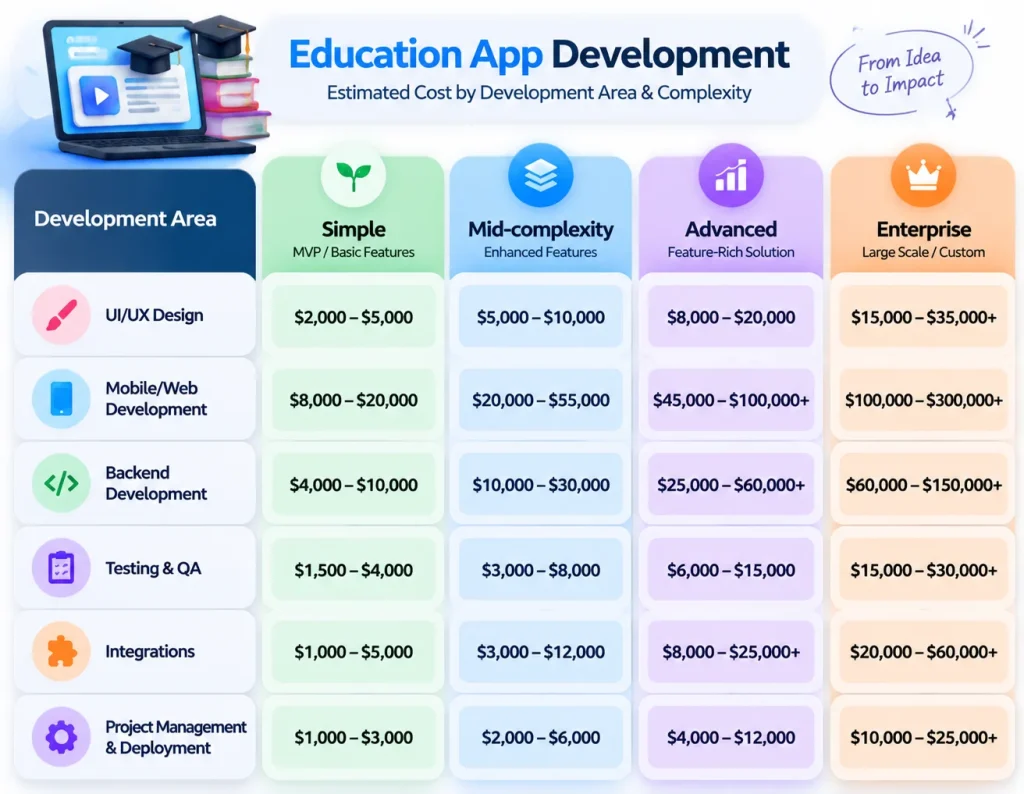
The actual allocation can vary considerably. Some projects may spend more on backend development and integrations, while others may require a larger UI/UX or content-management scope.
What Does a Simple Education App Cost?
A simple education application generally focuses on delivering learning content without extensive real-time or institutional functionality.
It may include:
- Student registration
- Login
- Course catalog
- Video or document lessons
- Basic quizzes
- Progress tracking
- Notifications
- Basic admin panel
A simple education app can cost approximately $15,000–$40,000, with a planning timeline of around 2–4 months.
This approach can work well for startups, individual educators, training providers, or businesses that want to launch a focused learning product.
What Does a Mid-Complexity Education App Cost?
A mid-complexity education application usually includes more user roles and a wider set of learning features.
It may include:
- Student dashboard
- Teacher dashboard
- Course management
- Assignments
- Assessments
- Progress reports
- Payments
- Certificates
- Discussions
- Notifications
- Content management
The planning range for this type of application is approximately $40,000–$120,000, with development often taking around 4–8 months.
The cost increases because the application needs more backend logic, user permissions, dashboards, testing, and integrations.
What Does an Advanced Education App Cost?
An advanced education application can include real-time learning and more complex systems.
Typical functionality may include:
- Live classes
- Virtual classrooms
- Real-time chat
- Advanced analytics
- Offline learning
- Gamification
- Complex assessments
- Multiple dashboards
- External integrations
- AI-based features
- Advanced administration
An advanced education app can fall within a planning range of approximately $120,000–$250,000+, with a timeline of around 8–12+ months.
What Does an Enterprise Education App Cost?
Enterprise education applications are usually built for larger institutions, education companies, or organizations with complex operational requirements.
They may require:
- Multiple organizations
- Multi-tenant architecture
- Large numbers of users
- Advanced security
- Complex administration
- Multiple integrations
- Custom LMS functionality
- Advanced analytics
- AI functionality
- Web and mobile applications
- Enterprise infrastructure
The planning range can reach $150,000–$500,000+, with development timelines of 9–18+ months, depending on scope.
How Much Does It Cost to Build Different Types of Education Apps?
The type of education application also changes the features and technical requirements involved.
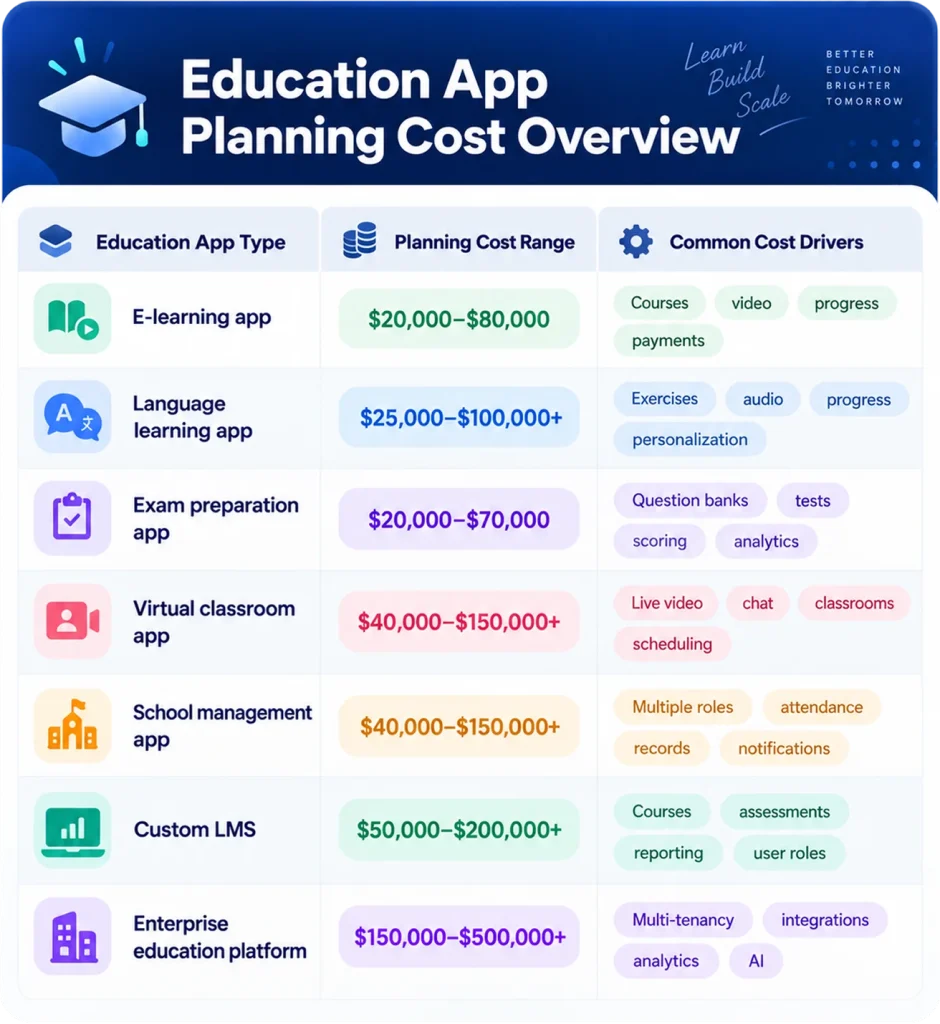
The category alone does not determine the final cost. The exact features, platforms, integrations, and technical requirements matter more.
How Long Does It Take to Develop an Education App?
Development timelines depend on the scope and complexity of the application.
As a general planning framework:
- Simple education app: 2–4 months
- Mid-complexity education app: 4–8 months
- Advanced education app: 8–12+ months
- Enterprise education app: 9–18+ months
A complete project may involve:
- Requirements and discovery
- UX/UI design
- Backend development
- Mobile or web development
- Integration
- Quality assurance
- Deployment
- Launch preparation
These stages can overlap, so adding every stage together does not necessarily represent the final development timeline.
Changes in requirements during development can also increase both cost and delivery time.
What Are the Ongoing Costs After Launch?
Education app development does not necessarily end when the application is launched.
Ongoing costs can include:
- Bug fixes
- Security updates
- Operating system compatibility
- Cloud hosting
- Database management
- Video storage and delivery
- Third-party services
- New features
- Analytics
- Technical support
- Performance improvements
Maintenance requirements depend on the size and complexity of the application.
For planning purposes, annual maintenance should be budgeted separately from the initial development cost rather than treating it as part of the one-time build.
What Are the Hidden Costs of Education App Development?
Some costs may not be obvious when preparing an initial budget.
Cloud Infrastructure
An education application may require hosting, databases, file storage, backups, and monitoring.
Video-heavy applications can require additional storage and bandwidth because lessons may need to be stored and delivered to many users.
Third-Party Services
Payment gateways, video services, email providers, analytics tools, and other APIs may have their own usage-based or subscription costs.
Content Creation
Technology is only one part of an education product.
Courses may require:
- Video production
- Written lessons
- Quizzes
- Illustrations
- Audio
- Assessments
- Downloadable materials
Content creation can therefore become a separate part of the overall product budget.
Security and Compliance
Security testing, monitoring, updates, and compliance requirements may create additional development and operational costs.
Marketing and User Acquisition
Launching the application does not automatically bring users.
Marketing, advertising, partnerships, and content promotion may need to be budgeted separately from development.
Ongoing Support
Users may need help with accounts, payments, courses, technical problems, or other issues after launch.
How Linkitsoft Approaches Education App Development
At Linkitsoft, the development process starts with understanding what the education product actually needs to accomplish rather than applying the same feature set to every project.
Step 1: Understand the Users and Learning Model
We identify the target users, learning goals, business requirements, and main workflows.
This helps determine whether the product needs to support students only or also teachers, parents, administrators, institutions, or other users.
Step 2: Define the Core Features
The planned functionality is divided into essential and future features.
This helps keep the first release focused instead of including every possible feature from the beginning.
Step 3: Plan the Technical Architecture
The architecture is planned around the required platforms, backend, database, APIs, authentication, user roles, integrations, and expected usage.
Requirements such as live classes, offline learning, AI, or LMS functionality can significantly change the technical scope.
Step 4: Design the User Experience
Student, teacher, and administrator workflows are mapped before development moves too far forward.
The aim is to make important learning and management tasks simple to navigate.
Step 5: Develop and Integrate the Product
The development team works on the agreed mobile applications, web components, backend systems, dashboards, APIs, and third-party integrations.
Step 6: Test the Application
Testing covers functionality, user permissions, integrations, device compatibility, performance, and key learning workflows.
Step 7: Launch and Continue Improving
After launch, the application can be monitored and improved based on user feedback, technical requirements, and future business needs.
How to Reduce Education App Development Costs
Reducing development cost does not mean removing important quality checks or choosing the cheapest development team.
The better approach is to control the scope and prioritize what users actually need.
Start With an MVP
An MVP allows you to launch the core learning experience without building every planned feature at once.
For example, an exam preparation app could initially include:
- Student accounts
- Question bank
- Timed tests
- Results
- Basic progress tracking
Advanced analytics, AI recommendations, gamification, or live classes could be introduced later.
If you want to validate the first version before investing in the complete product, MVP development can be considered as part of the initial development strategy.
Define Requirements Before Development
Clear requirements reduce unnecessary changes during development.
Before work begins, define the main users, features, platforms, integrations, and launch requirements.
Choose the Right Platform Strategy
If the app needs both iOS and Android, a cross-platform approach may reduce duplicated development work when the requirements are suitable for it.
The decision should still be based on technical requirements rather than cost alone.
Use Existing APIs Where Appropriate
Using established services for payments, notifications, authentication, video, or other functions can reduce the need to build everything from scratch.
However, each external service should be evaluated for pricing, security, API limitations, and long-term availability.
Roll Out Advanced Features in Phases
You do not necessarily need AI, gamification, live classes, and advanced reporting in the first release.
A phased approach allows the core product to launch first and gives you an opportunity to learn what users actually need.
Don’t Cut QA to Save Money
Reducing testing may lower the initial development budget, but it can create more expensive problems after launch.
Proper QA helps identify functional, usability, compatibility, and integration issues before users encounter them.
What Is the Cheapest Way to Build an Education App?
The cheapest practical approach is usually to build a focused MVP rather than trying to launch a complete education ecosystem from day one.
Start with the core learning experience and the features required to make the product usable.
For example, a basic learning application could begin with:
- User registration
- Course catalog
- Learning content
- Quizzes
- Progress tracking
- Basic administration
Once the product is validated, additional functionality can be introduced based on user feedback and business requirements.
The goal should not be to build the cheapest possible app. It should be to avoid spending money on features that are not yet necessary.
How Can I Get an Accurate Education App Development Estimate?
A reliable estimate requires more information than an app idea alone.
Before requesting an estimate, prepare:
- Target audience
- User roles
- Core features
- Platforms
- Learning content
- Payment model
- Backend requirements
- Third-party integrations
- Admin functionality
- Security requirements
- Expected launch scope
The clearer these requirements are, the easier it is for a development team to estimate the required effort, timeline, and budget.