
AI software is becoming one of the most valuable tools for modern businesses, but the big question everyone asks first is: How much does it actually cost to build?
In most cases, AI software development can start around $40,000 for simpler systems and go well over $200,000 for advanced, data-heavy solutions. The range is wide because every AI project works differently and solves a different problem.
What is clear, though, is that companies are investing in AI faster than ever. In the United States, the artificial intelligence market is growing at a strong pace with a CAGR of 19.3% (2024–2034) and is expected to reach almost $851.46 billion. This shows how important AI has become for automation, cost reduction, smarter decisions, and better customer experiences.
If you are planning to build your own AI software, this guide will help you understand the real costs behind it. We will walk through the biggest factors that affect pricing, how the development process works, and how to plan your AI software budget without surprises. We will also share practical tips to reduce development costs at the end of this blog. Let’s dive in!
What Impacts the Cost of AI Software?
AI software costs can change a lot depending on what you want to build. A simple AI tool may cost around $10,000, while a more advanced system can go above $200,000. Big enterprise AI projects can even cross $1,000,000 if they need custom models and huge amounts of data. These price differences happen because every AI project has different needs, features, and development time. Here are the main things that affect the final cost.
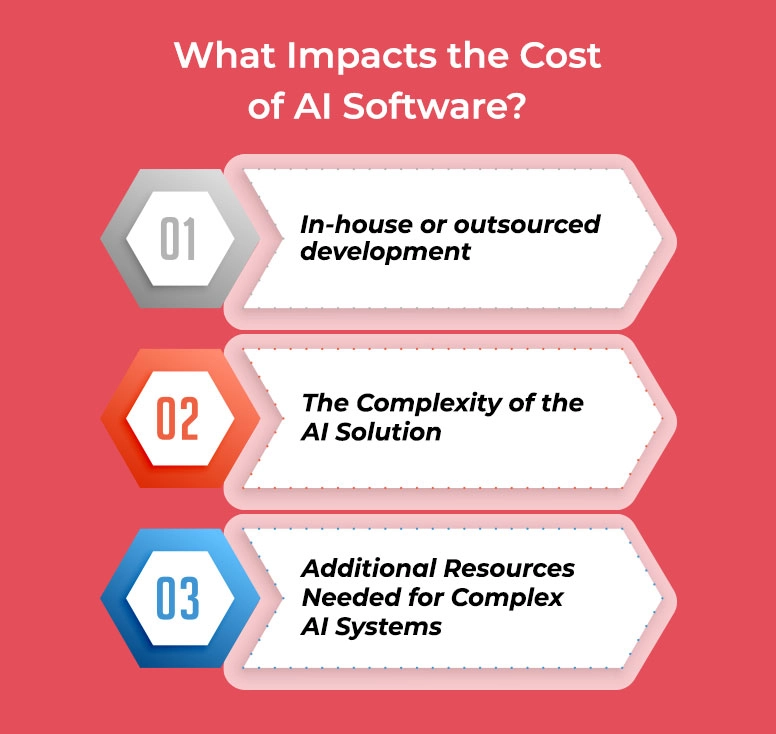
1. In-house or outsourced development
Your total cost can go up or down depending on who builds the AI. In-house teams are usually more expensive because of higher salaries and overhead. Outsourcing to an experienced AI development company is often more budget-friendly. The quality can be the same, but the cost changes based on the team you choose.
2. The Complexity of the AI Solution
The cost of an AI solution depends a lot on how complicated it is. Simple AI features are cheaper and faster to build, while more advanced ones take more time, work, and testing. The table below shows how different levels of complexity affect the price.
| AI Complexity Level | Description | Estimated Cost Range |
| Low-complexity AI | Simple AI features that are easier and faster to build. | $5,000 – $20,000 |
| Mid-complexity AI | More advanced features requiring additional time, research, and testing. | $30,000 – $100,000 |
| High-complexity AI | Includes computer vision, NLP, or custom deep learning models; requires extensive research, training, and testing. | $200,000 – $1,000,000+ |
3. Additional Resources Needed for Complex AI Systems
Developing advanced AI software is more than just writing code. These AI models need lots of good-quality data, strong computer systems to run on, and regular updates to keep working well. All of these things affect how much it costs to build AI solutions.
-
Infrastructure and Hardware Costs
Advanced AI software needs strong computers, servers, and cloud tools to run properly. Training deep learning models can take days or even weeks, which increases costs. Even after training, the AI software still needs reliable hardware to work quickly and smoothly.
-
Training and Data Costs
Advanced AI models need a lot of data to learn. This data must be collected, cleaned, and labeled by experts before the model can start training. The more data the AI needs, the more time and money it takes to prepare it.
-
Ongoing Maintenance Costs
AI software needs regular updates to stay accurate and useful. This means retraining models with new data, checking performance, fixing problems, and adding improvements. These ongoing tasks add to the long-term cost of keeping the AI system running well.
Types of AI Software Solutions and Their Costs
AI software comes in many forms, each designed to solve different problems. Costs vary depending on complexity. Here is a look at some popular AI software solutions:
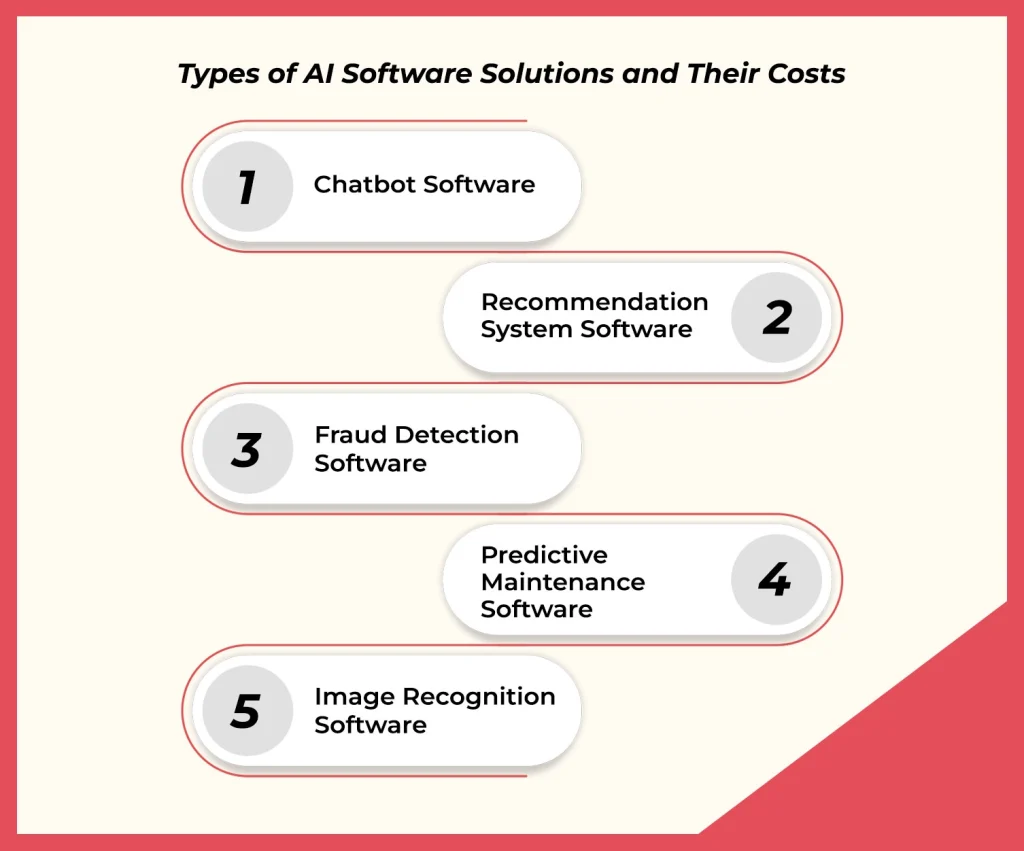
1. Chatbot Software
Starting Cost: $6,000
This AI software helps businesses communicate with customers by answering questions, booking appointments, or sharing product information. It is widely used in customer service, retail, and hospitality.
2. Recommendation System Software
Starting Cost: $15,000+
This Artificial Intelligence software analyzes user behavior and past activity to suggest relevant products, content, or services. It is commonly used in e-commerce, retail, and streaming platforms.
3. Fraud Detection Software
Starting Cost: $20,000+
Monitors transactions and data patterns to identify suspicious or fraudulent activity. Used by banks, insurance companies, and online stores.
4. Predictive Maintenance Software
Starting Cost: $20,000+
This AI software predicts any potential equipment or system failures before they happen, helping businesses avoid costly downtime. Typical in manufacturing and utilities.
5. Image Recognition Software
Starting Cost: $30,000+
Processes photos, MRI scans, or product images to detect objects, patterns, or other key information. Often used in healthcare, security, automotive, and retail.
These prices are rough estimates. Actual costs depend on dataset size, algorithm complexity, desired features, and the rates of the development team you hire.
Breaking Down the Cost of Building AI Software
Building AI software is exciting, but it involves several stages. Each stage has its own tasks, challenges, and costs. Understanding these stages will help you plan your budget more effectively and avoid surprises.
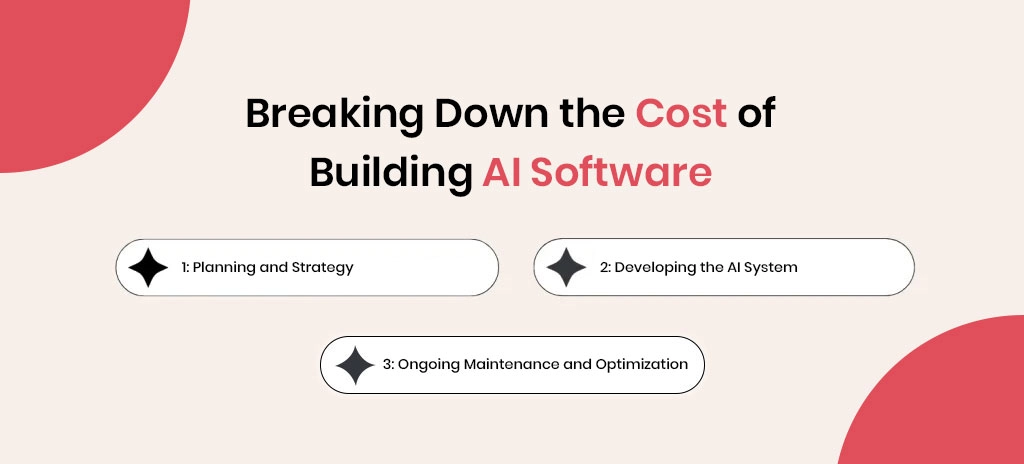
Stage 1: Planning and Strategy
Starting Cost: $5,000 to $25,000+
Before any coding begins, you need a clear plan. This stage focuses on figuring out what your AI should do and whether it is feasible. Common tasks include
- Consulting AI experts to define goals and strategies
- Checking technical and organizational readiness
- Allocating resources for planning, documentation, and workshops
The more complex your project, the more detailed the planning and the higher the cost.
Stage 2: Developing the AI System
Starting Cost: $15,000 to $300,000+
This is the core stage of AI development. How you approach it greatly affects the price. Here are the three main options:
1. Custom AI Development
Building a model from scratch gives you a fully tailored solution. This stage usually involves
- Collecting and preparing data for training
- Designing the model and training it with computing resources
- Testing and validating the model to meet performance goals
- Deploying the model and maintaining the necessary infrastructure
Estimated Cost: $50,000 to $300,000+
2. Pre-Trained AI Models
Pre-trained models save time and money, especially if you do not need a highly customized solution. Tasks include:
- Selecting and configuring the right model
- Integrating it into your existing system
- Testing and fine-tuning with your own data
For large models like LLMs, post-training may not be needed, but deployment can be resource-heavy.
Estimated Cost: $35,000 to $150,000+
3. Third-Party AI Services
You can also integrate existing AI solutions like GPT-4 Turbo instead of building your own. Consider:
- Subscription or usage fees
- Customizing the AI to fit your system
- Testing and deploying the AI features
Estimated Cost: $15,000 to $100,000+
Stage 3: Ongoing Maintenance and Optimization
Starting Cost: $20,000 to $80,000+
Once your AI system is live, it needs regular attention to stay working optimally. This stage involves:
- Updating and fine-tuning models for better performance
- Monitoring system performance and fixing issues
- Training stakeholders on updates and changes
With adaptable support plans, you can maintain your AI software effectively while keeping costs under control.
How Businesses Are Using AI Software Today
72% of companies worldwide now use AI in at least one part of their business. Using AI in your business is not about “what if” anymore. It is about “how to” put it to work effectively right now. Companies are already using AI software to work faster, make smarter decisions, and improve many parts of their operations.
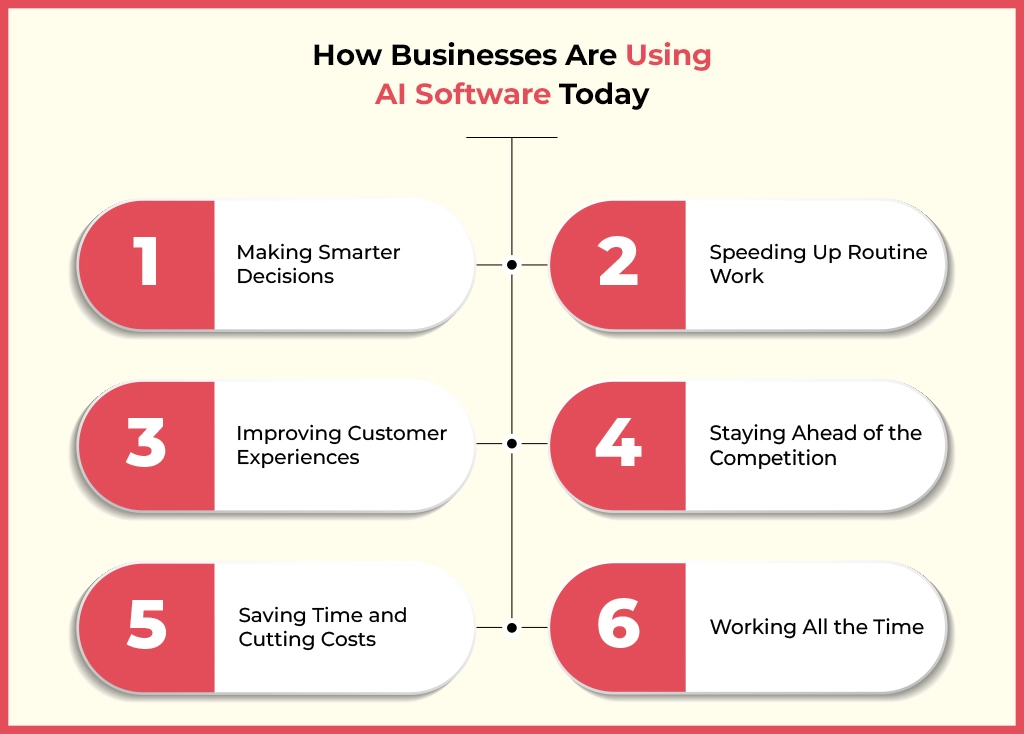
Making Smarter Decisions
Businesses use AI software to analyze large amounts of information. It finds patterns and trends that are easy to miss. This helps teams make better choices for daily work and long-term planning.
Speeding Up Routine Work
Tasks that once took hours can now be done in minutes. AI software automates repetitive processes. It reduces mistakes and frees your team to focus on more important work.
Improving Customer Experiences
AI software notices customer preferences and habits. Businesses can suggest products, services, or content that fit each person. This keeps customers happy and keeps them coming back.
Staying Ahead of the Competition
Companies use AI software to make operations more efficient. Decisions are made faster. Early adopters can improve products and services quickly and stay ahead of competitors who use traditional methods.
Saving Time and Cutting Costs
AI software helps streamline business operations. From handling customer questions to improving sales or logistics, it saves time. It reduces effort and can increase profits.
Working All the Time
AI software does not need breaks. It can process information and complete tasks around the clock. Businesses stay productive, handle more work, and provide better service to customers.
How to Reduce the Cost of AI Software
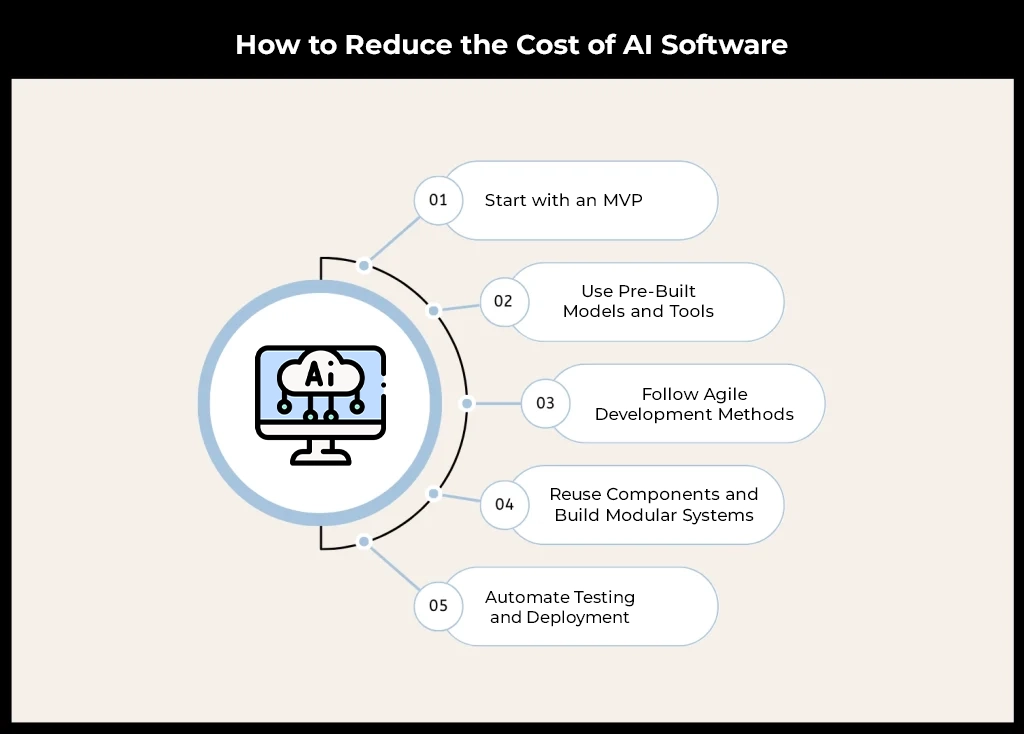
Building AI software can be expensive, but there are several ways to make it more cost-effective. Here are five practical approaches that help keep AI software development efficient and affordable.
1. Start with an MVP
A common mistake is trying to build everything at once. It can waste time and money. Instead, focus on the features that matter most to your business. Start with a simple version, like an MVP, to test your ideas and see what works. You can add more features later. This keeps costs low and avoids extra work.
2. Use Pre-Built Models and Tools
Not every system needs to be built from scratch. Pre-built models or tools from places like TensorFlow Hub or OpenAI’s GPT can save time and money. You can adjust them to fit your business requirements, which makes development faster and easier.
3. Follow Agile Development Methods
Breaking a project into smaller steps and using Agile methods helps keep costs under control. Working in short phases and checking progress often allows you to fix problems early and stay on schedule.
4. Reuse Components and Build Modular Systems
Many parts of software are used in more than one place. Using reusable pieces makes development faster and keeps quality consistent. It also helps prevent mistakes and reduces costs.
5. Automate Testing and Deployment
Testing and updating by hand takes time and can lead to errors. Using automated tools helps find problems faster and release updates quickly. This saves time, reduces mistakes, and keeps the project running smoothly.
By following these strategies, LinkitSoft helps clients get effective AI solutions that are cost-efficient, scalable, and built to deliver real value.
Making AI Software Work for Your Business
If you are unsure about adding AI software to your business, think of it this way. It can handle repetitive tasks and help you make better decisions faster. Instead of spending hours on routine work, the software does it for you. This gives your team more time to focus on the work that really grows your business. Over time, AI software becomes a tool that not only saves time but also helps your business stay competitive and ready for the future.
Frequently Asked Questions
How much does it cost to develop AI software?
AI software costs vary depending on complexity, data needs, and features. Simple systems like chatbots can start around $6,000, while full recommendation engines or predictive models can go from $20,000 to $300,000 or more. Ongoing updates and maintenance are additional but usually smaller compared to development costs.
What affects the AI software development cost the most?
The main factors are the type of system, the amount and quality of data, and the complexity of the features you need. Custom-built models require more resources than pre-trained ones. Integrations with existing systems and infrastructure can also impact cost.
Do I need a full custom solution, or can I use pre-built tools?
It depends on your business needs. Pre-built models or AI tools can save time and money and are suitable for many common tasks. Custom solutions are better if you need highly specific functionality, unique data processing, or advanced features tailored to your business.
How long does it take to build AI software?
Simple AI solutions can be ready in a few weeks, while more complex systems may take several months. Factors like data preparation, testing, and integration with existing systems influence the timeline. Although using pre-trained models or modular components can speed up this AI development process.
How long does it take to implement AI software for small business?
It depends on what you need. Simple systems can be up and running in a few weeks. More complex setups might take a few months because of testing, data prep, and connecting everything to your existing tools. A smart approach is to start with the most important features first. That way, you get results sooner and keep costs under control.
Can AI software replace my team?
Well, AI software is designed to assist, not replace your team. It handles repetitive tasks, speeds up decision-making, and provides insights. Your team can focus on higher-value work, strategy, and growth while AI handles routine or data-heavy tasks.