
Backend development is the foundation of every reliable digital product. It processes requests, manages data, and ensures system stability.
This guide examines backend development from a systems perspective. You’ll learn how it is architected and designed. We’ll also get into the depths to understand how the backend is scaled and operated in real-world production environments.
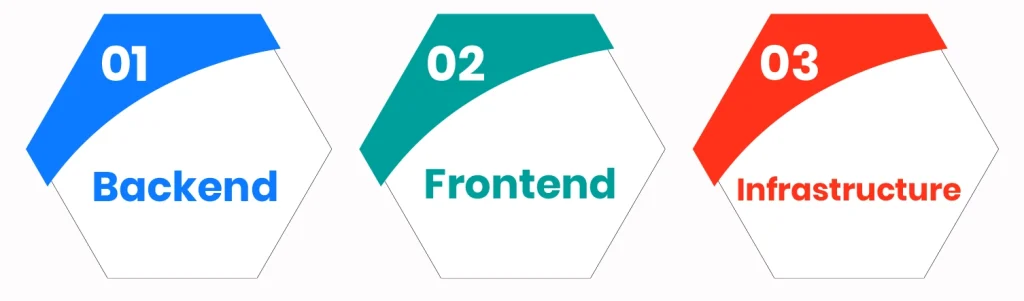
Conceptual Foundation: Backend vs. Frontend vs. Infrastructure
Backend development exists within a broader system composed of frontend apps and infrastructure layers. To design scalable and maintainable systems, it is essential to clearly distinguish the responsibilities of each.
Backend
The backend is responsible for enforcing system behavior. When users log into an app or load dashboards, backend systems execute the logic that makes those actions possible. It:
- Processes client requests
- Executes business rules
- Manages data persistence
- Enforces access control
- Integrates with external services
When an app is running smoothly on the frontend, there is a swift backend doing its job.
Frontend
The frontend, by contrast, is responsible for presentation and interaction. Frontend code operates in an untrusted environment and can be manipulated. It:
- Renders user interfaces
- Collects input
- Manages visual state
- Communicates with backend APIs.
Frontend apps may perform input validation to improve the overall user experience. However, they cannot be relied upon for security or data integrity.
Infrastructure
The infrastructure of an app forms the operational foundation on which backend systems run. It include:
- Compute resources
- Networking
- Storage systems
- Deployment pipelines
- Container orchestration platforms
- Load balancers
- Monitoring tools
However, it does not define business logic; it enables backend systems to execute reliably under production conditions.
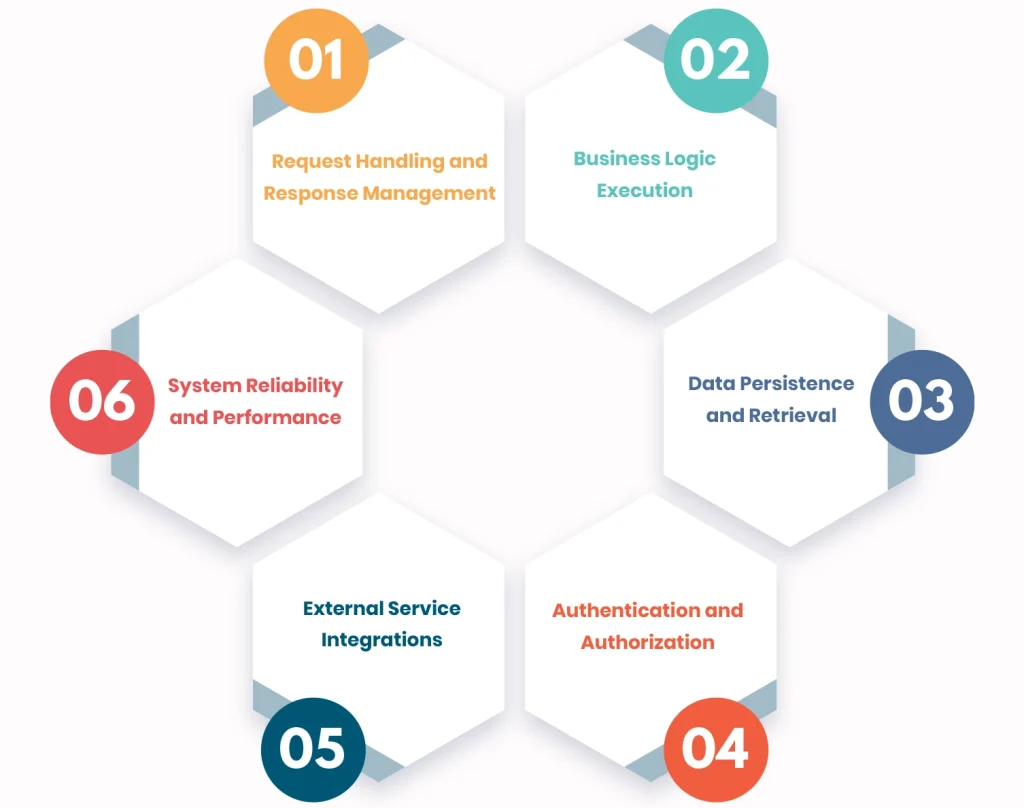
What are the Backend’s Core Responsibilities?
Backend systems carry operational responsibility for nearly all non-visual aspects of an app.
Request Handling and Response Management
The backend receives incoming requests, reads the data sent by the client, checks that everything is valid, and sends the request to the correct part of the system for processing. After the work is done, it returns a clear and structured response.
This includes sending the right status codes, returning meaningful error messages, and keeping responses consistent so other systems can rely on them.
If request handling is poorly designed, the app becomes unpredictable and difficult to integrate with reliably.
Business Logic Execution
Business logic defines how the system behaves. It enforces domain rules such as pricing policies, access permissions, transaction eligibility, and workflow states.
When business rules are scattered across controllers, database queries, or UI layers become inconsistent. This is where centralizing business logic helps. It ensures maintainability and correctness.
Data Persistence and Retrieval
Backend systems manage persistent storage. The database layer must ensure durability and integrity, whether relational or non-relational. Over 70% of professional developers still rely on relational databases for production systems. This highlights the continued importance of structured data modeling.
Good query design and schema structure directly impact the performance as well.
Authentication and Authorization
Authentication verifies identity. Authorization verifies permission.
A backend system must ensure that identity checks are robust and that permission enforcement is consistent across endpoints. Security misconfigurations remain one of the top causes of breaches, with IBM reporting in its 2023 Cost of a Data Breach Report that the global average breach cost reached $4.45 million.
External Service Integrations
Modern systems integrate with third-party services such as payment gateways and messaging services. They also integrate with analytics providers and identity platforms.
Each integration introduces network dependency, latency variability, and failure risk. Backend systems must handle retries, timeouts, and graceful degradation.
System Reliability and Performance
Beyond the correctness, backend systems must maintain uptime and performance under load, too. This includes managing concurrency and resource allocation. It should also have good fault tolerance.
Performance engineering is not reactive optimization; it is proactive architectural planning.
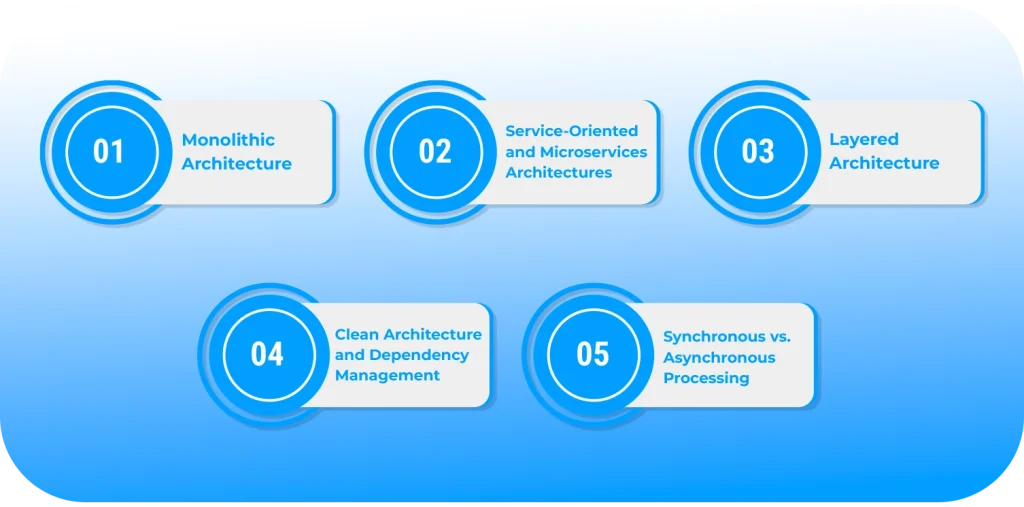
What is the Backend Architecture and System Design?
The architecture that you select for an app defines how its backend systems evolve. There are different types of architectures:
Monolithic Architecture
A monolithic architecture packages all the app’s functionality into a single deployable unit. It is often ideal for early-stage products because it simplifies development, deployment, and debugging.
As the system grows, however, components can become tightly coupled. Due to this, scaling or modifying one feature may require redeploying the entire app.
Service-Oriented and Microservices Architectures
Microservices split a system into independently deployable services aligned with business domains (e.g., authentication, payments, inventory). This enables teams to build, deploy, and scale services independently.
Communication typically occurs via APIs or messaging systems. While this model improves flexibility and scalability, it introduces distributed system challenges such as observability, failure handling, and data consistency.
Layered Architecture
Layered architecture organizes the backend systems into logical layers. Here are what they are and their responsibilities:
- Controller – handles incoming requests
- Service – coordinates use cases
- Domain – contains business rules
- Data access – interacts with the database
Clear separation between these layers improves the maintainability, readability, and testability of the app’s code.
Clean Architecture and Dependency Management
Clean architecture ensures that core business logic remains independent of frameworks and external systems. They also ensure the core logic of databases remains independent.
By enforcing strict boundaries and dependency inversion, teams protect domain logic from infrastructure changes. This improves long-term maintainability and testability.
Synchronous vs. Asynchronous Processing
Synchronous processing follows a direct request–response flow, where the client waits for completion.
Asynchronous processing offloads long-running tasks to background workers.
Event-driven patterns allow systems to react to events instead of direct calls. This improves the scalability and decoupling. However, it requires careful coordination and monitoring the whole time.
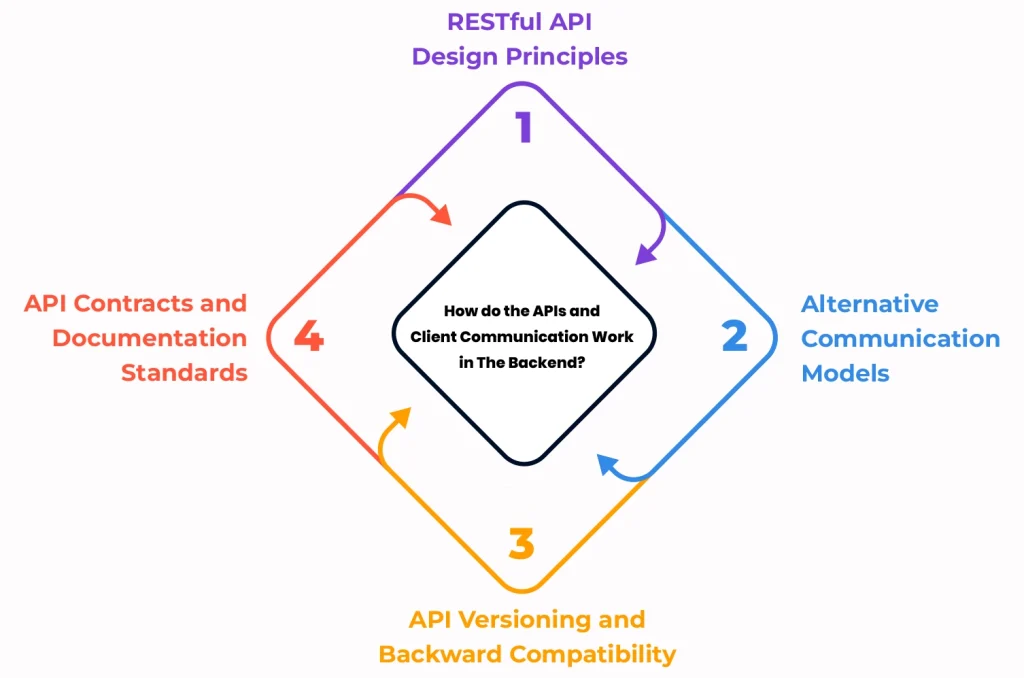
How do the APIs and Client Communication Work in The Backend?
APIs are the formal interface between backend systems and clients. They help with the communication. The different types of APIs are as follows:
RESTful API Design Principles
REST APIs model resources rather than actions. Proper HTTP semantics matter: GET retrieves data, POST creates resources, PUT updates, and DELETE removes.
Status codes communicate meaning. Clear API design reduces integration errors and accelerates the overall development speed.
Alternative Communication Models
Graph-based APIs allow clients to request only the data they need. RPC systems focus on executing procedures remotely.
Each model introduces different trade-offs between flexibility and performance. It also affects the complexity.
API Versioning and Backward Compatibility
Backward compatibility preserves trust. Breaking API changes without versioning can disrupt client apps.
Versioning strategies include URL-based versioning or header-based approaches. Mature systems treat API contracts as long-term commitments.
API Contracts and Documentation Standards
Clear documentation reduces onboarding friction. API contracts define expectations between backend and frontend teams.
Well-documented APIs reduce dependency misalignment and improve cross-team productivity.
What is the Role of Databases in Backend Systems?
Databases provide durable storage. They must balance consistency, availability, and partition tolerance, particularly in distributed systems.
Relational vs. Non-Relational Data Models
Relational databases store data in structured tables with predefined schemas and strong transactional guarantees. They work well when data has clear relationships, and consistency is critical.
Non-relational (NoSQL) databases offer more flexible data structures and are often easier to scale horizontally. They are useful when handling large volumes of unstructured or rapidly changing data.
The right choice depends on:
- How your data is structured
- How strongly related your data entities are
- Your consistency requirements
- Your expected workload and scale
There is no universal best option… The decision should align with the system’s needs.
Schema Design and Data Modeling
Schema design defines how the data is organized and related within your app.
Normalization reduces duplicate data and improves consistency. However, it can require more complex queries.
Denormalization simplifies queries and improves performance. However, it introduces some redundancy.
Indexing is equally important. Proper indexes allow databases to retrieve data quickly. Poor indexing can significantly increase response times, especially under heavy load.
Conclusion
Building a backend is as much about engineering judgment as it is about technology. It’s where trade-offs are made daily, and where design decisions echo throughout the life of an app. A backend that is thoughtfully structured does more than execute requests; it becomes a framework for enabling teams to experiment and grow without losing control.
In essence, mastering backend development is mastering the language of systems themselves. It teaches how to coordinate processes and design for change. Every API and service boundary is an opportunity to develop a system that is resilient and ready for the future.
Frequently Asked Questions?
What are the popular backend app development tools?
Popular backend tools include:
- Node.js
- Python
- Java
- Go
- Express
- Django
- Spring Boot
- PostgreSQL
- MySQL
- MongoDB
- Redis
The ultimate choice for your app depends on your project’s complexity and team expertise.
What happens if an app’s backend is not scalable or reliable?
If a backend cannot scale, it struggles to handle growth, leading to slow responses or crashes under high traffic. If it is unreliable, users may experience errors, data inconsistencies, or downtime, which can damage trust and business reputation.
How does a backend ensure data security?
Security must be built into the system from the start, not added later.
Backends secure data through:
- Authentication (verifying identity)
- Authorization (controlling access)
- Encryption (protecting the data that is in transit and at rest)
- Input validation
- Rate limiting
- Secrets management