

Choosing the right custom software development company can make or break your product, especially for founders, CTOs, and product leaders responsible for delivery timelines, budgets, and long-term scalability. The right partner accelerates growth and reduces risk, while the wrong one can result in missed deadlines, ballooning costs, and hard-to-maintain systems.
With countless development vendors offering similar services, identifying a truly reliable partner isn’t easy. Technical expertise matters, but it is only one piece of the puzzle. Reliability also depends on factors like process maturity, communication transparency, delivery consistency, and the ability to navigate real-world challenges.
In this blog, we outline the key criteria decision-makers should evaluate when selecting a custom software development company. From assessing technical capabilities and development methodologies to understanding risk management and collaboration practices, these insights will help you choose a partner that supports sustainable, long-term growth.
Why Does It Matter to Choose the Right Custom Software Development Company?
Selecting the right custom software development company is much more than just a decision relating to technology. This is a business move, and at times, it is emotional as well.
You are handing over your idea and capital to people you are trusting to build exactly what you have been visualizing. The right team does not just build what you ask for; they challenge weak ideas. They will properly analyze and suggest smarter alternatives. They prioritize the long-term success of your project, helping you avoid expensive mistakes before they happen.
Software needs more than just development and design. You need a whole team that is working in collaboration for the success of your project and your ideas. This is why hiring the right team is so important. You need to have someone that you can truly trust.
What would happen if You Select the Wrong Company for Software Development?
Selecting the wrong software development partner can have serious and lasting consequences. Projects may fall behind schedule, requirements can be misunderstood, and the final product may fail to align with business goals.
Poor architectural decisions made early in the development process often lead to scalability challenges, performance issues, and rising maintenance costs over time. These problems are difficult and expensive to fix once the product is live.
In many cases, organizations are forced to switch development partners and restart the project. This results in duplicated costs, lost time, and the need to re-explain the entire product vision from the ground up.
How do you evaluate a Company for Software Development?
Identifying a reliable custom software development company is not about finding the flashiest website or the longest list of logos. It involves understanding their operational DNA. You must determine how they handle challenges when a project becomes complex, because regardless of technical skill, every ambitious project eventually faces hurdles.
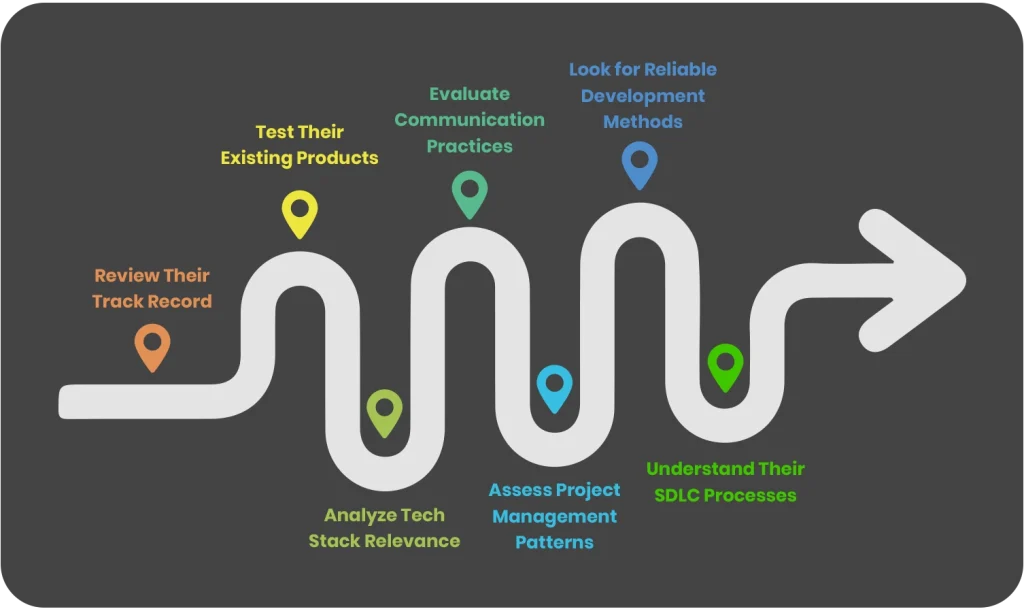
Review Their Track Record
A company’s portfolio reveals plenty if you look beyond the surface. Instead of just scanning testimonials, investigate the “why” behind their builds. Have they managed intricate, high-stakes systems or only basic applications? Look for evidence of long-term client partnerships and products that successfully reached the market. Consistency over time is the best indicator of future performance.
Test Their Existing Products
If possible, interact with software they have previously delivered. Explore the interface and pay attention to details like load speeds and intuitive navigation. Real products reveal the team’s true development habits. You want to see thoughtful features and a seamless user experience. If their past work is frustrating to use, it is a warning sign you should not ignore.
Analyze Tech Stack Relevance
Technology should serve the product, not the vendor’s convenience. Some teams rely on outdated or overly niche stacks to create “vendor lock-in,” making it difficult for you to switch providers later. A trustworthy partner selects technology based on your specific scalability needs. If they can explain their recommendations in plain language, it indicates they truly understand the strategic impact of their tools.
Evaluate Communication Practices
This factor is critical yet frequently overlooked. Observe their communication style during the initial consultation. Are they actively listening or simply pitching? A team that asks deep, probing questions is demonstrating an interest in your success. They should be honest about timelines and potential risks. Transparent communication at the start is the only way to avoid expensive misunderstandings once coding begins.
Assess Project Management Patterns
Disciplined management prevents a project from descending into chaos. Inquire about their process for planning sprints, tracking progress, and integrating your feedback. Use of professional tools like Jira or Slack shows a commitment to transparency. Regular updates and frequent demos ensure you remain in control of the budget and the timeline, which is a priority for every business owner.
Look for Reliable Development Methods
Whether they utilize Agile or a hybrid model, the specific methodology matters less than their commitment to it. Software requirements often evolve, and the right partner adapts to those changes through frequent feedback loops. They should never disappear for weeks at a time. The process should feel like a transparent collaboration rather than a “black box” where you wait in the dark for a final reveal.
Understand Their SDLC Processes
A reputable provider follows a structured Software Development Life Cycle. This journey spans from requirement gathering and architecture to rigorous testing and long-term maintenance. This framework ensures that vital steps, particularly security and quality assurance, are never bypassed. If a company rushes into coding without a clear roadmap, you will likely pay for those shortcuts later.
Supplemental Factors for Evaluating a Development Partner
Once you have verified the technical fundamentals, a secondary layer of criteria exists that often determines the daily quality of your experience. These factors provide deeper insight into how well a provider aligns with your operational style and long-term business objectives.
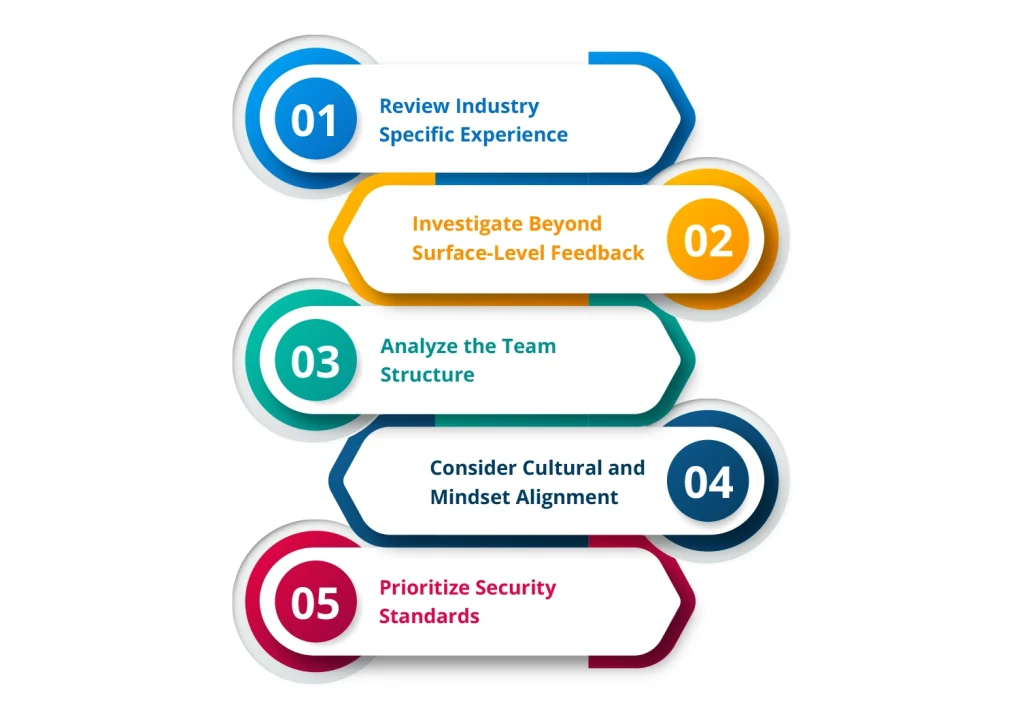
Review Industry-Specific Experience
While not always mandatory, a team familiar with your sector offers a significant advantage. They likely already understand common user behaviors and the specific hurdles unique to your market. This prior exposure results in less time spent on basic explanations and fewer “rookie mistakes” during the build. Often, this translates to more insightful feature suggestions and a faster path to launch.
Investigate Beyond Surface-Level Feedback
Client testimonials reveal the reality of working with a firm after the initial sales pitch ends. Look for recurring patterns in reviews rather than seeking perfect scores. Are clients satisfied with the team’s responsiveness and problem-solving agility? Consistent feedback provides a realistic glimpse into how the provider behaves when deadlines are tight and expectations are high.
Analyze the Team Structure
Understanding the internal organization of your project is vital for accountability. Verify that there is a dedicated project manager assigned to your account. Inquire whether roles for designers and quality assurance (QA) testers are clearly defined or if responsibilities are loosely managed. A structured team ensures you know exactly who is responsible for each deliverable, which indicates that the company is organized enough to scale alongside your project.
Consider Cultural and Mindset Alignment
This factor is subtle yet influential. Cultural alignment affects everything from design aesthetics to communication nuances. A partner that understands your target audience and business philosophy is more likely to build a product that feels authentic to your brand. This shared perspective reduces the risk of misinterpretation and prevents the frustration of realizing too late that the developers do not understand how your users think.
Prioritize Security Standards
Security should be a priority for your developer even if it is not currently your primary focus. Regardless of your industry, inquire about their protocols for data protection and secure authentication. Mature companies take code reviews and compliance seriously from the first day. Strong security practices do not just protect your users; they safeguard your brand reputation and ensure future growth is built on a stable foundation.
Essential Red Flags for Vetting Development Firms
Warning signs are often subtle during the initial stages of vendor evaluation. Seemingly minor issues, such as delayed communication or overly optimistic promises, often hint at deeper operational or technical flaws that will inevitably surface later in the project lifecycle.
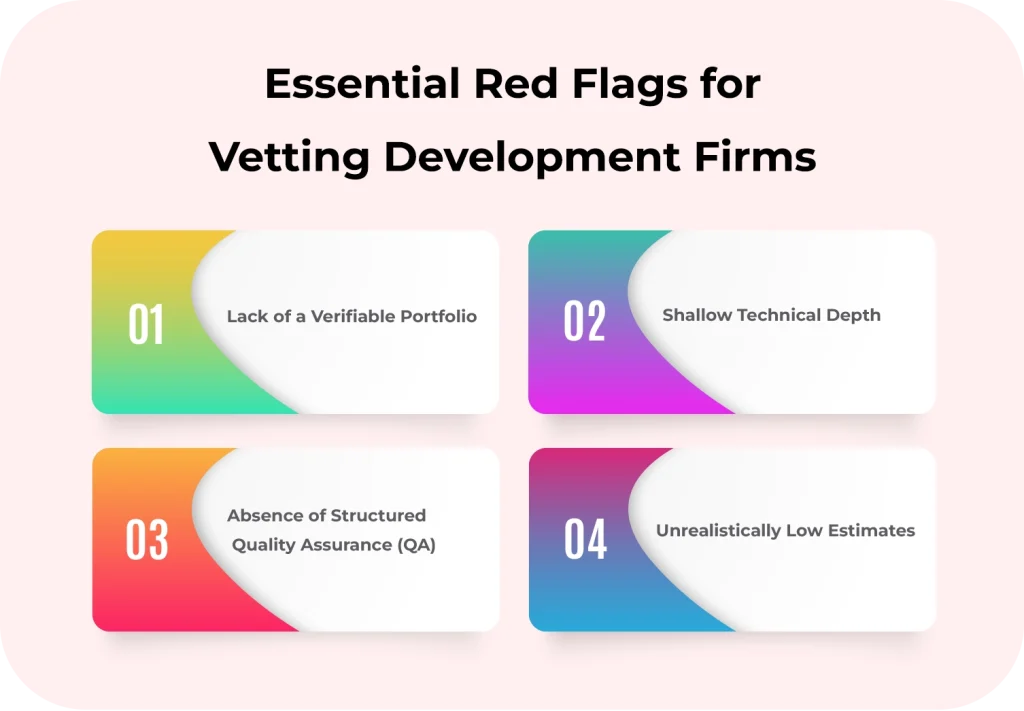
Lack of a Verifiable Portfolio
A provider that cannot clearly demonstrate their past work represents a significant risk. A reputable portfolio does not necessarily need to be vast, but it must showcase real-world projects and measurable outcomes. Detailed case studies and live applications carry far more weight than generic prototypes or screenshots. If their work history feels vague, it is likely that the team lacks the practical experience they claim.
Shallow Technical Depth
You do not need to be a developer to sense a lack of technical expertise. Pay attention to vague responses or an inability to answer fundamental questions about system architecture and scalability. A proficient team can simplify complex concepts without being condescending or dismissive. If they struggle to explain the “how” and “why” behind their technical choices, their expertise may be thinner than their marketing suggests.
Absence of Structured Quality Assurance (QA)
Bypassing rigorous testing is a guaranteed way to deliver a broken product. If a vendor fails to mention specific QA cycles or testing methodologies, consider this a major warning. Testing is the only way to ensure software functions reliably across different devices and remains stable under real-world usage. A company that treats QA as an afterthought will almost certainly cost you more in post-launch bug fixes.
Unrealistically Low Estimates
While cost is always a factor, extremely low pricing in software development usually masks significant compromises. Be cautious of quotes that seem disconnected from market reality, such as a complex mobile application offered for a fraction of the standard rate. These “deals” often involve junior developers, rushed timelines, poor documentation, and non-existent post-launch support. Quality engineering requires time and talent. If a quote feels too good to be true, it is essential to ask exactly what is being sacrificed to reach that price.
Conclusion
Selecting a reliable software development company requires a structured evaluation rather than a decision based on cost or promises alone. The right partner demonstrates proven experience and a strong commitment to quality and accountability.
By focusing on these criteria, businesses can reduce project risk and improve delivery predictability. When building custom software, enterprises should build long-term partnerships that support evolving technical and business requirements. A well-chosen development company does more than deliver software; it becomes a trusted extension of your organization, capable of supporting growth and operational stability.
Frequently Asked Questions
How do I know if a software development company is reliable?
A reliable software development company demonstrates consistent delivery through a proven track record and transparent communication. Indicators of reliability include documented case studies, regular progress updates, and a clear approach to testing and post-launch support.
Is cost the most important factor when choosing a custom software development company?
Cost is an important consideration, but it should not be the primary deciding factor. Extremely low pricing often leads to compromised quality and higher long-term maintenance costs. A balanced evaluation should consider technical expertise and the company’s ability to deliver scalable and maintainable software.
Why is SDLC important when selecting a software development partner?
The custom Software Development Life Cycle (SDLC) ensures that software is built through a structured process. It covers requirements analysis, design, development, testing, deployment, and maintenance. A company that follows a clear SDLC is more likely to deliver stable and scalable software.