
Ever felt the biggest wave of FOMO when everyone is secretly leveling up their business with smart tech while you’re still trying to figure out why your Wi-Fi is still so slow?
The Internet of Things is no longer something from the future. Neither is it reserved for sci-fi movies. It’s becoming a part of everyday operations and automating tasks you didn’t even know could be automated. And if you’ve ever wished your systems could just make life easier without you having to do anything, you’re already halfway into the IoT sector. So, let’s break this down and walk through IoT software development from a beginner’s lens.
What is IoT Software?
Think of IoT software as the “brain” that helps everyday devices act a little smarter than they look. It’s the layer that lets your gadgets collect data and actually do something useful with all that information.
Whether it’s your AC adjusting itself before you get home or a delivery van automatically sharing its live location, IoT software is what makes all that happen. It connects the physical world to the digital one, so your devices participate in their existence.
How does Traditional Software Development Differ from IoT Software Development?
Building IoT software is a whole different vibe compared to regular app or web development. They have their own set of rules.
| Traditional Software Development | IoT Software Development |
| Runs on computers, phones, or browsers | Runs on physical devices + cloud + apps |
| Mostly a software-only environment | Mix of hardware, sensors, and software |
| Stable networks assumed | Must handle unstable, low-power networks |
| Focuses on UI, logic, and backend | Focuses on data collection, device control, and communication |
| Testing is predictable and controlled | Testing includes hardware behavior and real-world conditions |
| Security focuses on the app or server | Security extends to devices, networks, and data transmission |
| Easier scalability | Scaling requires managing thousands of devices in sync |
| Updates delivered through app stores or servers | Updates often need OTA firmware delivery |
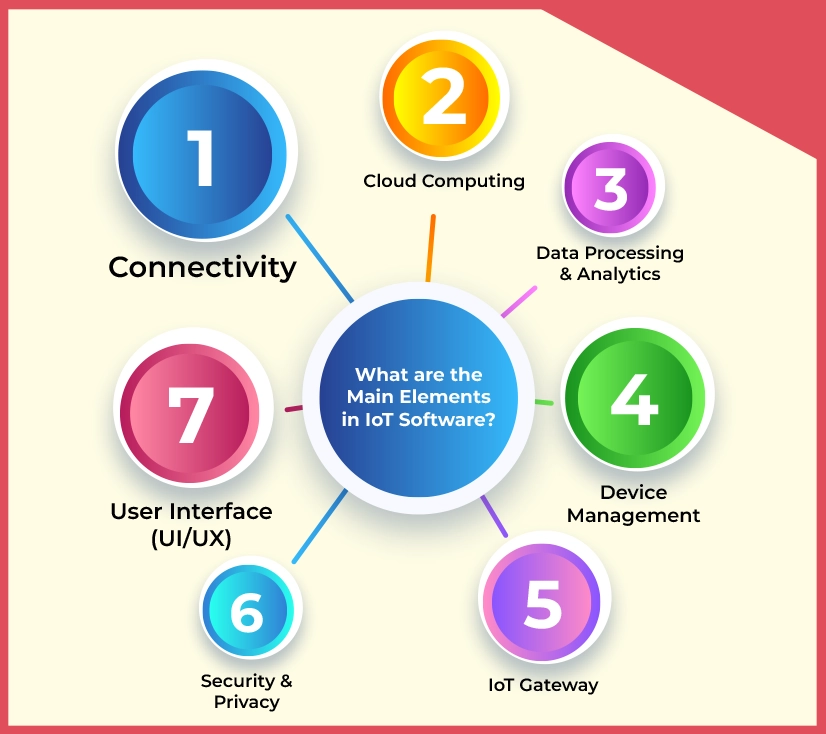
What are the Main Elements in IoT Software?
Once you understand what IoT software’s purpose is, you’ll automatically understand the main elements. It’s basically technology that enables smooth communication and interaction between hardware devices and the cloud. The main elements make up IoT technology.
Connectivity
Connectivity is literally what IoT is all about. It’s what allows devices and apps to constantly exchange data without you realizing there’s an entire digital conversation happening in the background. Whether it’s Wi-Fi or Bluetooth, the right connectivity ensures real-time updates and reliable communication.
Cloud Computing
The cloud is where all the heavy processing happens. Once devices collect data, the cloud stores and processes it, and makes it usable for apps or dashboards. It’s what makes IoT scalable. This means you can add more devices without blowing up your system. Plus, the cloud lets everything run remotely.
Data Processing & Analytics
IoT devices generate a lot of raw data. Processing and analytics turn that messy, chaotic information into insights that actually matter. This includes detecting patterns and triggering automated and accurate actions. It’s basically what transforms data into decisions for better operations.
Device Management
Imagine having thousands of devices out in the real world, all needing updates and maintenance. Device management is what keeps things organized. It helps control and update devices remotely, even if it’s firmware. Without this layer, IoT devices would be unmanageable and confusing.
IoT Gateway
The gateway acts like a translator and traffic controller between devices and the cloud. It filters data and ensures everything reaches where it should without blocking the network. It basically keeps things running smoothly by ensuring that your devices perform the right tasks at the right times.
Security & Privacy
IoT expands your digital footprint, which means more opportunities for cyber troublemakers. That’s why strong security is non-negotiable. From encrypted communication to secure boot processes and access control, this layer protects both the devices and the data. Privacy features also ensure that user information isn’t exposed or misused.
User Interface (UI/UX)
All the behind-the-scenes tech won’t matter if the user experience feels like rocket science. UI/UX is the part humans interact with, like mobile apps and dashboards. A clean and intuitive interface helps users understand device data and control systems easily. The goal is to enjoy the convenience IoT promises without any learning curve.
What’s the Step-By-Step Process for Internet of Things Software Development?
Building IoT software isn’t like building a regular app; you’re basically creating an entire ecosystem where devices and cloud platforms all need to work in perfect harmony. That’s why the development process has to be structured and a little extra careful.
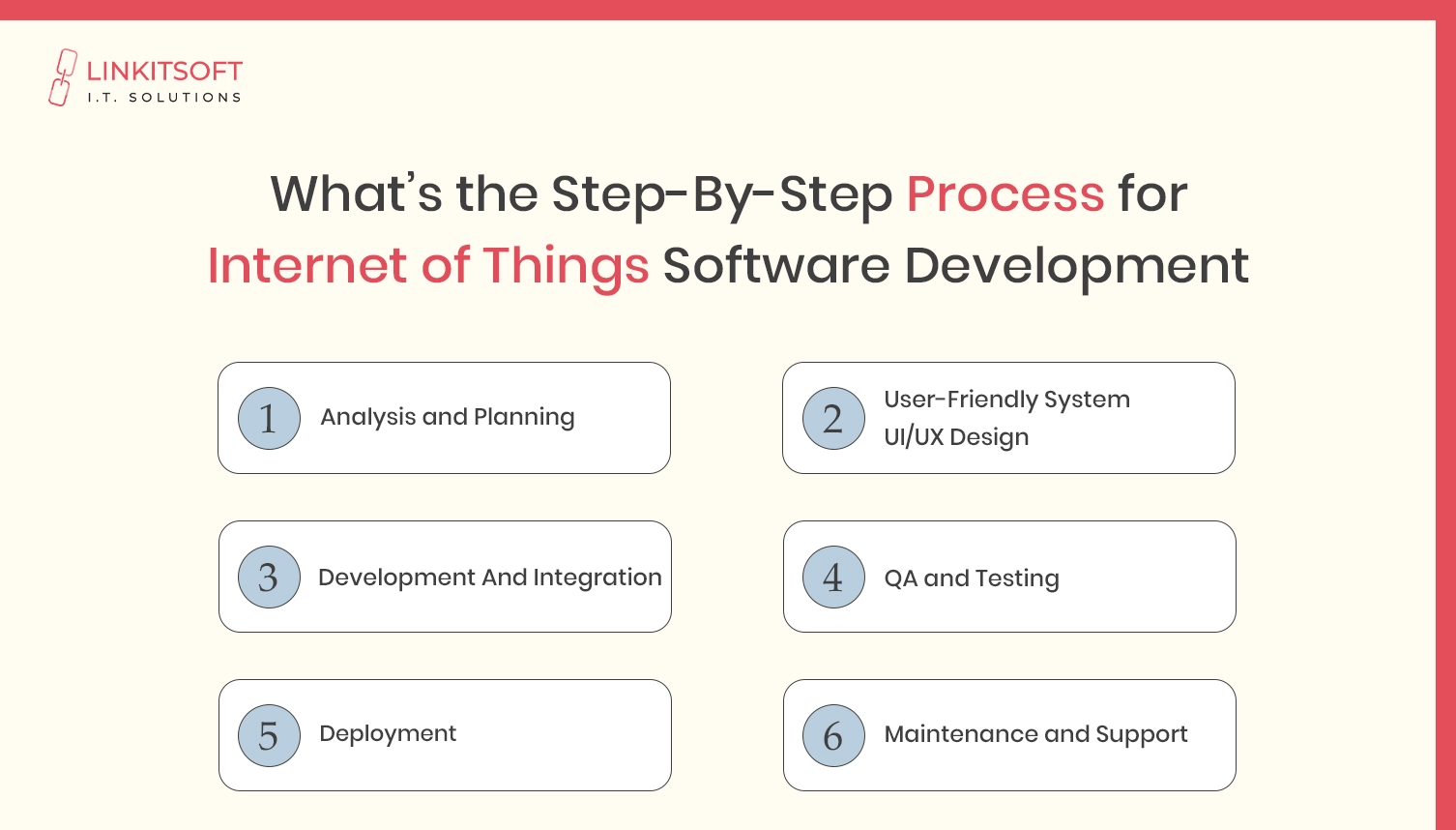
Analysis and Planning
This is where everything starts. The team defines the problem and maps out the system architecture. It’s also the stage where developers choose the tech stack and figure out connectivity options. This way, you are able to set realistic timelines. Basically, you’re laying out the blueprint so there are no surprises later.
User-Friendly System UI/UX Design
Even if the backend is complex, the user experience shouldn’t be. This step focuses on designing dashboards or control panels that are simple and easy to understand and navigate. It’s all about giving users clear visuals and intuitive controls. This is because complicated IoT systems don’t need complex interfaces.
Development And Integration
The real technological transformation begins here. Developers create the backend systems and cloud components. They also integrate devices and gateways alongside any other requirements. Everything is built in pieces and connected together so the entire system communicates seamlessly in real time.
QA and Testing
IoT testing is more intense than regular software testing. Along with software tests, devices are checked for connectivity stability and sensor accuracy. They’re also tested for security gaps and real-world behavior. The goal is to make sure both the hardware and software work flawlessly together before going live.
Deployment
Once the system passes testing, it’s ready to be deployed into the real world. This includes configuring devices and connecting them to the cloud. Then they set up user apps and ensure that the environment is stable. Developers also monitor early usage data to make sure everything is running smoothly.
Maintenance and Support
IoT systems are relatively new, which means they’re constantly evolving. Devices need firmware updates, and dashboards need improvements. If that wasn’t enough, there are new features to add over time. Maintenance ensures everything stays optimized and functional. This is because in IoT, the job doesn’t end at launch; it actually begins there.
What are the Best Practices to Follow in Internet of Things Software Development?
IoT software isn’t something you build casually. It needs to be reliable and secure because it’s constantly interacting with the real world. Following the right best practices makes sure your system works, but works smoothly and long-term.
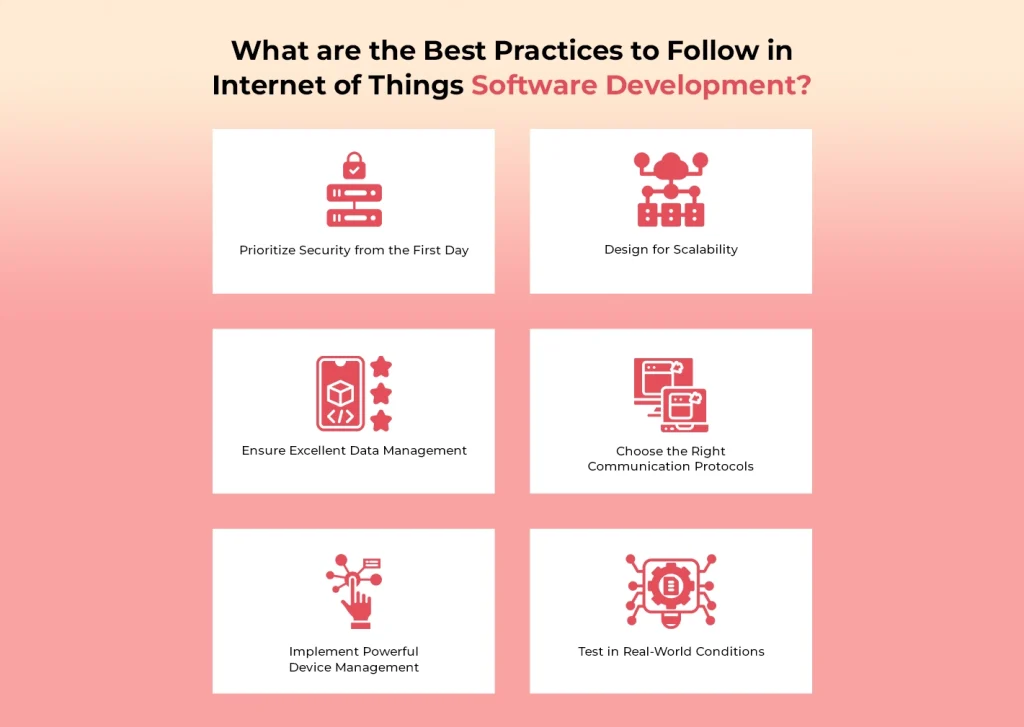
Prioritize Security from the First Day
In IoT, security is a serious matter. Devices and cloud layers all need protection from cyberattacks. This means using encryption and strong authentication methods right from the start. The earlier you build security in, the harder it is for vulnerabilities to sneak through.
Design for Scalability
IoT systems often start small but can quickly grow into hundreds or thousands. That’s why the architecture should support easy expansion. Scalable databases and modular components help you add more devices without rebuilding the entire system from scratch.
Ensure Excellent Data Management
IoT devices generate a huge and continuous stream of data, and not all of it is useful. Good data management ensures the system captures and filters data properly so it knows how to store the right information. Clean data means better insights and less pressure on storage and bandwidth.
Choose the Right Communication Protocols
Different IoT systems have different communication needs. You have to choose the protocols according to what your devices will be doing. Some require low power, others need high-speed data transfer. Choosing protocols like Bluetooth or 5G can ensure smoother and more reliable device-to-device interaction.
Implement Powerful Device Management
With the Internet of Things, you’re dealing with a mix of firmware and cloud components. Strong device management helps monitor performance and keep everything in sync. It’s the base that keeps large IoT ecosystems healthy and manageable.
Test in Real-World Conditions
IoT devices don’t live in clean lab environments. They deal with heat, weak networks, and even face some unpredictable behavior. Testing under real conditions ensures your system can handle actual stress. It should be capable of surviving environmental changes and inconsistent connectivity before it gets to your users.
Conclusion
Stepping into Internet of Things software development may feel overwhelming at first, but once you understand how the pieces fit together, it becomes a powerful way to transform ordinary processes into automated systems. As devices and data work in sync, businesses can achieve smoother operations and smarter user experiences.
Frequently Asked Questions
Which Tech Stack is best for IoT Software Development?
There isn’t just one tech stack in IoT, but a solid setup usually starts with languages like C or Python. On the backend, developers often use Node.js or Java.
For communication, IoT apps depend on protocols such as MQTT and HTTP, while cloud platforms like AWS IoT and Google Cloud IoT help with storage and device management.
Which Industries are Benefiting the Most from IoT Software Development
IoT is everywhere, even where you don’t notice. Industries leading the pack include healthcare, manufacturing, transportation, retail, and agriculture. These industries rely a lot on automation and real-time monitoring, which is exactly what IoT is built for.
How Long Does it Take to Build IoT Software?
IoT development usually takes longer than regular software development because you’re building both the software and the device communication layer. A simple IoT software can take around 3–6 months, while more complex systems can take 9–18 months.
How Do I Know My Business Needs IoT Technology?
You’re ready for IoT when your operations start relying heavily on manual monitoring, or you want to automate tasks without hiring thousands of employees.