Mobile app development in 2026 is entering a new phase driven by artificial intelligence, ultra-fast connectivity, and platform efficiency. Businesses are no longer competing on features alone. Performance, scalability, security, and cost optimization now directly determine market success.
As mobile ecosystems grow more complex and user expectations continue to rise, companies must adopt technologies that reduce time to market, improve retention, and deliver measurable long-term return on investment. Trends such as edge intelligence, cross-platform development, privacy-by-design architecture, and automation-driven workflows are no longer optional for sustainable growth.
This article explores the most important mobile app development trends in 2026, explaining what is changing, why it matters, and how businesses and development teams can align their mobile app strategy for long-term success.
Why Does Keeping Up with Mobile App Trends Matter?
Mobile apps have become a core component of modern digital strategy. In 2026, mobile applications influence customer acquisition, operational efficiency, and brand perception across nearly every industry.
Staying aligned with current development trends allows teams to build applications that scale efficiently, meet evolving user expectations, and remain competitive in saturated marketplaces. Organizations that fail to modernize their mobile stack often experience higher maintenance costs, slower feature delivery, and declining user engagement.
Keeping up with mobile app development trends enables businesses to:
- Improve user retention through intelligent personalization and responsive interfaces
- Reduce long-term development costs by adopting scalable architectures
- Accelerate product launches through shared codebases and automation
- Meet evolving security and privacy regulations without costly rework
- Remain competitive as performance and experience standards continue to rise
The future of mobile apps is not defined by adding more features. It is defined by delivering smarter experiences that align with real user needs and business goals.
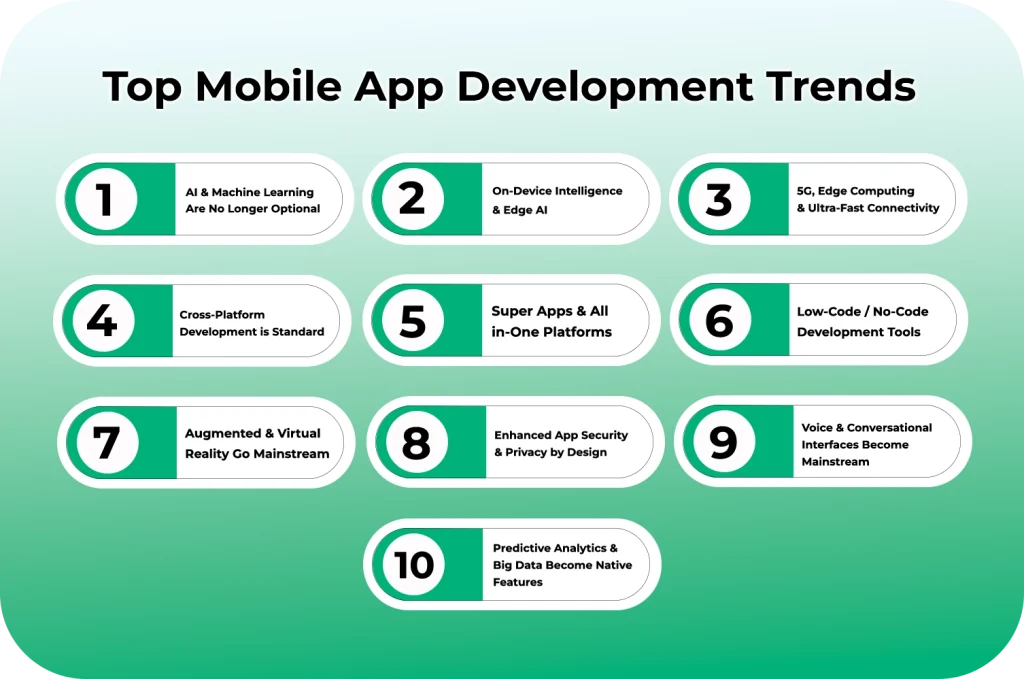
Top Mobile App Development Trends in 2026
Below are the most impactful mobile app development trends shaping product strategy, architecture, and delivery in 2026.
AI & Machine Learning Are No Longer Optional
Artificial intelligence is the most transformative force shaping mobile app development in 2026, moving beyond experimentation into core product architecture. It results in powerful tools such as personalization, predictive behavior, automation, and more.
Key AI features include:
- Personalized content recommendations based on real behavior
- Predictive analytics that anticipate user needs
- Virtual assistants and smart chatbots
- Automated workflows and contextual UI adaptation
- Image and voice recognition integrated at the system level
Industry forecasts show 40% of enterprise apps will include task‑specific AI agents by the end of 2026. This is up significantly from just 5% in 2025. It indicates an eightfold increase in AI adoption in a single year.
Organizations are embedding AI directly into mobile app architecture to optimize personalization, automate workflows, and improve decision-making at scale. The focus has shifted from experimental AI features to task-specific intelligence that delivers measurable business outcomes.
On‑Device Intelligence & Edge AI
Edge AI refers to executing machine learning tasks directly on the user’s device rather than relying entirely on cloud-based processing. This architectural shift significantly reduces latency, improves reliability, and enhances user privacy.
Benefits of on‑device intelligence include:
- Faster response times
- Lower latency (no network delay)
- Improved data privacy and security
- Offline functionality for key features
In 2026, an estimated 90% of new mobile apps will include AI capabilities. A significant portion of that will involve performing AI tasks directly on devices. This trend is especially important for industries handling sensitive data. This trend is especially critical for regulated industries such as healthcare and financial services, where latency, reliability, and data privacy are non-negotiable.
For businesses, on-device intelligence reduces cloud dependency, lowers infrastructure costs, and enables real-time experiences even in limited connectivity environments. This makes edge AI especially valuable for applications operating in regulated or latency-sensitive industries.
5G, Edge Computing & Ultra‑Fast Connectivity
The expansion of 5G networks globally is a fundamental shift for mobile app development. With higher bandwidth and faster download speeds, 5G allows:
- Real‑time multiplayer gaming
- High‑definition streaming without buffering
- IoT‑centric applications
- Rich AR/VR experiences
- Cloud‑powered processing with near‑zero lag
In 2026, applications designed specifically for 5G environments unlock new categories of real-time interaction. Developers are increasingly building mobile apps that assume high bandwidth and low latency as a default, enabling richer experiences that were previously impossible on mobile devices.
For businesses, 5G-optimized applications enable real-time engagement, richer user interactions, and faster data processing, directly supporting higher retention, new revenue models, and scalable digital services.
Cross‑Platform Development is Standard
In 2026, developing separate codebases for iOS and Android is fading. Frameworks like React Native and Kotlin Multiplatform are increasingly the default choice for many teams.
Benefits of cross‑platform development include:
- Unified codebase for multiple platforms
- Faster time‑to‑market
- Lower development and maintenance costs
- Consistent UX across devices
It is estimated that around 70% of new apps in 2026 will be built cross‑platform. Modern cross-platform frameworks now offer near native performance while significantly reducing development effort. As a result, businesses are prioritizing shared codebases to improve maintainability, shorten release cycles, and ensure consistent user experiences across platforms.
Super Apps & All‑in‑One Platforms
Super apps have been popularized by WeChat, Grab, and others. They combine multiple services into a single digital ecosystem.
Typical super‑app features include:
- Messaging
- Payments and wallets
- E‑commerce
- Social networking
- On‑demand services
Rather than managing multiple fragmented applications, users increasingly prefer consolidated platforms that centralize services within a single ecosystem.
For businesses, super app architectures reduce user churn by increasing engagement within a single ecosystem. However, successful implementation requires careful planning around scalability, modular architecture, and long-term feature expansion.
Low‑Code / No‑Code Development Tools
Low-code and no-code platforms are increasingly used to accelerate development rather than replace traditional engineering. In 2026, these tools will be commonly integrated into mobile development workflows for rapid prototyping, internal tools, and MVP validation.
Benefits include:
- Rapid prototyping and deployment
- Reduced dependency on large developer teams
- Lower development costs
- Easy iteration based on real‑world feedback
In fact, projections suggest that 75% of new apps in 2026 will add low‑code technology at some stage of development.
This shift is particularly impactful for startups and small businesses that want to launch MVPs or experiment without heavy investment.
Augmented & Virtual Reality Go Mainstream
AR and VR are moving far beyond gaming. Market projections estimate the AR and VR industry could reach nearly $2 trillion by 2035. It will do this while underscoring the broad opportunity beyond basic entertainment.
In 2026, these technologies will play major roles in:
- Retail (virtual try‑on and product visualization)
- Education (interactive learning environments)
- Training simulations in healthcare and industrial sectors
- Spatial computing experiences on mobile devices
As mobile hardware improves, AR and VR applications are becoming more practical beyond entertainment. Businesses are adopting immersive experiences to improve customer engagement, training efficiency, and product visualization across multiple industries.
While AR and VR adoption varies by industry, mobile-first immersive experiences are increasingly used where visualization, training, or engagement directly impacts business outcomes.
Enhanced App Security & Privacy by Design
Mobile devices are handling more sensitive data than ever. Security and privacy are foundational requirements for mobile apps in 2026. With increasing regulatory scrutiny and growing user awareness, applications must be designed with security controls embedded directly into the architecture rather than added later.
Apps in 2026 must be secure by design with:
- End‑to‑end encryption
- Biometric and passkey authentication
- Compliance with regulations like GDPR and CCPA
- Minimal data collection and transparent permission flows
Security is essential not just for regulatory compliance but also for building user trust. Both of them are critical for retention and monetization.
Voice & Conversational Interfaces Become Mainstream
Voice in apps isn’t just a novelty anymore; it’s part of how users interact with apps. As natural voice technology improves, mobile apps become more accessible.
The modern apps in 2026 are increasingly adopting:
- Hands‑free voice commands
- Contextual voice search
- Conversational UIs powered by generative AI
- Voice‑enabled workflows and automation
Voice interfaces improve accessibility, reduce friction, and enable faster task completion. As conversational AI matures, voice-driven interactions are becoming a standard component of modern mobile user experiences.
Predictive Analytics & Big Data Become Native Features
Apps in 2026 are increasingly proactive, using predictive analytics to anticipate user behavior and optimize engagement in real time. Using predictive analytics that are powered by AI and machine learning apps can do a lot.
Moreover, they can anticipate:
- User needs based on behavioral data
- Content delivery that maximizes engagement
- Personalized promotions or recommendations
- Real‑time suggestions that increase conversion rates
Predictive analytics allows mobile apps to move from reactive behavior to proactive engagement. By anticipating user needs, businesses can improve conversion rates, personalize experiences, and make data-driven decisions in real time.
Challenges Developers Must Manage in 2026
While the future of mobile apps is exciting, developers face persistent challenges. Successfully managing these challenges requires strategic planning, architectural discipline, and continuous optimization. Teams that address performance, security, and scalability early are better positioned to build resilient and future-ready mobile applications.
Key challenges in 2026:
- Balancing complex features with performance constraints: With AI, AR, VR, and cloud integration becoming standard, developers get a new responsibility. They now have to ensure that apps remain fast and lightweight.
- Ensuring data privacy and regulatory compliance: Users demand transparency and control over their data. Apps definitely need to comply with regulations such as GDPR and HIPAA.
- Designing for diverse devices and screen formats: The ecosystem now includes foldable devices and wearables. Designing responsive interfaces that adapt seamlessly across multiple devices is crucial.
- Maintaining security in an era of AI threats: With AI capable of sophisticated attacks, apps must proactively detect and prevent vulnerabilities.
By planning for these challenges early, development teams can avoid costly setbacks. In this way, they are able to ensure that apps remain highly secure and user-friendly.
Conclusion
Mobile app development in 2026 is defined by intelligent automation, platform efficiency, and user-centric design. Trends such as artificial intelligence, edge computing, cross-platform development, and privacy by design are reshaping how mobile applications are built and scaled.
Rather than adopting every new technology, businesses must focus on selecting trends that align with their product goals, user needs, and long-term growth strategy. Organizations that prioritize performance, security, and scalability will be best positioned to deliver mobile experiences that users trust and rely on.
The most successful mobile apps in 2026 will be built by teams that prioritize strategic alignment over trend adoption, focusing on technologies that deliver clear user value and sustainable business growth.
Frequently Asked Questions
What happens when you don’t follow the latest mobile app development trends?
Your app quickly becomes outdated, and users are more likely to migrate toward competitors offering faster, more intelligent, and better-optimized experiences. In 2026, user expectations are rising. The moment an app introduces something new, your users and the market start expecting it from you.
Are AI and no-code apps secure and reliable?
Yes, when you build apps using modern frameworks with proper hosting and security, AI apps are reliable. Most teams upgrade architecture as users and traffic grow, which ensures easy scalability as well.
Can any industry follow the latest trends in mobile app development 2026?
Yes, any industry can follow the latest mobile app development trends. However, this does not mean that every industry should. Some trends are entirely irrelevant, while some of them are very helpful. If you’re thinking about incorporating them, just remember to strike a balance in what your app needs to have and when you are going overboard.
How do businesses decide which mobile app trends to adopt?
Businesses should evaluate trends based on user value, implementation cost, scalability, and long-term ROI rather than popularity alone.
Do cross-platform apps perform as well as native apps in 2026?
Modern frameworks offer near native performance for most use cases, making cross-platform development a viable choice for many applications.
Is edge AI suitable for all mobile apps?
Edge AI is most effective for apps that require low latency, offline functionality, or enhanced data privacy. Not all applications require on-device intelligence.