Custom software is changing fast, and it doesn’t look like it’s slowing down anytime soon. Every year brings new tools, frameworks, and ways to build applications, and 2026 will be no different. If teams don’t keep up, they risk falling behind before they even know it.
At the same time, custom software is becoming more important than ever. Businesses don’t just want software that just works. They want customised solutions that fit their processes and can grow with their needs.
In fact, the global custom software market is expected to grow from $43.16 billion in 2024 to $146.18 billion by 2030. That’s a huge jump, and it goes on to show how companies are willing to invest in software that actually solves real problems.
Users also notice the little things. A slow feature, a confusing menu, or a bug can ruin the experience. Because of this, teams that focus on building practical, dependable software always have an edge.
So, in this blog, we’re going to explore the key trends in custom software development that will shape custom software in 2026. Some of these trends are extensions of what teams are already doing. Others are bigger shifts in how software is designed, built, and maintained. Either way, understanding these trends now can give your team a competitive edge and put you ahead as the industry evolves.
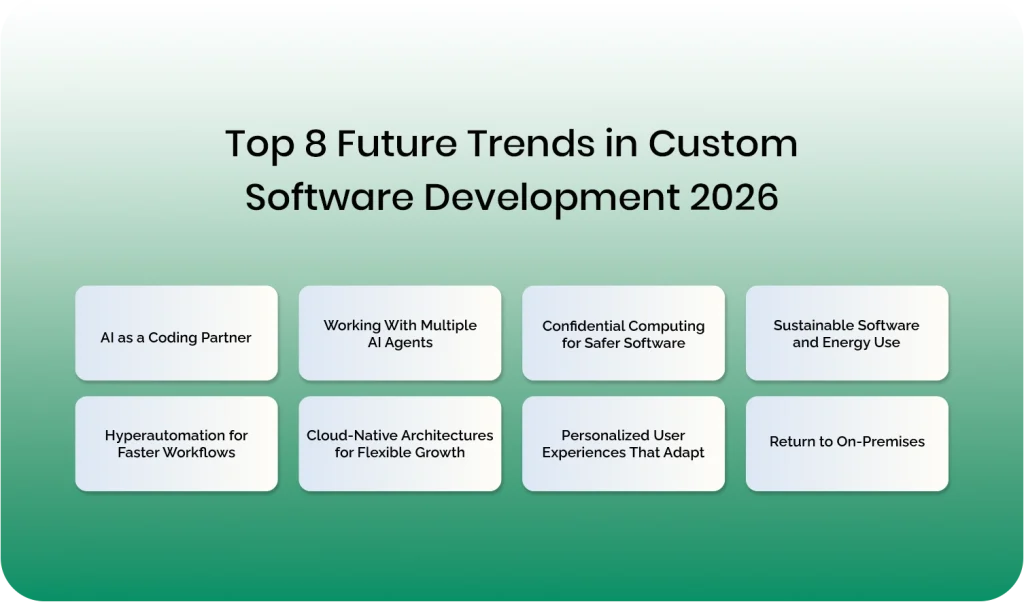
1. AI as a Coding Partner
Tools that help developers write and check code are becoming a regular part of daily work. A recent report found that nine out of ten developers already use them to speed up coding and reduce mistakes.
In 2026, more teams will rely on these AI helpers to manage repetitive tasks, so devs can focus on building software that meets specific business needs.
Most developers use simple AI features daily. For example, chat-style suggestions in coding tools or automatic text completion inside the code editor are the most common. These features are easy to use and fit naturally into normal workflows. More advanced tools that can handle bigger parts of a project are still rare, but interest is growing.
There is a risk if developers rely too much on these helpers. Teams may know that code works, but not fully understand why. This can make debugging, adding new features, or maintaining software harder. The trend in 2026 is about using these tools wisely to save time while keeping control over how custom software is designed, built, and maintained.
2. Working With Multiple AI Agents
Custom software is starting to use several AI agents instead of just one doing everything. Each agent has a specific job. One looks at the data, another studies it, another talks to users, and another makes decisions. It’s like a small team, but all digital.
This way of working is expected to grow fast. By 2027, most systems will have agents that focus on one task. This makes the system more accurate. At the same time, teams need to make sure the agents work well together and check that everything runs smoothly.
In 2026, multi-agent systems will be more useful for custom software. They can take care of routine work, giving developers more time to plan how the agents work together and solve bigger problems.
3. Confidential Computing for Safer Software
Custom software is handling more sensitive data than ever. That means protecting it isn’t just about storage or sending it safely. Teams also need to keep data safe while it’s being processed.
Experts expect that by 2026, 75% of sensitive data processed in shared or cloud environments will be protected this way. This is a big shift, and it changes how software needs to be built.
The very first step is using secure enclaves or trusted execution environments from cloud providers. These environments keep data encrypted even while it is being used. The tricky part isn’t speed, but making sure workflows are set up correctly. Developers need to ensure sensitive logic stays inside the protected environment and that secrets never leak out.
Lastly, security has to be part of the coding process. Now, frameworks and build tools include safe defaults. But the point is that teams still need to enforce them. Automated checks, clear rules, and verification tools make it easier to catch problems early.
So, developers can focus on building custom software for businesses that not only works well but also keeps data truly safe.
4. Sustainable Software and Energy Use
Data centers already use a lot of electricity, and the demand keeps growing. According to the International Energy Agency, by 2027, global energy consumption in data centers is expected to reach 84 gigawatts.
About 50% of that will come from cloud workloads, 27% from AI systems, and the rest from traditional computing.
This shows that as software becomes more complex and data-heavy, energy use is no longer just a background concern. It directly affects how systems are built and maintained.
At the same time, new regulations in Europe and the U.S. will require companies to report energy and emissions data. By 2026, software teams will need to understand how their systems use power, because it can affect everything from budgeting to how they design their software.
Many companies aren’t ready yet. Tracking energy use isn’t easy, and not all data centers are built for efficiency. At the same time, big cloud providers are shifting to cleaner energy. Teams that plan ahead and keep energy in mind while building software will be better prepared.
5. Hyperautomation for Faster Workflows
Hyperautomation is becoming a key trend for engineering teams in 2026. Teams are automating more tasks to keep up with faster release cycles.
According to the State of Quality 2025, 45% of mature QA teams already run automated regression tests. This shows that automation is moving from being optional to essential.
The main goal is to get rid of manual handoffs. For example, instead of waiting for someone to start a test or update a configuration, these tasks happen automatically. Tools like GitHub Actions, Jenkins, GitLab CI/CD, and CircleCI make this possible. When teams use them the right way, they can work faster and avoid mistakes, which makes their software more reliable.
Automation also allows developers to spend more time on complex problems rather than repetitive work. Therefore, teams that embrace hyperautomation will improve consistency, reduce errors, and keep up as release cycles continue to speed up.
6. Cloud-Native Architectures for Flexible Growth
Cloud computing is growing fast, and it is helping companies handle more data, apps, and online services than ever before. Tools like Kubernetes and containers make it easier to run software reliably and scale up when needed. Because of this, these tools are becoming standard for teams who want their systems to stay consistent and easy to manage.
At the same time, most companies still rely on a mix of on-site servers and cloud services. However, the push toward using the cloud more is clear. Teams are moving important workloads and data pipelines to cloud setups because it helps them respond faster to business needs while keeping operations running smoothly.
Getting this right takes careful planning. So, companies need to standardize how they deliver updates, organize key components in containers, and prepare workloads for cloud deployment.
When done well, cloud architecture makes systems easier to manage and gives teams the confidence to grow and adapt quickly.
7. Personalized User Experiences That Adapt
In 2026, personalization will be a standard for custom software. Now, people expect apps and websites to adjust to them.
For leading industries such as fintech, healthcare, and retail, this means user interfaces that change layout, suggestions, and workflows depending on the user. At the same time, accessibility and inclusive design will make sure these experiences work for everyone, regardless of their ability or environment.
The push comes from changing demographics. Gen Z now makes up more than a third of the global population, according to the UN’s World Population Prospects 2024. They grew up online, know what they want, and will leave an app or site that feels generic or slow to respond.
Because of this, companies need to design software that anticipates user needs and adapts automatically. Personalization will shape product strategies, improve engagement, and become a key factor in keeping users satisfied across all consumer-facing industries.
8. Return to On-Premises
In 2026, many companies will start moving some of their work back from the cloud to on-premises systems.
According to a 2024 IDC study cited by CIO, nearly 80% of businesses expect to get at least part of their storage or computing back on-site within a year. But, this doesn’t mean leaving the cloud completely. Instead, it’s about finding a better balance between cost, control, and meeting regulations.
The reason is clear. Some workloads, especially those that handle a lot of data or sensitive information, are cheaper and easier to manage on-premises. Teams are asking pretty straightforward questions: Is the data sensitive or regulated? Will it cost more in the cloud? Does the cloud really add value for this work?
And, if the answer is no, these workloads move back to on-site systems where costs are predictable, and control is stronger.
At the same time, companies are making sure that cloud and on-premises systems work well together. By using the same automation and container tools for both, deployments stay reliable, and security is easier to manage. In the end, the best approach in 2026 will be a mix of cloud and on-premises, using each where it makes the most sense.
Looking Ahead to 2026
The year 2026 will favor teams that make thoughtful decisions right of the bat. Custom software will shape how businesses grow, operate, and compete. Because of this, choices around software development, security, and user experience will be more important. Users now expect software that is fast, intuitive, personalised, and built around real user needs rather than workarounds.
The companies that succeed in 2026 will focus on building custom software with a clear purpose. They will create solutions that solve real business problems and reduce inefficiencies without unnecessary complexity. At the same time, they will invest in strong development practices and skilled teams so their software can grow as the business grows. With this approach, businesses will not only keep pace with change but set the direction for others to follow.
Frequently Asked Questions
Why are custom software development trends for 2026 important?
Because software decisions made today decide how stable your business will be tomorrow. Custom software development trends do not work overnight. They need planning and time. When teams delay, they end up fixing things in a rush, which costs more and creates problems later.
Do businesses need to follow every custom software development trend?
No. Every business is different. Some need faster systems, some need better security, and others need software that can grow with them. The smart move is to focus only on the custom software development trends that solve your actual business problems.
How Linkitsoft helps businesses prepare for 2026?
Linkitsoft helps businesses improve and build custom software that fits their goals. The focus stays on clean systems, better performance, and software that is easier to manage as the business grows.
Can existing custom software be improved without rebuilding it?
Yes. In many cases, Linkitsoft upgrades existing custom software instead of replacing it. This includes improving speed, adding needed features, and fixing weak areas without interrupting daily work.