

Moving to the cloud can improve performance, reduce costs, and help businesses scale faster. But the process is not as simple as shifting data from one system to another.
That’s where a cloud migration strategy comes in. It provides a clear plan for moving applications and data to the cloud in a safe and structured way. In this guide, we’ll break down what a cloud migration strategy is, how it works, and the key methods to use to make the transition efficient for businesses.
What a Cloud Migration Strategy Really Means?
A cloud migration strategy is a step-by-step plan. It explains how a business moves its data, applications, and systems from on-premise servers to a cloud platform like AWS, Azure, or Google Cloud. It is not just about moving everything at once. It is about deciding what to move, when to move it, and how to move it safely.
This process also looks at system dependencies, security, downtime risk, and cost control. In simple terms, it is a roadmap that helps businesses shift from traditional IT systems to cloud-based infrastructure in a planned and controlled way.
Why Companies Are Moving to the Cloud?
As companies grow, they need faster performance, easier updates, and better control over costs. Traditional systems often struggle to keep up with these needs. Cloud platforms offer a more flexible and scalable way to run applications and store data, which is why this shift has become so common today.
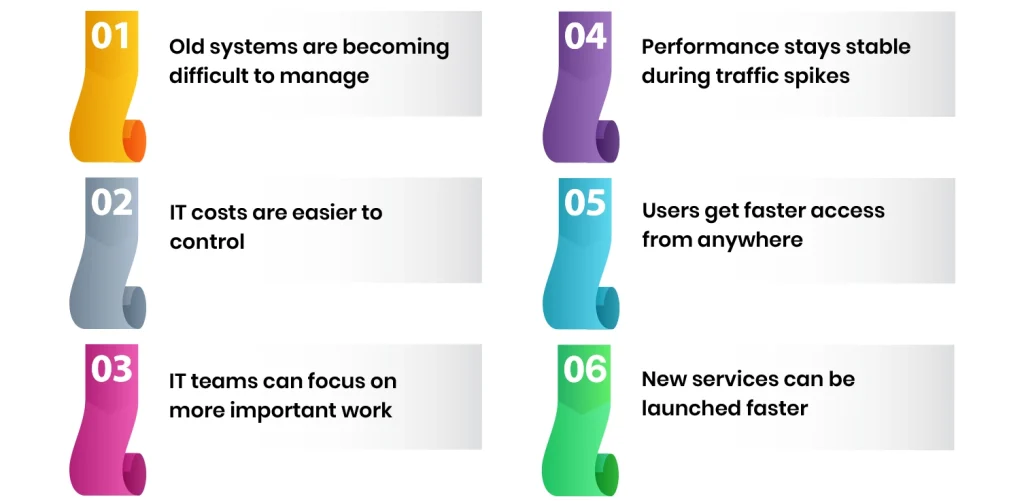
Old systems are becoming difficult to manage
A lot of companies still rely on older software and infrastructure. These systems take more time to update and maintain. Even small changes can feel slow and costly. Cloud platforms make this process easier and more flexible.
IT costs are easier to control
Traditional systems depend on physical servers. This means hardware costs, maintenance, and power usage all add up. Cloud computing removes most of these fixed expenses. Businesses can also scale usage based on what they actually need.
IT teams can focus on more important work
In older setups, IT teams spend a lot of time monitoring systems and fixing issues. Cloud platforms reduce this workload because the provider handles most of the infrastructure work. This gives teams more time to focus on development and improvements.
Performance stays stable during traffic spikes
Websites and applications often experience sudden increases in users. On-premise systems can slow down or struggle during these moments. Cloud systems automatically adjust resources to keep performance stable.
Users get faster access from anywhere
When systems run from a single location, users far away may experience delays. Cloud platforms solve this issue by using multiple regions around the world. This helps improve speed and reduces waiting time.
New services can be launched faster
Setting up traditional infrastructure takes time. New hardware, configurations, and approvals slow things down. Cloud systems remove many of these steps, allowing businesses to launch products and updates much faster.
Cloud Migration Strategies: The 6 Rs
Enterprise environments consist of multiple apps with different dependencies, architectures, and performance requirements. To manage this complexity, firms typically follow the “6 Rs” migration framework.
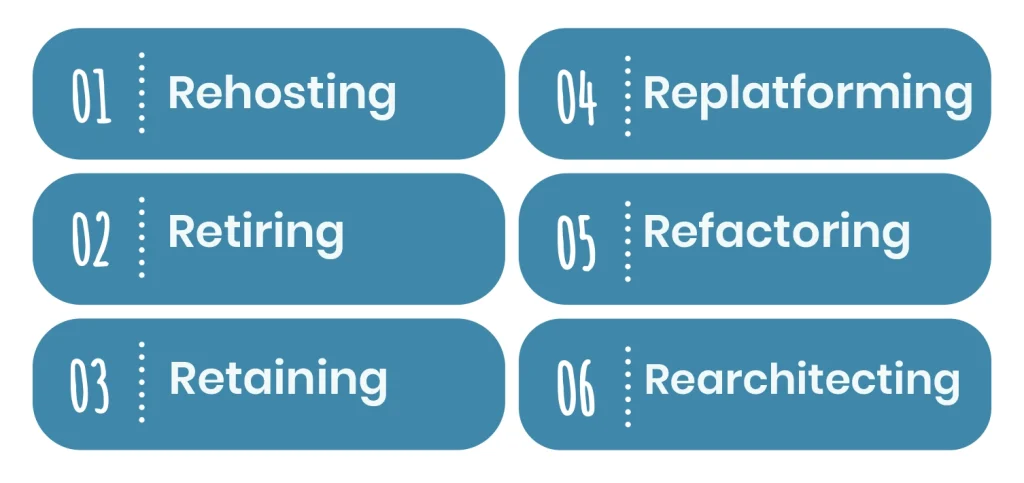
1. Rehosting
This refers to migrating apps and workloads to cloud infrastructure with minimal or no changes to the existing architecture.
This approach is used for rapid migration or when organizations want to reduce data center dependency quickly. While it enables faster deployment, it does not fully optimize applications for cloud-native capabilities such as autoscaling or distributed computing.
2. Retiring
During portfolio assessment, organizations often identify applications that are no longer in use or provide limited business value. These workloads are decommissioned as part of the migration process.
Retiring applications reduces infrastructure overhead, lowers operational cost, and minimizes security exposure from legacy systems that are no longer maintained.
3. Retaining
Certain workloads cannot be migrated due to compliance restrictions, latency sensitivity, or tight integration with on-premise systems.
In such cases, these applications are retained within existing infrastructure while the rest of the environment transitions to the cloud. This is common in hybrid cloud architectures.
4. Replatforming
This strategy involves making targeted modifications to app components to improve compatibility and performance in a cloud environment.
Changes may include adjustments to the runtime environment, database services, or middleware layers. This approach allows organizations to leverage partial cloud-native features without a full architectural redesign.
5. Refactoring
Refactoring requires modifying and optimizing the application architecture to align with cloud-native principles.
This may include decoupling components, introducing APIs, or optimizing for distributed environments. The goal is to improve scalability, resilience, and performance while enabling better integration with cloud services.
6. Rearchitecting
This strategy refers to redesigning and rebuilding applications as cloud-native systems, often using microservices or serverless architectures.
This approach allows full utilization of cloud capabilities such as elasticity, fault tolerance, and automated scaling. While resource-intensive, it is typically applied to mission-critical systems that require long-term scalability and modernization.
Now that we’ve covered the primary cloud migration strategies, the next step is understanding how organizations translate these models into a structured migration plan.
How to Formulate a Successful Cloud Migration Strategy?
A cloud migration strategy works best when it is directly aligned with business and technical goals. It is about planning how each system will transition, how performance will be measured, and how risks will be controlled across the process.
At a high level, a strong strategy is built around a few core principles.
1. Define Clear Migration Objectives
Every migration should start with clear goals. These goals guide all technical and architectural decisions.
Common objectives include reducing infrastructure costs, improving application performance, increasing scalability, or enabling faster deployment cycles.
Once goals are defined, they should be translated into measurable KPIs. These may include compute cost per workload, application response time, system uptime, or resource utilization. Tracking these metrics before and after cloud migration helps validate success and justify investment to stakeholders.
2. Evaluate the Existing IT Environment
A complete assessment of the current IT environment is essential before cloud migration can take place.
This includes identifying applications, databases, infrastructure components, and operational dependencies. It also involves mapping workloads to understand how systems interact with each other.
This baseline view helps determine which applications are suitable for migration, which require modification, and which may need to remain in the existing environment.
3. Map Dependencies and Prioritize Critical Systems
Most enterprise environments are interconnected. Applications rarely operate in isolation.
Understanding dependencies between systems is critical for avoiding disruption during migration. This includes identifying upstream and downstream integrations, shared databases, and external service connections.
Once dependencies are mapped, workloads should be prioritized based on business criticality, complexity, and risk level. This allows organizations to migrate in controlled phases rather than attempting a full-scale move at once.
4. Plan for Risk and Continuity
Cloud migration also comes up with operational risks such as downtime, data inconsistency, and compliance gaps.
A strong strategy anticipates these challenges early. This includes implementing security controls, defining access policies, and ensuring compliance requirements are met across environments.
It is also common for organizations to revisit disaster recovery and business continuity plans during this stage, since cloud adoption changes how systems failover and recover.
5. Leverage Automation and Infrastructure as Code
Automation plays a key role in modern cloud migration strategies.
Infrastructure as Code (IaC) allows teams to define and manage infrastructure using version-controlled templates rather than manual configuration. This improves consistency and reduces configuration drift across environments.
Automation tools also support faster provisioning, easier scaling, and more reliable deployment processes, especially when migrating large or complex workloads.
Execute Your Cloud Migration Strategy in 8 Steps
A cloud migration is most effective when it follows a structured execution model. Instead of moving workloads randomly, organizations follow a phased approach that reduces risk, improves visibility, and ensures alignment with business goals.
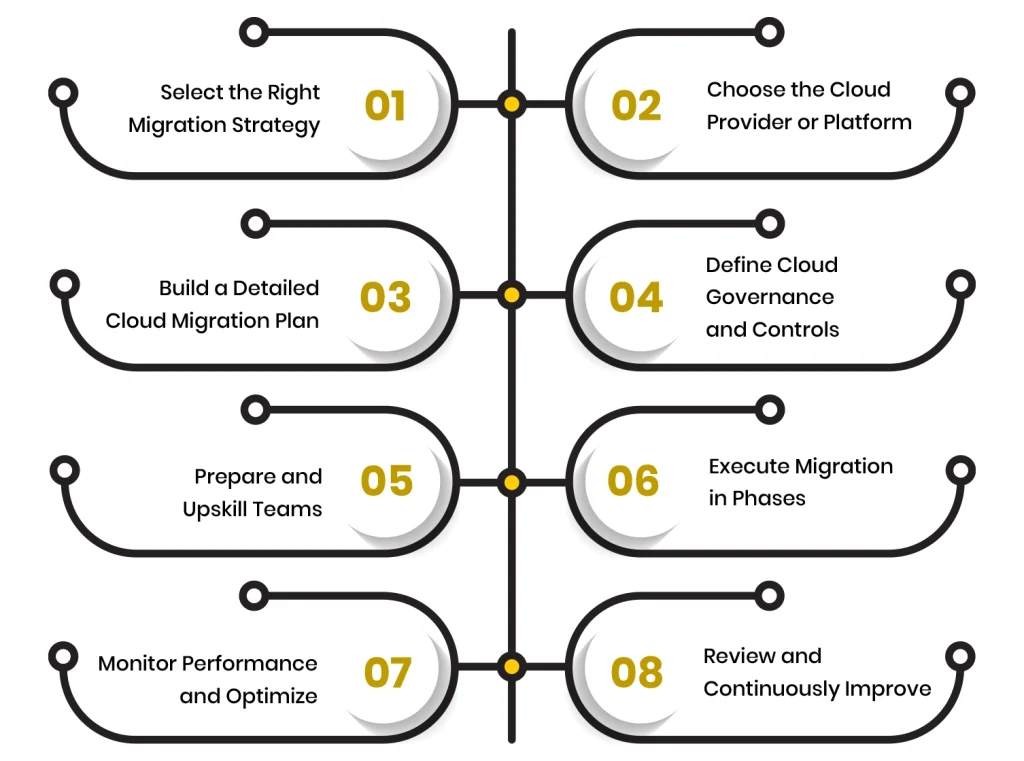
1. Select the Right Migration Strategy
Start by mapping each workload to a suitable migration approach, such as rehosting, replatforming, refactoring, or retaining.
Not all applications should be treated the same. Legacy systems, critical databases, and cloud-ready applications often require different strategies. This step makes sure that workloads are moved based on technical fit and business priority.
2. Choose the Cloud Provider or Platform
Evaluate cloud providers based on technical and operational requirements, not just pricing.
Key factors involve:
- Scalability and managed service options
- Data center regions and latency requirements
- Compute and storage performance
- Compliance and certification support
- Risk of vendor lock-in and portability options
- Integration with existing systems
Many FIRMS also adopt multi-cloud or hybrid models to balance THE performance, cost, and compliance needs.
3. Build a Detailed Cloud Migration Plan
A cloud migration plan defines how the transition will be executed from the beginning to the end.
It should include workload prioritization, timelines, resource allocation, and team responsibilities. It must also map application dependencies to avoid breaking interconnected systems during migration.
A strong plan also has rollback procedures and failure thresholds to ensure safe recovery if issues occur during deployment.
4. Define Cloud Governance and Controls
Governance defines how cloud resources are managed across the firm.
This involves policies for:
- Identity and access management (IAM)
- Security and encryption standards
- Cost management and budgeting controls
- Compliance and audit requirements
A clear governance model helps maintain consistency and reduces any uncontrolled cloud sprawl.
5. Prepare and Upskill Teams
For a successful implementation of a cloud migration strategy, teams may need training in cloud platforms, automation tools, DevOps practices, and security configuration.
In some cases, organizations also bring in cloud specialists or partners to fill skill gaps during early migration phases.
6. Execute Migration in Phases
Migration should be carried out in controlled stages rather than a full-scale cutover.
Workloads are typically moved in waves, starting with low-risk applications. Each stage includes testing, validation, and performance checks before moving to the next set of systems. This leads to less downtime and also limits operational disruption.
7. Monitor Performance and Optimize
Once workloads are live in the cloud, continuous monitoring is critical for the successful implementation of your cloud migration strategy.
Organizations track metrics such as resource utilization, latency, error rates, and cost efficiency. These insights help optimize scaling policies, improve application performance, and eliminate unnecessary resource usage.
8. Review and Continuously Improve
Cloud migration is not a one-time project. It is an ongoing process.
Organizations regularly evaluate whether the cloud migration is meeting defined business goals. Based on performance data, they refine architecture, optimize costs, and adjust workloads.
The Bottom Line
Cloud migration is a practical step for businesses that want better scalability, performance, and cost control. But the real difference comes from execution. Moving in phases, checking performance as you go, and making adjustments after properly executing the cloud migration helps keep things stable and avoid any major disruption. If you are an entrepreneur or if you’re running a business, cloud migration is something you plan carefully and do at the right time, not something you keep pushing aside.