
As companies grow, managing IT becomes more challenging. What once worked with quick fixes and small teams slowly becomes complex systems that require proper structure. And without a clear IT approach, businesses encounter problems such as system downtime, security risks, and poor service quality.
This is where frameworks like COBIT and ITIL come in. Both are widely used to improve how IT is managed. They help companies stay organized, reduce risks, and make better use of technology. But even though they are often mentioned together, they are not the same.
Many people get confused between the two because they both deal with IT management. The truth is, they focus on different areas and solve different problems.
In this blog, we’ll break things down in a clear and simple way so you can clearly understand what COBIT and ITIL are, how they differ, and whether your business needs one or both.
What Are The Frameworks of IT Management?
In the early stages of a business, IT is usually handled in a very basic way. A small team manages everything, and decisions are often made quickly without much planning.
But as the company grows, things start to change. Systems become more complex. Data becomes more valuable. Risks increase. At the same time, customers expect better performance and faster service.
Without structure, IT teams struggle to keep up. That’s why businesses start using frameworks. These frameworks provide a clear way to manage IT instead of relying on guesswork or constant firefighting.
COBIT and ITIL are two of the most trusted frameworks used for this purpose.
Understanding COBIT in Simple Terms
COBIT stands for Control Objectives for Information and Related Technologies. It is mainly used for IT governance and control.
Instead of focusing on daily IT tasks, COBIT looks at the bigger picture. It helps businesses make sure their IT systems are aligned with business goals and are working in a controlled and secure way.
In simple terms, COBIT answers questions like:
- Are we using IT in the right way?
- Are risks being managed properly?
- Are we meeting compliance requirements?
COBIT was developed by ISACA in the 1990s when businesses started relying heavily on technology but lacked proper control systems.
Over time, it has become a standard for organizations that need strong governance, especially in industries like finance, healthcare, and large enterprises.
COBIT focuses on areas such as governance, risk management, performance tracking, and compliance. It ensures that IT is not just running, but running in the right direction.
Understanding ITIL in Simple Terms
ITIL stands for Information Technology Infrastructure Library. It is focused on IT service management.
While COBIT looks at strategy and control, ITIL focuses on how IT services are actually delivered and managed on a daily basis.
It provides a set of best practices that help IT teams handle tasks like fixing issues, managing changes, and improving service quality.
ITIL answers questions like:
- How do we resolve issues faster?
- How do we improve user experience?
- How do we keep services running smoothly?
ITIL started in the 1980s as a project by the British government to improve IT operations. Today, it is used by companies all over the world.
The latest version, ITIL 4, focuses on modern practices and continuous improvement.
COBIT vs ITIL: Top 5 Key Differences Explained
Your IT department needs structure, but choosing the right framework is not always simple. COBIT and ITIL are two of the most widely used IT management frameworks, yet they solve different problems. COBIT focuses on governance and control, while ITIL focuses on service delivery and operational efficiency. Many organizations either choose the wrong framework or try to implement both without a clear plan, which leads to confusion and wasted effort.
These five differences explain how both frameworks actually work in practice. Each one affects how your IT teams are structured, how performance is measured, and how IT aligns with business goals.
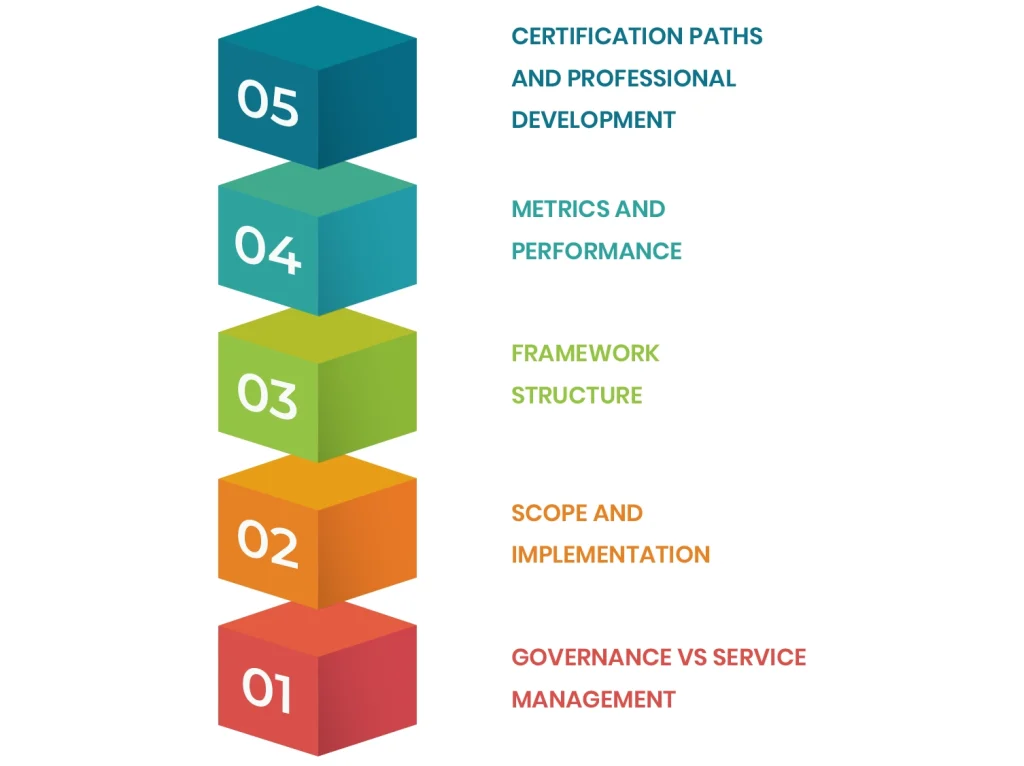
1. Governance vs Service Management
COBIT and ITIL start with completely different purposes. COBIT is a framework made for IT governance and enterprise control. It is created by ISACA and is used to ensure that IT systems are properly aligned with business objectives, risks are managed, and compliance requirements are met.
COBIT governs the entire IT environment of an organization. It focuses on oversight, accountability, and strategic alignment. It ensures that IT decisions support long term business direction and that risks are identified and controlled at a structural level.
Its governance approach includes areas such as board level IT oversight, enterprise risk management, regulatory compliance, and alignment between IT and business strategy. It also defines structured control objectives that guide how IT should operate across the organization.
ITIL works in a different space. It focuses on IT service management and is designed to improve how IT services are delivered to users. It is more operational and process driven, helping teams manage day to day IT activities.
ITIL includes areas such as service desk management, incident handling, problem resolution, service level management, and continuous service improvement. It provides structured practices that ensure IT services remain stable, efficient, and user focused.
COBIT 2019 is built around governance objectives that connect IT activities to business risk and stakeholder expectations. ITIL 4 is built around service practices that guide the full lifecycle of IT service delivery, from planning to continuous improvement.
2. Scope and Implementation
COBIT and ITIL differ significantly in how and where they are implemented within an organization. COBIT operates at a strategic level, while ITIL works at an operational level.
COBIT implementation typically starts with senior leadership. It requires defining governance structures, assessing enterprise wide risks, and aligning IT with long term business strategy. It also involves coordination across departments. This often requires alignment with other frameworks, such as ISO standards or enterprise risk models.
ITIL implementation starts with IT teams and operational processes. It focuses on improving how services are delivered and how incidents are managed. As well as how workflows are structured. It can be introduced gradually, starting with specific IT functions such as service desk or change management.
Because of this difference in scope, COBIT usually takes longer to implement and requires broader organizational involvement. ITIL can show results more quickly because it targets specific service areas instead of restructuring the entire IT governance model.
COBIT also requires more executive involvement and governance expertise. ITIL requires operational training and process adoption from IT staff.
Budget and resources also differ between the two frameworks. COBIT tends to require higher upfront investment due to its enterprise wide nature. ITIL allows phased adoption, which spreads cost and effort over time.
3. Framework Structure
COBIT and ITIL are structured in fundamentally different ways, which affects how organizations apply them.
COBIT is built around control objectives. These objectives define what an organization must achieve to ensure effective IT governance. Each objective is linked to business goals, risk management, and compliance requirements. This makes COBIT highly structured and control oriented.
COBIT 2019 includes governance and management objectives, performance measurement systems, governance components, and maturity models that assess capability levels. The structure is designed to create accountability from executive leadership down to operational teams.
ITIL, on the other hand, is structured around service management practices. Instead of defining controls, it provides practical guidance on how IT services should be delivered and improved.
ITIL 4 includes the service value chain, service management practices, guiding principles, and a continual improvement model. It focuses on how work flows through IT teams and how services are created, delivered, and maintained.
COBIT connects IT processes directly to business outcomes and risk control. On the contrary, ITIL focuses on making sure of efficient service delivery across IT operations.
This difference also affects documentation. COBIT requires formal governance documentation to support compliance and audits. ITIL focuses on practical process documentation used by IT teams in daily operations.
4. Metrics and Performance
COBIT and ITIL use very different approaches to measuring performance.
COBIT uses maturity based measurement systems. It evaluates how well developed and controlled IT processes are within an organization. These maturity levels show how advanced an organization is in terms of governance and control.
COBIT measurement includes capability maturity levels, governance performance indicators, risk metrics, and compliance scorecards. The focus is on long term improvement of governance systems and control effectiveness.
ITIL uses service based performance metrics. It measures how well IT services are performing in real time or over short periods.
ITIL metrics include service level agreements, key performance indicators, incident resolution times, system availability, and customer satisfaction scores. These metrics provide immediate feedback on service performance.
COBIT focuses on long term maturity growth and governance improvement. ITIL focuses on continuous operational improvement and service quality enhancement.
5. Certification Paths and Professional Development
COBIT and ITIL also vary in terms of how they shape professional careers and certification paths.
COBIT certifications are focused on IT governance, risk management, and compliance roles. The main certification levels include COBIT 2019 Foundation, Design and Implementation, and Assessor certifications. There are also specialized certifications for areas like risk and information security.
These certifications are designed for professionals working in auditing, compliance, and enterprise governance roles. The training focuses on control objectives, risk evaluation, and aligning IT with business strategy. Career paths often result in senior governance roles or consulting positions.
ITIL certifications focus on IT service management and operational roles. The certification path begins with ITIL 4 Foundation and progresses through Specialist modules, Strategist streams, and Leader qualifications, with ITIL Master as the highest level.
ITIL training focuses on practical service delivery skills such as incident management, change control, and service improvement. It is widely used by service desk teams, IT operations staff, and IT service managers.
COBIT certifications are fewer but more governance focused. ITIL certifications are more layered and allow gradual specialization based on job roles.
Which ITSM Framework is Right for You?
The choice between COBIT and ITIL depends on the problem you are trying to solve in your organization.
Choose COBIT if your main challenge is control, risk, or compliance. It is useful when you need clear governance over IT decisions, especially in regulated industries like finance, healthcare, or large enterprises. If your leadership wants better visibility into IT risks, stronger policies, and alignment between IT and business goals, COBIT is the right fit.
Pick ITIL if your main challenge is day-to-day IT performance. It works best when your team needs to reduce downtime, improve incident response, or deliver faster and more reliable IT services. It is especially helpful for growing teams that want structured processes without changing the entire organization.
In simple terms, use COBIT when you need stronger control over IT, and use ITIL when you need better service delivery in daily operations.