

Software development often begins with excitement and big expectations. There’s a clear vision in mind. You have a team with whom you have discussed all the deadlines, and everyone is eager to see the final product come to life.
However, as the project moves forward, unexpected problems start appearing. Timelines get longer, and the costs unexpectedly rise. Sadly, features don’t always work the way they were imagined either.
This isn’t because software development is unreliable; it’s because it comes with a set of risks that are often overlooked at the beginning.
This article explains the most common software development risks across the Software Development Life Cycle (SDLC) and how businesses can reduce delays, cost overruns, and long-term technical debt.
Understanding these risks early helps organizations improve delivery predictability, control total cost of ownership (TCO), and avoid failed launches.
Why Do Software Projects Often Face Problems?
Most software projects fail because of more than one major issue. Instead, problems build up gradually due to small gaps in planning or technical understanding.
These gaps might seem harmless at first, but over time they grow into delays and budget problems. When risks are not identified early, teams are forced to react instead of proactively managing challenges. This often causes issues that always lead to stress.
Being aware of potential risks allows teams to move from simply having ideas to making better and more calculated decisions. It creates a foundation where expectations are realistic, and there are little to no surprises. Industry data shows that fewer than half of software projects meet their original success criteria, largely due to unmanaged technical and operational risks.
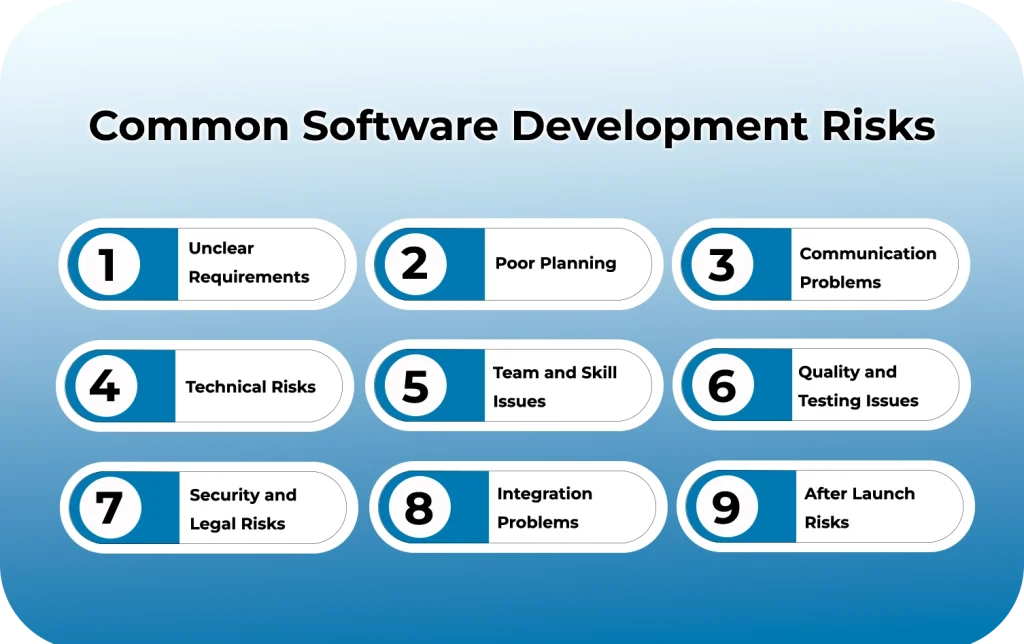
Common Software Development Risks
The following risks commonly appear across custom software, SaaS platforms, and enterprise systems when risk management is not addressed early.
Unclear Requirements
One of the most common risks in software development is unclear requirements at the start of a project. When goals and features are poorly defined, developers are forced to make assumptions. Since they can’t guess business needs, critical details are often missed.
Without structured requirement validation methods such as Agile backlog grooming or stakeholder sign-off, scope gaps often remain undiscovered until late in development.
As a result, the final product may function correctly from a technical standpoint but still fail to solve the real problems users face.
Common issues caused by unclear requirements include:
- Misaligned expectations between business and development teams
- Missing or misunderstood features
- Increased rework and wasted development effort
- A product that doesn’t meet user or business needs
Another major challenge occurs when requirements keep changing during development. While some changes are expected, frequent or unplanned updates can disrupt progress and strain timelines.
Even small changes can impact multiple parts of the system, causing delays that add up over time. Without a structured process to control these changes, projects can quickly lose focus.
Poor Planning
Poor planning is a major risk that affects timelines, budgets, and overall delivery quality. Even when requirements are clear, projects fail when effort estimation, resource capacity, and technical complexity are underestimated.
Unrealistic timelines often ignore integration work, testing cycles, and potential rework. Teams may commit to aggressive deadlines due to business pressure rather than technical feasibility. As a result, development becomes reactive instead of structured.
Common issues caused by poor planning include:
- Inaccurate time and cost estimates
- Overloaded development teams
- Missed milestones and rushed releases
- Increased burnout and reduced code quality
Effective planning requires realistic estimation, buffer time for unknowns, and continuous reassessment as the project evolves.
Communication Problems
Communication breakdowns are a common source of failure in software projects, especially when business stakeholders and technical teams operate with different priorities and assumptions. Business stakeholders and technical teams typically focus on different priorities and use different terminology. When these groups are not aligned, misunderstandings are likely to occur.
When product decisions are not translated into clear technical artifacts such as user stories, workflows, or architecture diagrams, misunderstandings quickly turn into incorrect implementations.
These gaps in communication often result in incorrect implementations and repeated revisions. 57% of projects fail due to communication breakdowns. What the business expects and what developers deliver may not match, slowing progress and increasing frustration on both sides.
Common communication-related risks include:
- Misaligned expectations between stakeholders and development teams
- Incorrect or incomplete feature implementation
- Frequent revisions and rework
- Slower project progress and rising frustration
Delayed or insufficient feedback can make these problems worse. When feedback is provided too late, issues that could have been resolved quickly become more complex and costly to fix.
Regular communication and timely input help teams identify problems early and stay aligned throughout the project.
Technical Risks
Technical decisions made too early in a project can have significant long-term consequences. Choosing the wrong tools, frameworks, or technologies may limit the software’s ability to scale or adapt to future needs.
Early technical decisions shape the long-term stability of the system. Poor architecture choices and weak DevOps practices can limit scalability, increase latency, and make future enhancements difficult and expensive.
Systems that are difficult to maintain or update often require expensive rework, making any initial cost or time savings irrelevant.
Common risks from poor technical decisions include:
- Limited scalability and flexibility of the software
- Increased maintenance complexity
- Higher costs for updates or system changes
- Wasted time and effort on unsuitable technologies
Technical debt is another major risk that can accumulate over time. When teams implement quick fixes to meet deadlines, the codebase becomes harder to manage. This slows down updates and reduces overall stability.
Addressing technical debt early and making careful, informed technology choices helps maintain system stability and reduces costly challenges in future development.
Team and Skill Issues
Project execution quality is directly tied to team capability, experience, and continuity throughout the development lifecycle. If team members lack the necessary expertise, mistakes are more likely to occur.
These problems may not appear immediately but often surface later as performance issues or security gaps.
The absence of documentation and structured knowledge sharing increases dependency on individuals. When team members leave, progress slows as new contributors struggle to understand the system.
Common risks due to team skill gaps include:
- Increased likelihood of coding errors and bugs
- Poor system performance or instability
- Security vulnerabilities
- Delays in development due to mistakes needing correction
Changes within the team can also introduce significant risks. When key team members leave, valuable project knowledge is lost, and new members need time to understand the system.
Maintaining a skilled, stable team and promoting strong knowledge-sharing practices can significantly reduce these risks and ensure smoother project execution.
Quality and Testing Issues
Quality assurance (QA) is sometimes treated as a final step rather than an ongoing process. When testing is limited or rushed, bugs are often discovered late in the project or even after launch. A significant number of software failures can be traced back to insufficient testing and late-stage quality assurance.
Teams that lack automated testing, continuous integration, and release validation pipelines often discover critical defects late, when fixes are more expensive and disruptive. Fixing issues at this stage is more expensive and can damage user trust, especially when the core functionality is affected.
Common risks from poor QA practices include:
- Late discovery of critical bugs
- Higher costs for fixing issues
- Reduced user trust and satisfaction
- Core functionality failures affecting overall software performance
The absence of clear quality standards further complicates development. Without a shared understanding of what “finished” means, teams may deliver inconsistent results. This naturally leads to rework and confusion.
Implementing continuous testing and high-quality standards throughout development helps catch problems early and maintain user confidence.
Security and Legal Risks
Security risks are among the most damaging in software development. Weak security practices can leave systems vulnerable to attacks, including data breaches and cyberattacks.
Failing to address security and compliance requirements early exposes systems to legal risk and costly remediation. Regulatory issues discovered after launch often require architectural changes rather than simple fixes.
Such grave incidents not only disrupt operations but also seriously damage a company’s reputation and user trust.
Common security risks include:
- Data breaches exposing sensitive information
- Cyberattacks that disrupt software functionality
- Loss of user confidence and brand reputation
- Increased costs for emergency fixes and recovery
Legal and regulatory risks are equally critical. Ignoring industry regulations or compliance requirements can lead to legal action or force costly changes after launch.
Addressing security and legal risks early in the development process ensures compliance and avoids expensive measures later.
Integration Problems
Modern software often depends on third-party tools and services, which introduces additional risks. External systems can change or discontinue features at any time, and businesses typically have little control over these decisions.
Heavy reliance on third-party APIs, SDKs, or external platforms increases operational risk. Changes in versioning, rate limits, or service availability can disrupt core functionality with little notice. Even small changes in these tools can cause significant disruptions if the software relies heavily on them.
Common risks from third-party dependencies include:
- Unexpected changes or discontinuation of external services
- Disruptions in software functionality
- Increased troubleshooting and maintenance efforts
- Reduced reliability and stability of the system
Integration challenges can also arise when different components of a system struggle to work together. Connecting multiple platforms or services often requires more time and effort than initially anticipated.
Careful integration planning and monitoring of external dependencies help ensure stable performance and reduce the risk of delays or disruptions.
After Launch Risks
Many teams focus heavily on launching software but underestimate what comes after. Ongoing maintenance and support require both time and resources.
Without monitoring, maintenance planning, and performance optimization, post-launch costs rise steadily. Over time, this reduces return on investment and limits the product’s ability to scale.
Without a long-term plan, maintenance costs can grow unexpectedly, and unresolved issues can gradually degrade system performance.
Common post-launch risks include:
- Rising maintenance and support costs
- System performance degradation over time
- Unplanned resource allocation impacting budgets
- Increased risk of technical failures if issues remain unresolved
User adoption is another major post-launch challenge. Even well-built software can fail if users do not understand how to use it or perceive little value. Poor onboarding and unclear documentation can prevent full adoption. This reduces the overall return on investment.
Planning for ongoing maintenance and effective user onboarding helps ensure long-term software success and protects the investment.
Real-World Examples of Software Failures Caused by Poor Risk Management
The following real-world failures demonstrate how unmanaged software risks can result in severe financial, operational, and reputational damage.
Healthcare.gov Launch Failure (2013)
The U.S. government launched Healthcare.gov in October 2013 to support the Affordable Care Act. Despite a massive budget and multiple vendors involved, the website failed almost immediately after launch. Users faced crashes, slow loading times, and failed registrations.
The failure was later attributed to:
- Poor coordination between multiple development teams
- Last-minute requirement changes
- Lack of end-to-end testing before launch
- No single authority responsible for system integration
Instead of proactive risk management, teams reacted after the system collapsed publicly. This led to emergency fixes and reputational damage.
Why This Matters:
This case clearly shows how unclear requirements and poor communication can derail even well-funded software projects.
Knight Capital Trading Disaster (2012)
Knight Capital, a major U.S. trading firm, lost $440 million in under 45 minutes due to a faulty software deployment in August 2012.
The issue occurred because:
- Old, unused code was accidentally reactivated
- Deployment scripts were inconsistent across servers
- There was no proper rollback or kill switch
- Testing and release validation were insufficient
The bug caused the system to place thousands of unintended trades automatically. This forced the company into near bankruptcy.
Why This Matters:
This example highlights how technical debt and poor deployment controls can have destructive financial consequences.
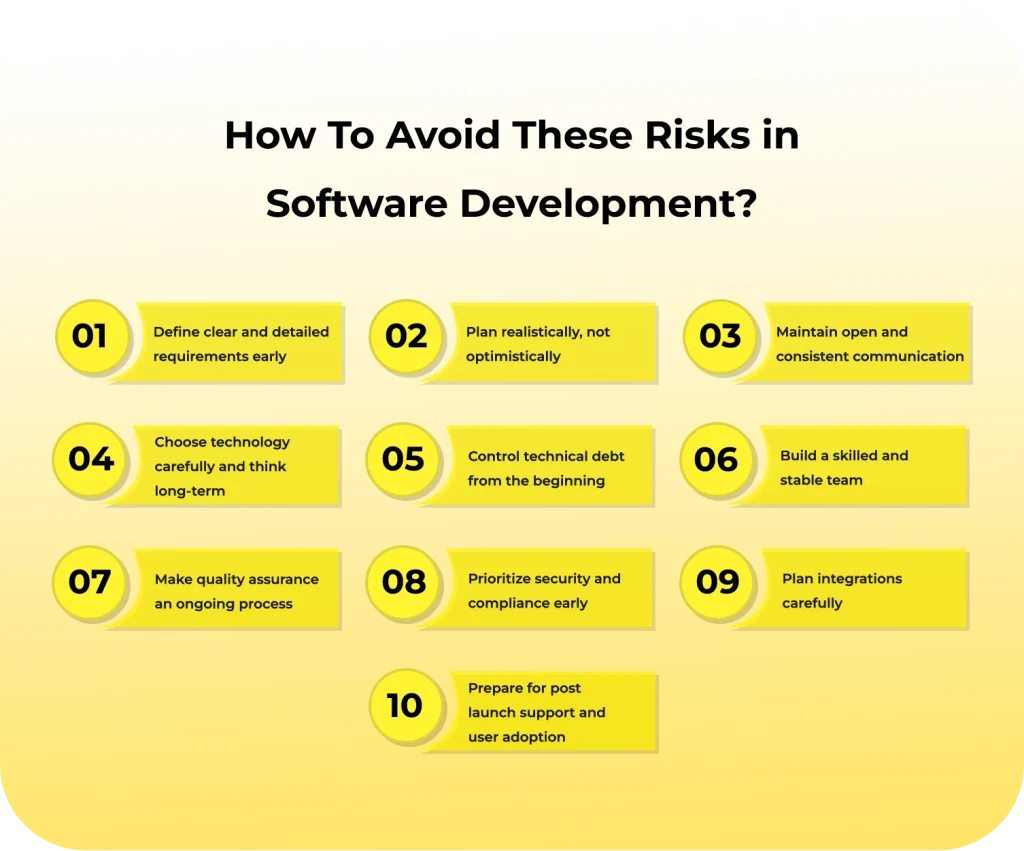
How To Avoid These Risks in Software Development?
Reducing software development risks requires structured processes, informed decision-making, and continuous oversight across the project lifecycle. Most risks arise from rushed decisions or short-term thinking. By putting the right practices in place early, teams can significantly control costs and deliver software that truly meets business goals. Below are practical and proven ways on how to manage software risks
Define clear and detailed requirements early.
Invest time in understanding business goals and technical expectations before development begins. Well-documented requirements prevent scope issues and ensure everyone is working toward the same outcome.
Plan realistically, not optimistically
Set timelines and budgets based on technical complexity, not pressure or assumptions. Include buffer time for unexpected challenges and avoid committing to aggressive deadlines without proper analysis.
Maintain open and consistent communication
Encourage regular collaboration between business stakeholders and development teams. Frequent check-ins and feedback sessions help catch misunderstandings early and prevent costly rework later.
Choose technology carefully and think long-term
Select tools and frameworks that support future growth and maintenance. Avoid making rushed technical decisions that may limit flexibility or increase long-term costs.
Control technical debt from the beginning
Avoid relying on quick fixes to meet deadlines. Writing clean, maintainable code and addressing issues early keeps the system stable and reduces risks during future updates.
Build a skilled and stable team
Ensure your team has the right technical expertise and clearly defined roles. Promote knowledge sharing and documentation so the project remains stable even if team members change.
Make quality assurance an ongoing process
Testing should happen throughout development, not just before launch. Continuous testing helps detect issues early when they are easier and less expensive to fix.
Prioritize security and compliance early
Implement strong security practices from the start and ensure compliance with industry regulations. Addressing these risks early prevents legal issues and reputational damage.
Plan integrations carefully
When relying on third-party tools or services, evaluate their reliability and limitations. Design integrations that are flexible and easy to update in case external systems change.
Prepare for post-launch support and user adoption
Plan for maintenance and user training after launch. Clear documentation and onboarding help users adopt the software easily and protect long-term return on investment.
Conclusion
Software development risks are inevitable, but unmanaged risks are what cause projects to fail. The good part is that they don’t have to lead to complete failure. When such risks are identified early and are addressed thoughtfully, teams can avoid costly mistakes. They can make better and more thoughtful decisions throughout the project lifecycle.
Frequently Asked Questions
What is the biggest risk in software development?
The biggest risk in software development is unclear or poorly defined requirements. When project goals, features, and expectations are not clearly documented from the beginning, development teams are forced to make assumptions. This often results in software that technically works but fails to meet business or user needs.
How can software risks be reduced?
Software risks can be reduced through early planning and proactive risk management. This includes defining detailed requirements, setting realistic timelines and budgets, involving stakeholders regularly, and conducting continuous testing throughout development.
What happens if a risk in software development goes unnoticed?
When a risk goes unnoticed, it usually grows into a larger and more expensive problem over time. Small issues can turn into major delays or security vulnerabilities. In severe cases, unnoticed risks can lead to system outages or even complete project failure.