
Up until a few years ago, users didn’t even have apps for basic tasks, but as time passed, apps showed up for the simplest of tasks, like grocery delivery and ticket booking. Now, with the changing era, even these apps are going one step further. In the 2020s, convenience has become the default expectation for almost every user. This is where super apps make an entry.
They bring a whole new wave of convenience. In this Blog, we’ll explore the how and why of super app development. Let’s dive in!
What is a Super App?
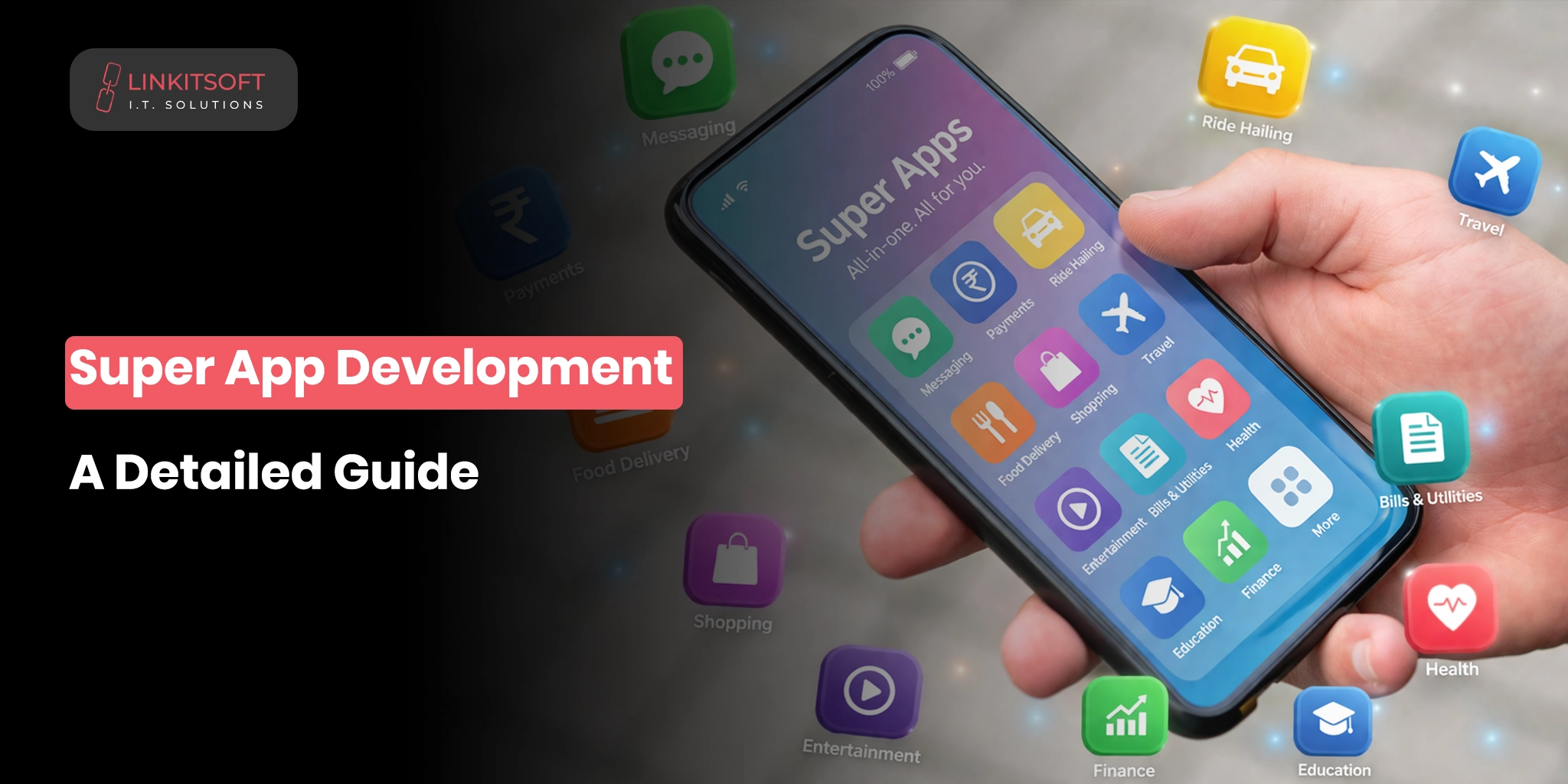
A super app is exactly what the name suggests. It’s an app turned into a superhero. An ordinary app might let you perform specific tasks, such as ordering food from a particular restaurant or booking tickets to a specific event. Now, when a super app comes in, you don’t even have to leave the platform once to perform each of these tasks. When you use a super app, you can:
- Send messages
- Book a room/ticket
- Make secure payments
- Order groceries/food
- And more
All on the same platform. Super apps are incredibly convenient as they are multi-functional apps. They are known to get things done quickly and securely. Allowing reliable third-party “mini-apps” to smoothly run within them, super apps also integrate social networks and payment gateways to allow maximum functions to be carried out from one platform.
What Are The Types of Super Apps?
Super apps have become one of the most compelling creations in the digital ecosystem. As we know now, they are offering unmatched convenience by combining multiple types of services into a single platform. However, there isn’t a universal blueprint or pattern for building one.
These platforms evolve in different ways depending on their core purpose. Here are some different types of super apps:
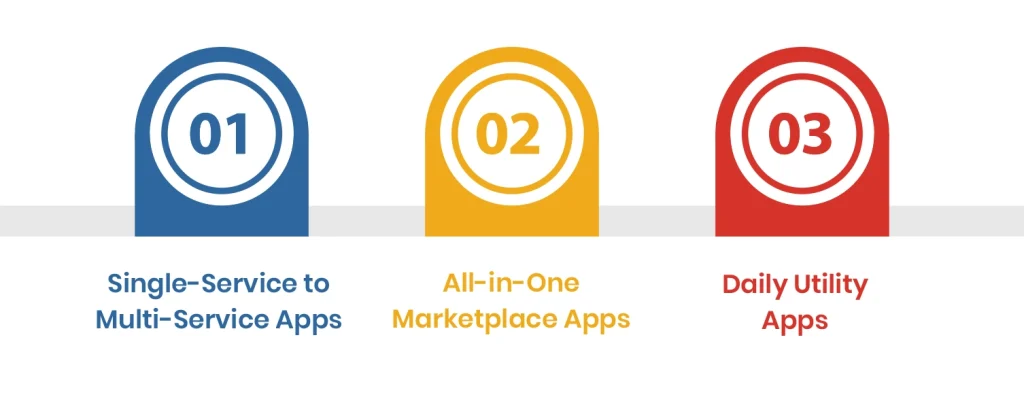
Single-Service to Multi-Service Apps
Some super apps begin with a single service that is highly valued. Then they gradually build an ecosystem around it. The initial offering acts as the foundation. It is present to attract users and create trust, which then enables the platform to introduce complementary features over time.
This model highlights a lovely fact. A strong starting point can easily evolve into a multi-service platform.
Examples:
- Grab: It was originally focused on ride-hailing before it expanded into providing food delivery and more
- WeChat: started as a messaging platform and grew into a comprehensive lifestyle and services hub
All-in-One Marketplace Apps
In this model, the super app operates as a unified marketplace. Here, it connects users with a wide range of third-party providers. Instead of building every service internally, the platform enables external vendors to offer products and services. This benefits every party and creates a diverse and scalable ecosystem of transactions.
Examples:
- Paytm: integrates shopping and ticket booking within a unified platform
Daily Utility Apps
These super apps focus on simplifying day-to-day life by combining essential services and provdiding it in one place. The emphasis is on convenience and the frequency of use that the app gets. This makes them part of a user’s daily routine and genuinely makes things easier for them.
Examples:
- Foodpanda: A Singaporean online food/drink and grocery delivery platform
What are the Technicalities that go into Super App Development?
Since a super app does so much from a single platform, developing one isn’t easy. Since it handles multiple services at once, the underlying technology needs to be flexible and secure. Here are some of the essential technical elements that make it all work:
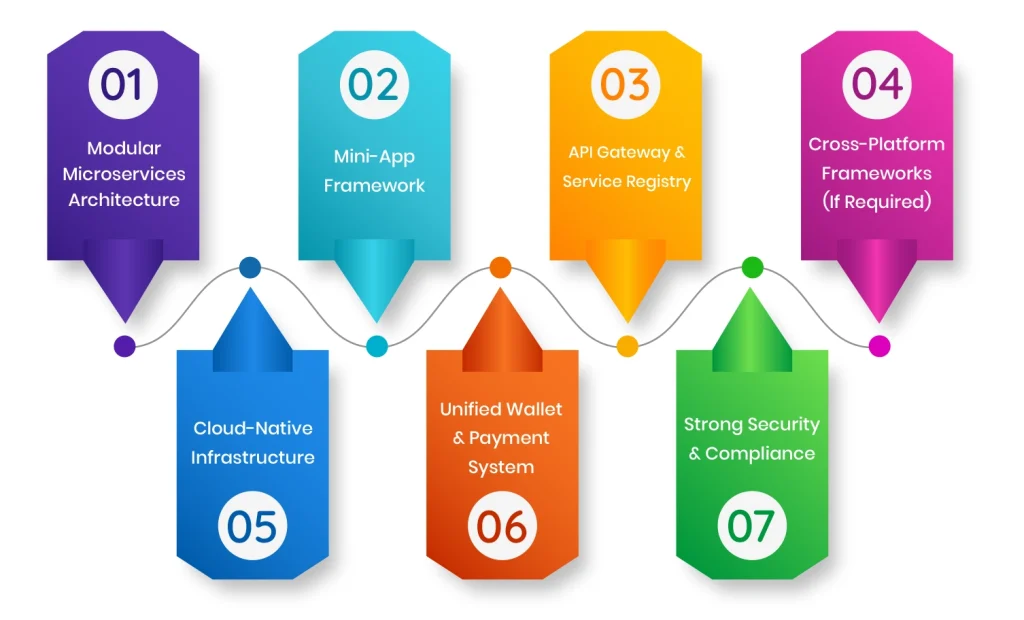
Modular Microservices Architecture
Most super apps use a microservices architecture. Instead of building one large, tightly connected system, developers break the app into smaller and independent services (that’s what a microservices architecture means). For example:
- Payments
- Messaging
- Ride-booking
- Notifications
can all run as separate modules. This makes the app much easier to manage because teams can easily update or fix one service without disrupting the others. It also improves the scalability… if one feature suddenly gets a surge in traffic, only that part needs to expand, not the entire app.
Mini-App Framework
One of the best features of many super apps is the ability to host mini-apps within the main app. These are lightweight apps, often built by third-party developers, that run inside the super app without requiring separate downloads.
To support this scenario, a strong mini-app framework is needed. It provides tools and a controlled environment so developers can build and integrate their services while maintaining excellent performance and security.
API Gateway & Service Registry
With so many moving parts, communication between services becomes critical. This is where an API gateway plays a very important role. It acts as the single entry point for all user requests. Once it gets them, it directs them to the appropriate service behind the scenes. Alongside it, a service registry keeps track of all available services, their locations, and their status.
Together, these systems ensure that everything connects smoothly and efficiently. Without them, managing dozens (or even hundreds) of services would quickly become chaotic.
Cross-Platform Frameworks (If Required)
Maybe you want your super app to be native, but that kills the point. Most super apps are built to be cross-platform so that they are able to reach the maximum number of users. For this, developers often use cross-platform frameworks to make the process easier.
This allows them to write code once and deploy it across multiple platforms with very little platform-specific adjustments. However, developers still need to balance performance and native feel, especially for more complex features.
Cloud-Native Infrastructure
Handling millions of users and live interactions requires serious computing power. That’s why most super apps rely on a cloud-native infrastructure. Cloud platforms make it much easier to scale resources up or down. This depends on the demand. It also makes sure that the app remains fast and reliable even during peak usage. They also support:
- Data storage
- Backups
- Global accessibility.
In simple terms, the cloud keeps everything running smoothly.
Unified Wallet & Payment System
A unified payment system is what connects many super app services together. Instead of asking users to switch between different payment methods, a built-in wallet allows them to handle everything, including:
- Paying bills
- Booking rides
- Receiving refunds
And it all happens within the same app. This not only improves convenience but also encourages users to stay within the ecosystem. Designing such a system requires careful attention to transaction speed and financial regulations, as even small issues can affect user trust.
Strong Security & Compliance
Since super apps deal with sensitive user data and financial transactions, ensuring strong security is very important. Developers need to implement:
- Strong encryption
- Secure authentication methods
- Multi-factor login
- Constant monitoring for potential threats
On top of that, they must comply with local and international regulations that are related to data privacy and financial services. This adds even more complexity, but it’s necessary to protect users and maintain credibility.
How do you develop a Successful Super App?
Building a super app also follows the classic SDLC process; however, it isn’t just about developing the super app. To succeed, it needs to be built on a powerful plan and strategy. Before you start developing one, you need to answer a few questions and even implement a few best practices to make sure everything turns out right. Before you begin the development stage, ask yourself these questions:
- Is my app going to solve any existing gaps or user problems, or is it just going to be another app?
- What main service should I start with that will surely attract and retain users in the beginning?
- Will I be building all the services in-house on the platform, or will I rely on third-party integrations?
- What monetization strategy will I follow, and will my users be okay with it?
- What legal and regulatory requirements do I need to comply with?
- How will I collect user feedback and continuously improve the app to keep users engaged?
These questions may seem basic, but once you start doing the research, you’ll have your notes app full of random scribbles. It’s quite necessary because without proper planning, an app as heavy as a super app is doomed to fail. Here are some additional pieces of advice/practices from Linkitsoft that you can implement:
- Start by prioritizing the main feature and launching an MVP for your super app
- Test your idea and gather feedback, both positive and negative
- Improve the app based on the reviews you get and keep testing until things start feeling perfect
- Over time, keep adjusting the screens and adding more features and expanding your MVP into a complete app
Conclusion
Users across different ages, whether millennials, Gen Z, or even Baby Boomers, are all now expecting digital convenience. Not everyone in the market is doing it, giving businesses like you a solid chance to shine. Super app development can help you deliver value to users by meeting their expectations or perhaps doing even more! With the right team and support by your side, nothing is impossible.