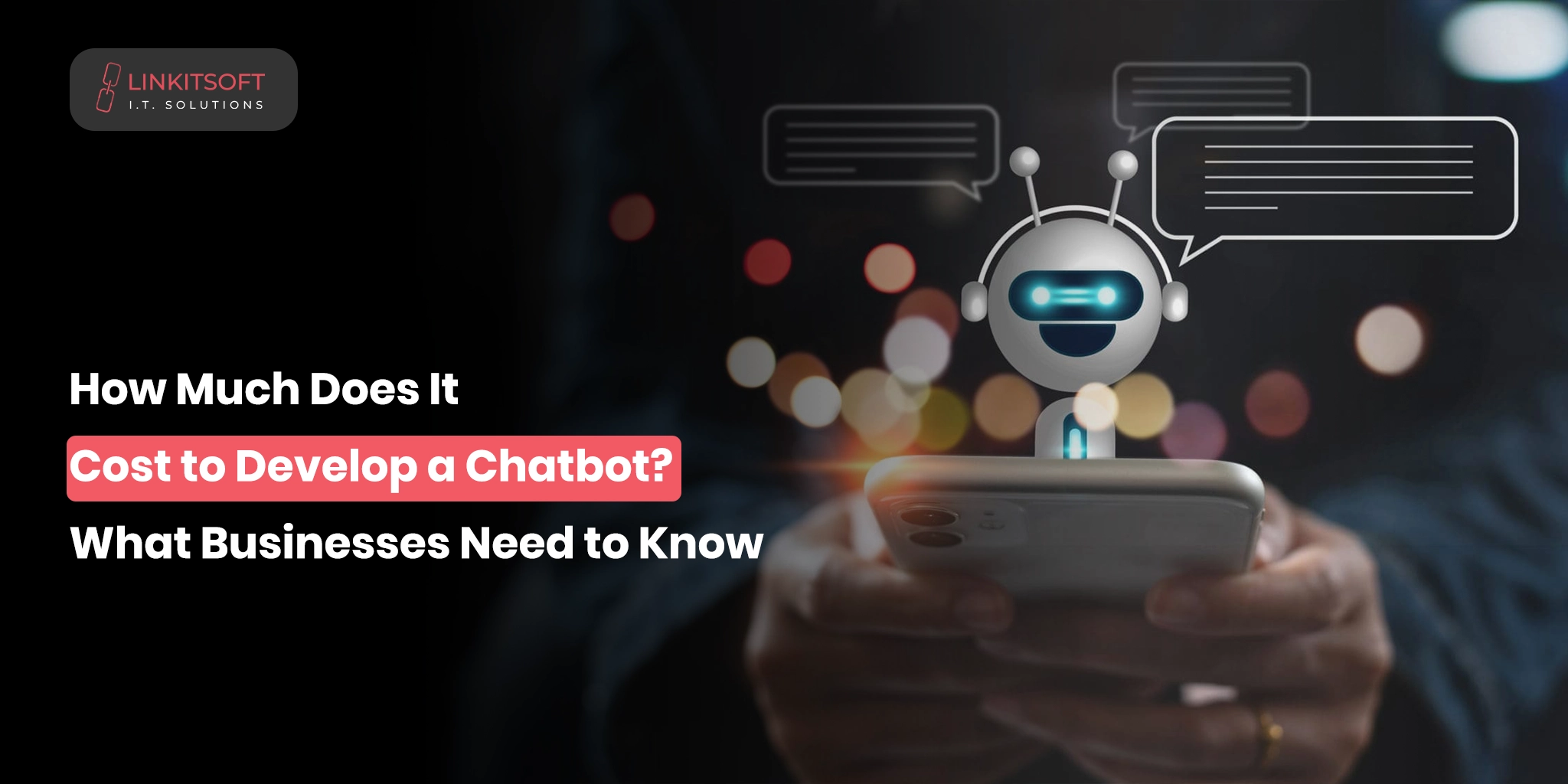
Chatbots in 2026 are core business infrastructure. They are now powering support, sales, and internal automation.
The costs to build one vary widely… a basic chatbot may cost five figures, while an enterprise AI assistant can reach six figures or more. The difference depends on several factors and ongoing, hidden costs that you’ll see along the way.
In this guide, we break down what those chatbot development costs are and what businesses should budget for.
Why Companies Are Investing in Chatbots in 2026
Modern AI assistants impact sales, retention, and employee productivity. For many businesses, they’re becoming a powerful tool that’s helping their organizations grow.
Every additional customer typically requires additional human capacity. Automation breaks that pattern by handling repetitive queries instantly and operating 24/7.
Moreover, the industry data shows why businesses are increasingly investing in chatbots:
- Gartner projects that by 2027, chatbots will likely become the main customer service channel for about ~25% of organizations.
- IBM reports AI chatbots can reduce customer service costs by up to 30%.
- Juniper Research estimates chatbots will probably help businesses save more than $11 billion annually in the form of customer service costs worldwide.
What are the Costs Based on Chatbot Complexity?
The most useful way to estimate chatbot development cost is by understanding the technical depth. Complexity determines several aspects, from model selection to long-term operational expenses.
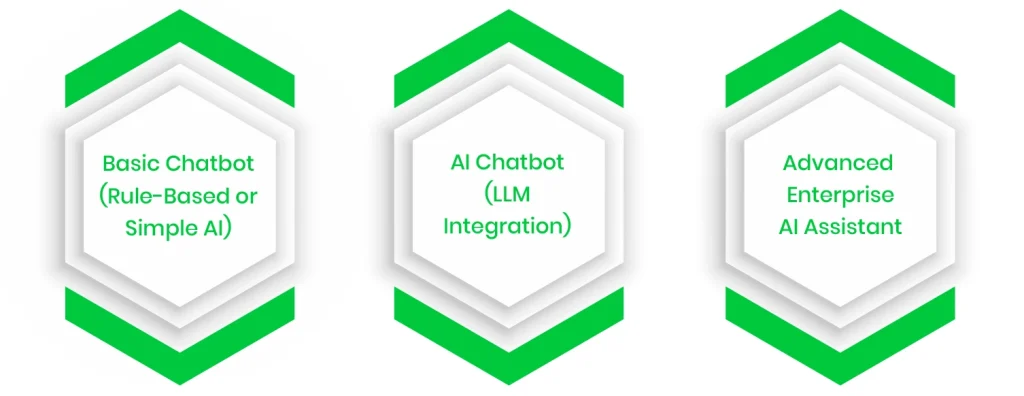
Basic Chatbot (Rule-Based or Simple AI)
Estimated Cost: $10,000 – $30,000
A basic chatbot follows predefined conversation flows with minimal AI logic. It is ideal for small businesses and companies that are automating FAQs or lead capture.
These systems typically include structured conversation trees. They may have a website or WhatsApp integration and come with a simple admin panel and basic analytics.
Costs remain lower because there is no advanced model training or complex backend orchestration. This type of bot works well for repetitive queries but is not suited for multi-step interactions.
AI Chatbot (LLM Integration)
Estimated Cost: $30,000 – $120,000
This is the most common investment tier for growing digital businesses. These chatbots integrate large language model APIs from providers such as OpenAI or Anthropic, enabling context-aware conversations.
They often include knowledge base integration (RAG) with multi-channel deployment. Their reporting dashboards are detailed and have human handoff workflows.
The costs increase due to API token usage and vector database configuration. Mostly, the backend integrations with CRM or helpdesk systems add to the costs. This tier offers meaningful automation without full enterprise complexity.
Advanced / Enterprise AI Assistant
Estimated Cost: $120,000 – $500,000+
Enterprise AI assistants operate at a significantly larger scale and are embedded into mission-critical workflows. They may include multi-agent orchestration and custom model hosting using open-source models such as those developed by Meta.
These systems often require adjusting pipelines and role-based access control. The analytics are far more advanced. Moreover, these AI chatbots offer multilingual support and are based on strict compliance frameworks.
At this stage, the costs rise due to high conversion volume and complex ERP or CRM integrations. Many companies go for private cloud infrastructure and require regulatory requirements such as HIPAA or GDPR.
What are the Major Factors That Influence Chatbot Development Cost
Beyond the complexity tiers, there are several architectural decisions that shape the final budget. We have mentioned the most significant factors below:
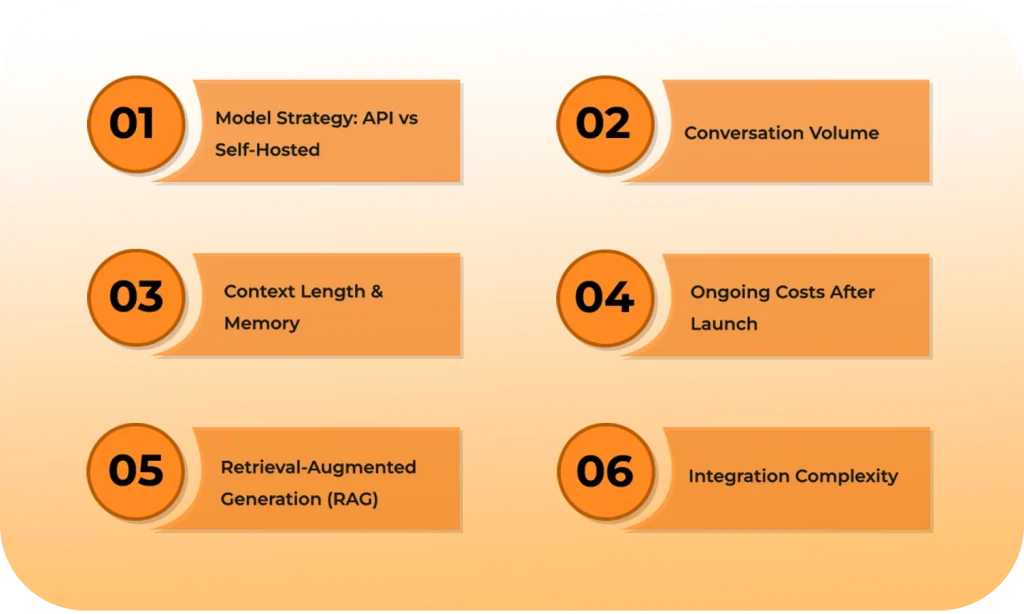
Model Strategy: API vs Self-Hosted
Using third-party APIs accelerates development and reduces the complexity of the infrastructure. However, token-based billing can accumulate quickly at high volumes.
Self-hosting open-source models reduces per-message cost over time. It’s a great way to optimize the costs, but requires GPU infrastructure and machine learning engineers. So, the beginning investment is higher, but long-term economics may improve for very large deployments.
The choice significantly impacts both capital expenditure and operational expense.
Conversation Volume
There is a dramatic difference between 1,000 conversations per month and 1 million. As usage increases, infrastructure must scale accordingly.
Token usage rises, logging and monitoring complexity grows, and high-availability architecture becomes necessary.
At high volumes, costs may grow exponentially rather than linearly. This naturally happens due to scaling and reliability requirements.
Context Length & Memory
Short Q&A bots operate within small context windows and generate lower inference costs. In contrast, long multi-step conversations with persistent memory require processing larger token volumes per request.
Many AI APIs charge based on tokens processed. This expands the context length… dramatically increasing the recurring costs.
Ongoing Costs After Launch
A chatbot is an evolving AI system. API and inference costs frequently become the largest recurring expense, especially as usage grows. Context expansion and peak traffic spikes can significantly increase monthly bills.
Infrastructure expenses include servers, storage, vector databases, monitoring tools, and load balancing systems. These scale with user activity.
Maintenance and optimization are equally important. Prompt updates and security patches require continuous attention. Many organizations allocate 15–30% of the initial build cost annually for maintenance.
Retrieval-Augmented Generation (RAG)
RAG allows chatbots to retrieve relevant information from company documentation or internal databases before generating responses.
While powerful, it adds embedding generation, vector database hosting, and re-indexing expenses.
The more documents and frequent updates involved, the higher the ongoing cost.
Integration Complexity
Modern chatbots often integrate with CRM systems and helpdesks. They can even connect with platforms, payment gateways, internal databases, collaboration tools like Slack or Teams, and enterprise resource planning systems.
Each integration increases the development time and testing requirements. And the more the integrations, the more the maintenance responsibilities. Integration complexity is often underestimated during initial budgeting.
Development Team & Budget Structure: In-House vs Outsourcing
Who builds the chatbot matters just as much as what is built.
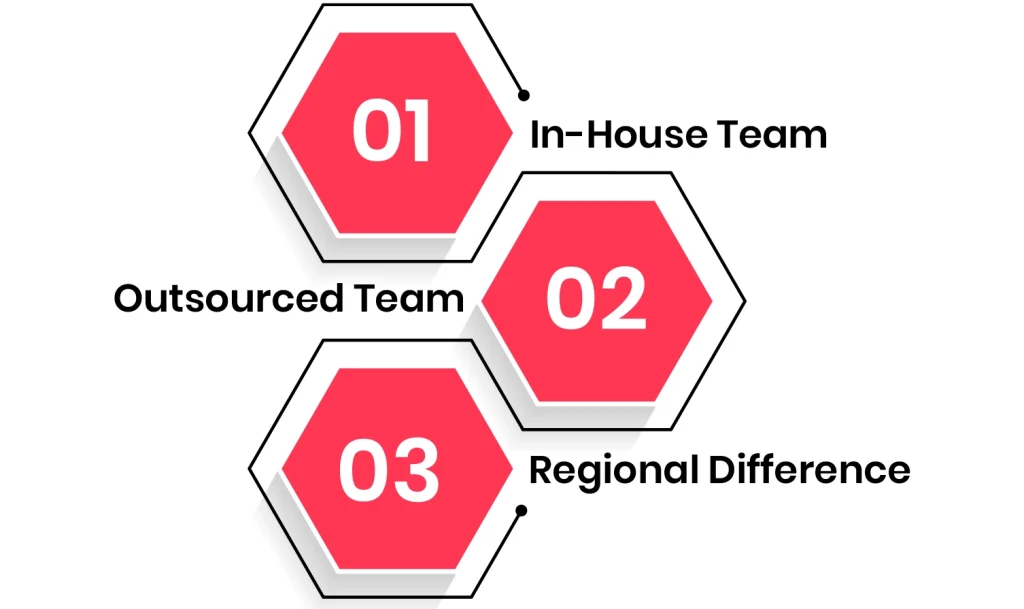
In-House Team
An in-house team offers long-term capability development and full control over architecture decisions. However, hiring AI engineers, backend developers, and DevOps specialists introduces significant fixed salary costs and longer onboarding time periods.
Outsourced Team
Outsourcing enables faster launch and lower short-term commitment. It can be highly effective when product management and requirements are clearly set. However, dependency on vendor quality and communication clarity becomes a factor.
Regional Difference
Regional cost differences also play a significant role when selecting your final team.
| Region | Average Hourly Rate (USD) | Overall Cost Level | Typical Engagement Profile |
| North America | $120 – $200+ | Highest | Enterprise projects, complex AI systems, and strict compliance environments |
| Western Europe | $90 – $160 | High | Advanced mid-size to enterprise chatbot builds |
| Eastern Europe | $50 – $100 | Moderate | Strong technical expertise with balanced pricing |
| Asia | $30 – $70 | Affordable | Budget-conscious projects and scalable offshore teams |
What are the Hidden Costs Involved in Chatbot Development?
Chatbot budgets often look reasonable on paper. The overruns usually come from areas that owners and teams underestimate during the whole planning phase. Here’s what you should consider:
Token Inefficiency & Model Misuse
Poor prompt design increases token consumption, especially in high-volume environments. Long system prompts and redundant conversation history can silently multiply API costs.
Using large models for simple classification, routing, or FAQ responses is another common mistake. Without a model-tiering strategy, operational expenses get out of hand pretty quickly.
Vector Database & Knowledge Base Growth
Retrieval-Augmented Generation (RAG) systems introduce ongoing infrastructure costs. As the documentation grows, embedding generation, re-indexing, and even storage requirements increase unexpectedly.
High query-per-second (QPS) environments may require scaling vector databases horizontally. It sounds a bit technical, so in general terms, this will add replication and performance tuning costs.
Integration & Backend Complexity
Each integration, like a CRM/ERP or internal tool, adds to the development time. It also increases the time needed for testing and long-term maintenance responsibility.
APIs change. Systems update. Authentication flows evolve. What appears to be a “simple integration” can become an ongoing engineering commitment. It comes with a lot of responsibility and money involved.
Compliance, Security & Governance
Enterprise deployments often require audit logs, encryption policies, access control layers, and regulatory compliance (such as GDPR or HIPAA).
To make the security stronger, multiple tests like penetration testing and data isolation architecture are required. They can significantly increase both initial and recurring costs.
Latency & Global Infrastructure
Delivering real-time AI responses across multiple regions requires load balancing, CDN configuration, edge routing strategies, and sometimes multi-region model deployment.
Latency mitigation is engineering-heavy and frequently overlooked during early budgeting.
What are some Smart Ways to Control Chatbot Development Cost?
Cost control is not about reducing capability. It’s about architectural discipline, along with phased and careful execution.
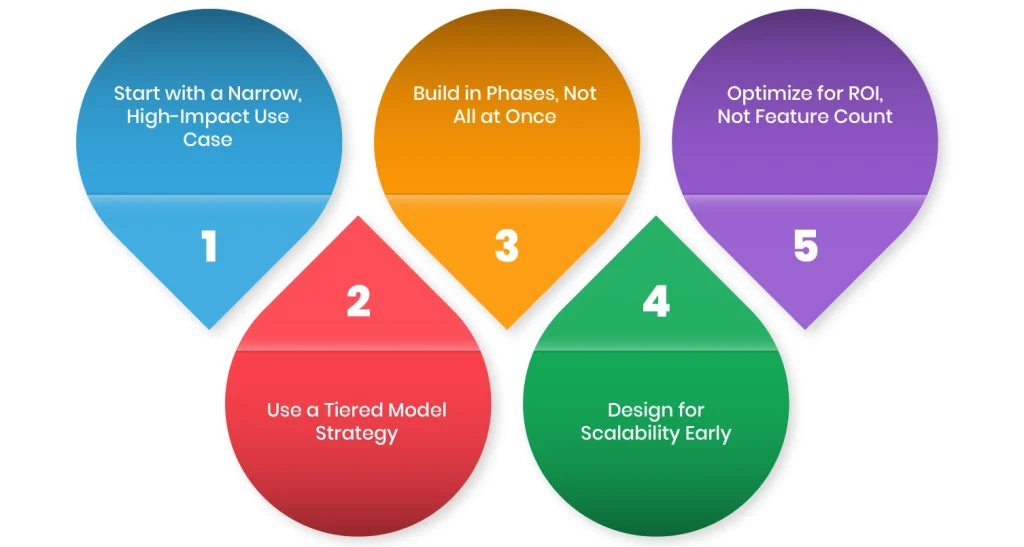
Start with a Narrow, High-Impact Use Case
Instead of automating everything, begin with one workflow that delivers an impactful and visibly strong ROI. This can include FAQ deflection, lead qualification, or internal ticket routing.
Basically, focus on validating the performance before expanding the scope.
Use a Tiered Model Strategy
Deploy smaller, lower-cost models for intent detection or simple responses. Escalate to larger models only when reasoning depth is required. This hybrid approach can reduce token expenditure significantly without sacrificing performance.
Build in Phases, Not All at Once
Here’s how it should go:
- Phase 1: Core conversation engine + basic RAG
- Phase 2: Workflow automation & system integrations
- Phase 3: Advanced analytics, agents, and optimization
Phased development reduces risk. Thus spreads investment over time and allows better iteration based on performance.
Design for Scalability Early
Choose infrastructure that supports horizontal scaling and modular integrations. Refactoring architecture after growth is far more expensive than planning for scale from day one.
Optimize for ROI, Not Feature Count
Every feature should tie directly to measurable impact. It should offer reduced support costs with higher conversion rates and shorter sales cycles. At the least, it should result in improved employee productivity.
Chatbots become expensive when they are feature-driven. They become profitable when they are outcome-driven.
Final Thoughts
Unlike traditional web apps, chatbots are AI operational systems with ongoing inference expenses. Their cost structure includes both development and recurring usage components.
However, when architected correctly, a chatbot does far more than just answer questions. It reduces operational burden and heavily improves response time. A great chatbot even standardizes communication, captures leads around the clock, and scales interactions without scaling the payroll. The real question is: how much does manual inefficiency cost you without an AI Chatbot?