


Agile has now become the default approach for modern software development, but adopting Agile frameworks alone doesn’t guarantee a noteworthy outcome for anyone. As teams grow and delivery cycles become faster, businesses need clear visibility into performance and value delivery.
This is where keeping track and measuring these elements becomes critical. Without the right data, even well-structured Agile teams can struggle to identify issues or align their development efforts with broader business goals.
Tracking the right indicators allows organizations to move beyond their intuition and make better decisions with more calculated data. In our guide, we’ll break down the most valuable Agile metrics you should track to get sustainable business growth.
What Are Agile Metrics?
Agile metrics are basically quantifiable indicators. They’re used to evaluate how nicely and productively a team is delivering software within an Agile environment. In this case, the focus is never on one kind of output; these metrics actually provide deeper insight into things like:
- Delivery speed
- Workflow stability
- Product quality
- Overall team performance
They help translate day-to-day development activities like sprint planning and releases into measurable data that stakeholders can act on. This helps teams constantly improve themselves by understanding their patterns.
These metrics are often derived from tools such as Jira, Azure DevOps, or other project management systems that already track tasks and workflows.
Why Should You Track Agile Metrics?
You’ll actually find several reasons on the “why” of tracking agile metrics. Keeping track of them gives teams and business leaders a view of how teams are progressing. It replaces miscellaneous assumptions with reliable and trustworthy evidence… Metrics provide a clear picture of what’s actually happening.
Using this data, leaders can better forecast delivery timelines and identify whether the overall development is in the right place with the business goals.
When teams consistently track performance indicators, they start recognizing patterns in their workflow. If you start tracking these metrics, you’ll be able to keep track of:
- Where tasks are slowing down
- Where the rework needs to happen
- Where the work is unbalanced
- Where dependencies are becoming a problem
Over time, this will lead to improved collaboration and more predictable delivery cycles.
What are the Different Types of Agile Metrics?
Tracking agile metrics isn’t the only thing; you also have to know the type of metrics to cover every area. Different Agile frameworks focus on different aspects of delivery, so relying on a single category can leave gaps in visibility.
Let’s look at the different types below:
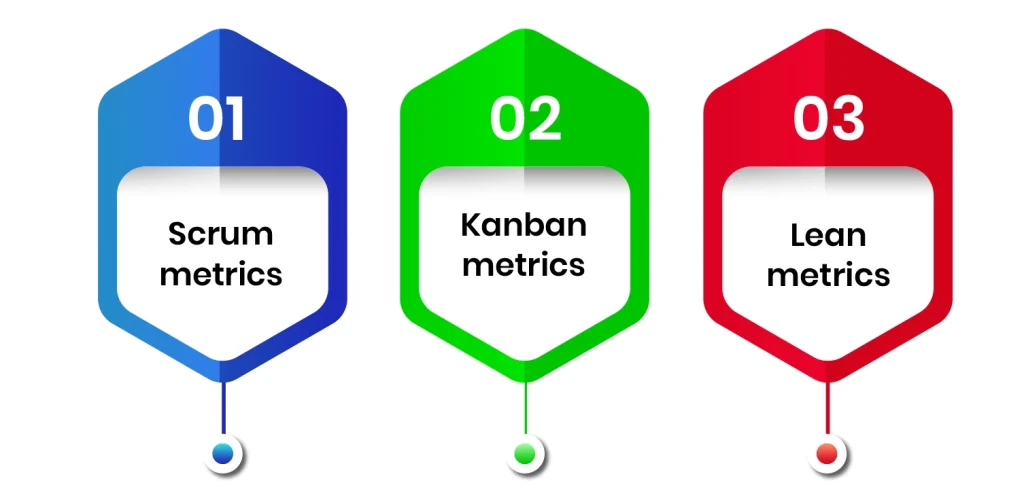
Scrum metrics
Scrum metrics are centered around timed iterations and the team’s commitment. These metrics help evaluate how a team plans and delivers work within a set timeframe. They provide insights into:
- If sprint goals are being met
- How predictable the team’s delivery is
- How well the workload is balanced
Kanban metrics
Kanban metrics focus on how smooth the flow is and continuous delivery rather than fixed iterations. They track how tasks progress through the workflow. These metrics are particularly useful for:
- Identifying bottlenecks
- Reducing cycle delays
- Optimizing throughput
Lean metrics
Lean metrics take a broader approach. Rather than focusing solely on speed or output, they measure how resources are being used to deliver customer value. The emphasis here is on:
- Eliminating waste
- Improving process efficiency
- Ensuring every activity contributes to meaningful outcomes.
What are the Agile Metrics That You Should Track for Business Growth?
Once you understand the types of Agile metrics, the next step is knowing which ones actually help you in growing your business. Your focus should be on metrics that deliver value. The following Agile metrics do exactly that:
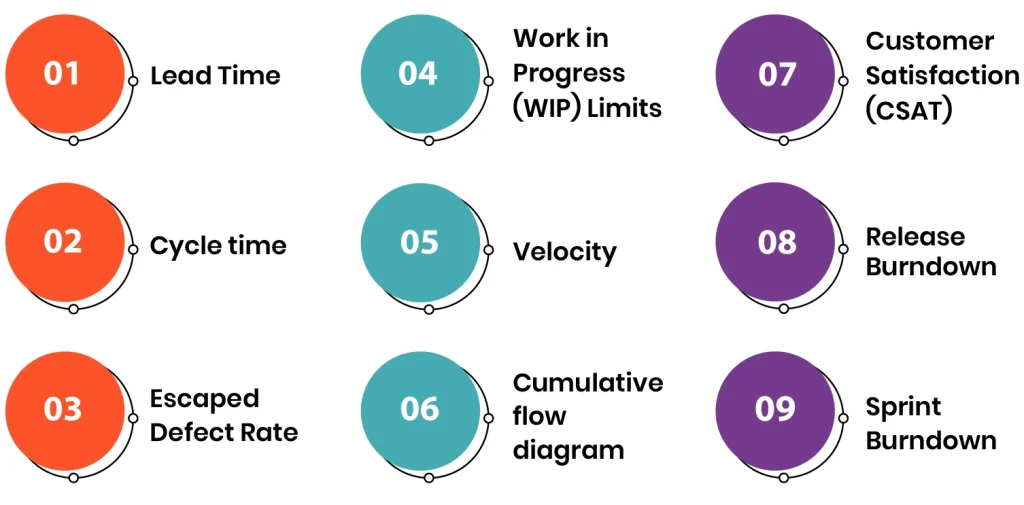
Lead Time
Lead time measures the total time it takes for a task to move from the request stage to the final delivery. This includes everything from backlog entry to the launch. This metric is critical because it reflects how quickly you can respond to market demands.
Cycle time
Cycle time zooms in on execution. It tracks how long a task takes once work has actually started. If your cycle time is increasing, it’s usually a sign of workflows slowing down or issues arising within the development process.
Escaped Defect Rate
This metric measures the number of defects that make it into production. They reach here instead of being caught during testing. A high defect rate directly impacts the user experience and retention. Tracking this helps teams strengthen their quality assurance (QA) processes.
Work in Progress (WIP) Limits
WIP limits explain how many tasks can be actively worked on at any given time. While it might seem counterintuitive, limiting work actually improves a team’s productivity. When teams take on too much at once, context switching increases and productivity decreases.
Velocity
Velocity basically measures how much work a team completes within a sprint, typically in story points. Over time, this metric becomes a reliable indicator of a team’s capacity. It’s important to use velocity solely as a planning tool.
Cumulative flow diagram
A cumulative flow diagram (CFD) visualizes the flow of tasks across different stages of the workflow over time. It gives teams a clear picture of where work is piling up and where progress is steady. If one stage starts expanding disproportionately, it signals a blockage. This is something that genuinely needs immediate attention.
Customer Satisfaction (CSAT)
At the end of the day, delivery metrics mean little if customers aren’t happy. CSAT helps in measuring how satisfied users are with your product or service, usually through surveys or feedback scores. It ensures that teams are delivering value according to customer expectations.
Release Burndown
Release burndown is here to help track the amount of work remaining in a release over time. It helps teams and stakeholders understand whether they are on track to meet release deadlines or not.
Sprint Burndown
Sprint burndown shows how much work remains versus the time left in the sprint. This metric provides daily visibility into progress and helps teams quickly identify if they’re falling behind.
How to Track Agile Metrics?
Without a clear approach, teams often end up with numbers that look good on dashboards but don’t actually result in any improvement. The goal is to build a system where metrics guide decisions. Here are the steps that you should follow for a structured method to track metrics:
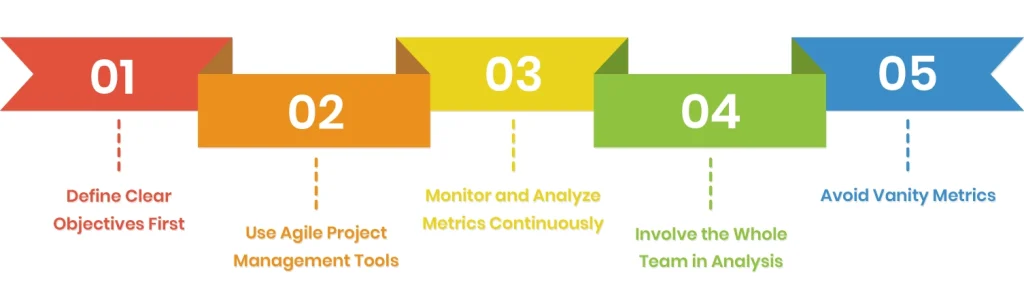
Define Clear Objectives First
Before tracking anything, you need to know what you’re trying to improve. Maybe you’re aiming for faster delivery, or you want better quality in your work. When you set your goals clearly, it will become easier to choose metrics that actually matter instead of tracking everything available.
Use Agile Project Management Tools
Most Agile metrics rely on accurate data, which is nearly impossible to manage manually at scale. By the use of reliable tools, you can automatically collect workflow data. This will naturally make it easier to track progress and generate reports.
Monitor and Analyze Metrics Continuously
Agile is built on continuous improvement, and your metrics should reflect that. Tracking them occasionally won’t give you the full picture. Instead, teams should review metrics more regularly to stay updated at all times.
Involve the Whole Team in Analysis
Metrics shouldn’t be limited to managers or stakeholders. The most valuable insights often come from the team doing the actual work. When the whole team is involved in analyzing the metrics, it creates better alignment and more practical solutions.
Avoid Vanity Metrics
Not all metrics are useful. Some may look impressive, but don’t provide any insights or contribute to business growth. For example, tracking the number of tasks completed without considering quality or impact can create a false sense of progress. Avoid that.
Conclusion
Agile metrics, when used correctly, shift your development process from a reactive one to a much more intentional one. Instead of relying on assumptions or surface-level progress updates, they give you a structured way to evaluate how work moves.
But the real impact comes from tracking the right ones and actually acting on them. Teams that treat metrics as a continuous feedback system are the ones that evolve faster and grow together.