


Most organizations today are struggling with making timely, confident decisions from all the data that they are dealing with. As data sources multiply across apps and customer touchpoints, the challenge has shifted from collection to actually being on the same page.
Legacy analytics environments are now too slow to adapt and resource-intensive when you look at the era we are currently in. They are increasingly misaligned with the pace at which modern businesses operate.
This growing gap has sped up the adoption of service-based models that make analytics more agile and accessible. Rather than investing heavily in infrastructure and specialized teams, organizations are turning to solutions that deliver insights on demand.
In this guide, we explore how the Business Intelligence As A Service model is reshaping the way organizations approach business intelligence.
What is Business Intelligence As A Service?
Business Intelligence as a Service (BIaaS) is a cloud service that takes the core capabilities of traditional analytics and delivers them in a much more flexible and accessible way. Traditionally, organizations had to build and maintain a complex in-house BI infrastructure. In the modern world, we have ready-to-use platforms (BIAAS) that can handle everything from data integration to reporting.
What makes BIaaS particularly appealing is the range of approaches it offers. Some providers deliver fully managed services, where most of the heavy lifting is handled externally, while others focus on self-service models that let internal teams explore and analyze data independently. We’ll explore these approaches later on in this blog.
What Are Some Famous Business Intelligence Tools?
When it comes to implementing business intelligence in practice, the tools you choose can significantly shape how effectively your organization turns data into a bunch of insights that you can actually use. Over the years, several platforms have appeared as industry leaders, each offering its own strengths and ease of use.
Microsoft Power BI
One of the most popular and widely adopted tools is Microsoft Power BI. It easily allows users to design interactive dashboards and reports with relatively low effort. Its affordability and user-friendly interface make it especially popular among small to mid-sized businesses, while still being powerful enough for enterprise use.
Tableau
Tableau has built a strong reputation for its advanced data visualization capabilities. It’s particularly favored by data analysts because of its unique features. They often need to explore complex datasets and present insights in a highly visual and intuitive way. Tableau helps do exactly that.
Sisense
Sisense stands out specifically beacuse of its ability to handle large and complex datasets easily. It offers strong data integration features and is often chosen by organizations that need to embed analytics into their own products or workflows.
SAP Analytics Cloud
For companies already invested in enterprise ecosystems, SAP Analytics Cloud provides a comprehensive solution that combines business intelligence and predictive analytics in one platform. It’s designed to work seamlessly with SAP’s broader suite of enterprise tools.
Oracle BI
Oracle BI is also often referred to as Oracle Analytics. It delivers robust reporting and analytics capabilities. They are particularly suited for large enterprises with complex data environments and strong database dependencies.
What types of BIAAS Approaches can businesses opt for?
Businesses adopting BIaaS don’t all follow the same path….Different needs and data maturity levels lead to different service models. Broadly, BIaaS can be delivered in three main ways, each offering a distinct balance between control and effort.
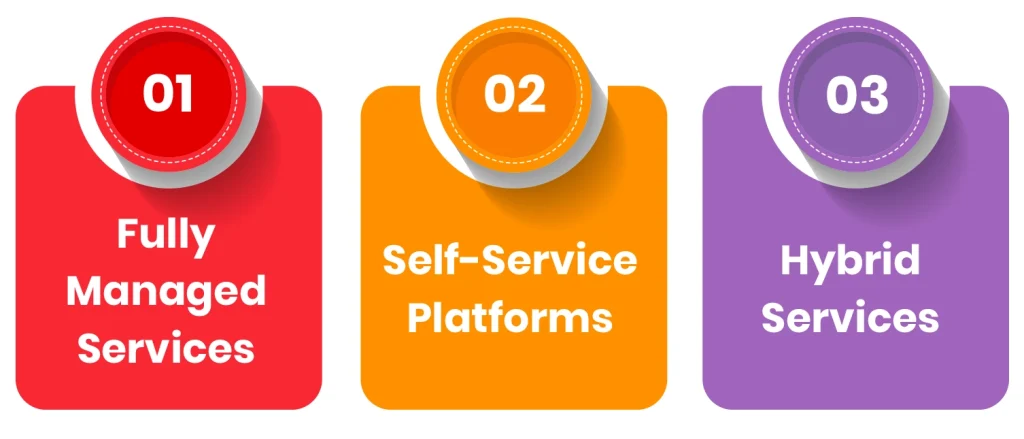
1. Fully Managed Services
In this model, most of the BI process is handled by the service provider. This includes:
- Data integration
- Pipeline management
- Dashboard creation
- Ongoing maintenance
It’s a strong fit for organizations that want to focus on outcomes rather than the technical details, or those that lack in-house data expertise.
2. Self-Service Platforms
Self-service BIaaS puts the power directly in the hands of business users. This is especially useful for businesses that want to be more in control of their data. With Self-Service BIAAS platforms, teams can:
- Connect data sources
- Build reports
- Explore insights independently
This model encourages a data- calculated culture across departments, reducing reliance on IT teams. However, it requires a certain level of data literacy within the organization to be sufficient.
3. Hybrid Services
Hybrid BIaaS combines elements of both managed and self-service approaches. Core infrastructure and data pipelines may be maintained by external providers or central teams. All while end users retain the ability to create reports and perform analysis eaily. This model offers a balanced approach, ensuring governance and data consistency while still enabling flexibility and user autonomy.
When Should Businesses Choose Business Intelligence As A Service?
Adopting Business Intelligence as a Service isn’t something that comes to organizations as a spontaneous technical decision. It’s often a result of carefully observing internal capabilities and how urgently a business needs to start using data. While BIaaS can benefit organizations at many stages, there are certain scenarios where it is particularly well-suited.
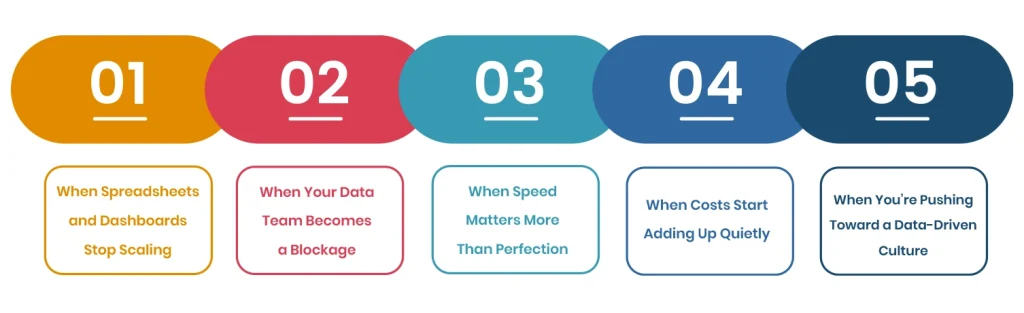
When Spreadsheets and Dashboards Stop Scaling
One clear moment is when your data starts outgrowing your tools. It genuinely becomes too much for your team. What worked fine in spreadsheets or basic dashboards suddenly feels unreliable. Teams spend more time cleaning data than actually using it. That’s often the point where BIaaS is needed.
When Your Data Team Becomes a Blockage
Another situation is when your team keeps depending on one or two “data people” for everything. Every report request turns into a ticket, every dashboard update becomes a delay. Over time, this creates a jam. BIaaS opens things up so non-technical users can explore data on their own without constantly waiting in line.
When Speed Matters More Than Perfection
It also becomes relevant when speed starts to matter more than perfection. Having a “good enough” insight today is often more valuable than a perfect report next week. BIaaS platforms are built for this kind of pace, where data is updated frequently, and insights are accessible in near real time.
When Costs Start Adding Up Quietly
Building a full BI stack internally sounds great in theory, yes, but in practice, it comes with ongoing costs that keep building on. Many teams realize they’re investing heavily just to keep things running. BIaaS shifts that model into something more flexible, where you pay for what you use and scale when needed.
When You’re Pushing Toward a Data-Driven Culture
And then there’s the bigger picture, when a company is trying to become genuinely led by data in day-to-day decisions. That shift requires making data accessible beyond just analysts or leadership. BIaaS supports that transition by lowering technical barriers and making insights part of everyday workflows.
Conclusion
The modern world has its own unique requirements. As convivninece is becoming a standard for businesses around the globe, so is new software emerging. BIAAS is one of these powerful cloud technologies that businesses need to make good use of if they want to make their processes easier and grow in the coming years.
Frequently Asked Questions
What’s the Difference Between BIAAS and SAAS?
SaaS (Software as a Service) is a broad model where software is delivered over the cloud. It consists of tools like CRMs or project management apps. BIaaS is more specific; it’s a type of SaaS focused only on data analytics and business intelligence. In simple terms, all BIaaS is SaaS, but not all SaaS is BIaaS.
What Are The Four Pillars Of Business Intelligence?
At a basic level, BI stands on four key things:
- Data collection
- Data storage
- Data analysis
- Data visualization
You gather data, organize it, make sense of it, and then present it in a way people can easily use.
What Should I Be Looking For When Choosing A BIaaS Provider?
Look for ease of use, strong data integration options, and how well it scales as your data grows. Also, pay attention to security and whether it fits your team’s technical skill level. A good BIaaS tool should feel like it simplifies your work.