

Programming is not just about writing code. It is about how you think while solving problems. Different developers follow different approaches to structure their code, and this often leads to a common comparison between two major programming styles: functional programming and object-oriented programming (OOP).
Both are widely used in modern software development, but they differ in how they handle data, logic, and structure. Instead of deciding which one is better, it makes more sense to understand how each approach works and where it fits in real projects.
Functional programming and OOP take very different paths to solving problems. Let’s break down both and compare how they actually work in practice.
Functional Programming in Simple Terms
Functional programming (FP) is a programming approach where software is built using functions that transform data instead of relying on changing state or object-based structures.
In this model, applications are designed as a sequence of function executions. Each function receives input through arguments (parameters), processes the data, and returns output without modifying external variables, shared state, or existing data. This eliminates side effects and reduces hidden dependencies in the system.
Because there is no mutation of state, program logic is expressed as data transformation pipelines rather than step-by-step state changes. This improves traceability and makes program behavior easier to reason about and debug.
Core Principles That Define Functional Programming
The use of immutable data types is a key part of functional programming. Once data is created, it cannot be modified directly. Instead, any required change creates a new data structure based on the original value rather than altering it.
Because of this immutability, pure functions become possible. These functions depend only on their input arguments. Meaning, they do not rely on or modify the external state. As a result, they also avoid side effects, such as changing variables outside their scope or interacting with shared system data.
Since inputs stay unchanged and side effects are removed, functions become deterministic. In other words, the same input will always produce the same output. No matter when or where the function runs. This improves reliability and makes testing much easier.
In addition, functional programming treats functions as first-class values. This means functions can be passed as arguments, returned from other functions, or stored in variables. As a result, developers can build higher-order functions, which help combine smaller functions into more complex logic.
Where Functional Programming Is Commonly Applied
Functional programming is commonly used in systems where predictable data flow is more important than object-based structure or shared state management.
It is often used in frontend development. Modern frameworks update UI state through controlled transformations instead of directly changing values. This way, the system becomes easier to manage and consistent.
It’s also widely used in data processing, financial systems, and distributed computing. In these systems, consistency and deterministic output matter a lot for stability. Because of this, avoiding side effects helps maintain predictable system behavior even at scale.
Object-Oriented Programming in Simple Terms
Object-oriented programming (OOP) is one of the most widely used programming paradigms and is considered more traditional compared to functional programming. It became popular through languages like Smalltalk and Objective-C in the late 1970s, and later became a core part of languages such as C++, Java, and C#.
In this approach, software is built by organizing code into objects that represent real-world entities. Classes act as templates that define the structure and behavior of an object.
Core Principles That Define Object-Oriented Programming
In OOP, apps are structured as collections of objects that interact with each other. Meaning, each object contains both data (properties) and behavior (methods), which are defined inside its class.
A class acts as a blueprint. Objects are instances created from that blueprint. Methods are functions attached to objects. They are used to perform actions or modify object data.
Unlike functional programming, object state is not fixed. Objects are mutable. This means their internal data can change over time through method calls. This allows systems to maintain and update state directly inside objects.
Because of this mutability, the current state of an object can change during execution, depending on which methods are called and in what order. While this makes modeling real-world behavior easier, it can also introduce complexity in tracking state changes across the system.
Where Object-Oriented Programming Is Used
Object-oriented programming has traditionally been used in building user interfaces and large application systems.
Many UI frameworks are designed around OOP principles, where components are structured as classes that can inherit behavior from other components. For example, a text input field can inherit properties from a generic input component. That component may itself inherit from a base control structure. This makes a clear hierarchy between elements.
This inheritance model reduces code duplication. It also allows developers to extend existing components. They can add or modify specific behaviors instead of rewriting entire logic blocks.
Today, object-oriented programming is supported in almost all general-purpose programming languages. Even languages that are mainly functional, like F#, still include OOP features such as classes and inheritance.
JavaScript is a good example. It did not originally include built-in support for concepts like classes or inheritance. These features were added later in newer versions.
How Functional Programming and OOP Differ?
Object-oriented programming and functional programming take very different approaches to building software.
OOP focuses on objects and their interactions. These objects hold state and behavior together. In contrast, functional programming focuses on functions and data transformation, where input is processed and returned without changing existing data.
The core principles behind both are also different. OOP is built on concepts like encapsulation, inheritance, polymorphism, and abstraction. Functional programming relies on immutability, pure functions, higher-order functions, and referential transparency.
Another key difference is how they handle data. In OOP, an object’s state can change over time through method calls. In functional programming, data is immutable, and functions avoid side effects, which makes behavior more predictable.
OOP is often used to model real-world systems using classes and objects. Functional programming, on the other hand, describes systems as a series of data transformations.
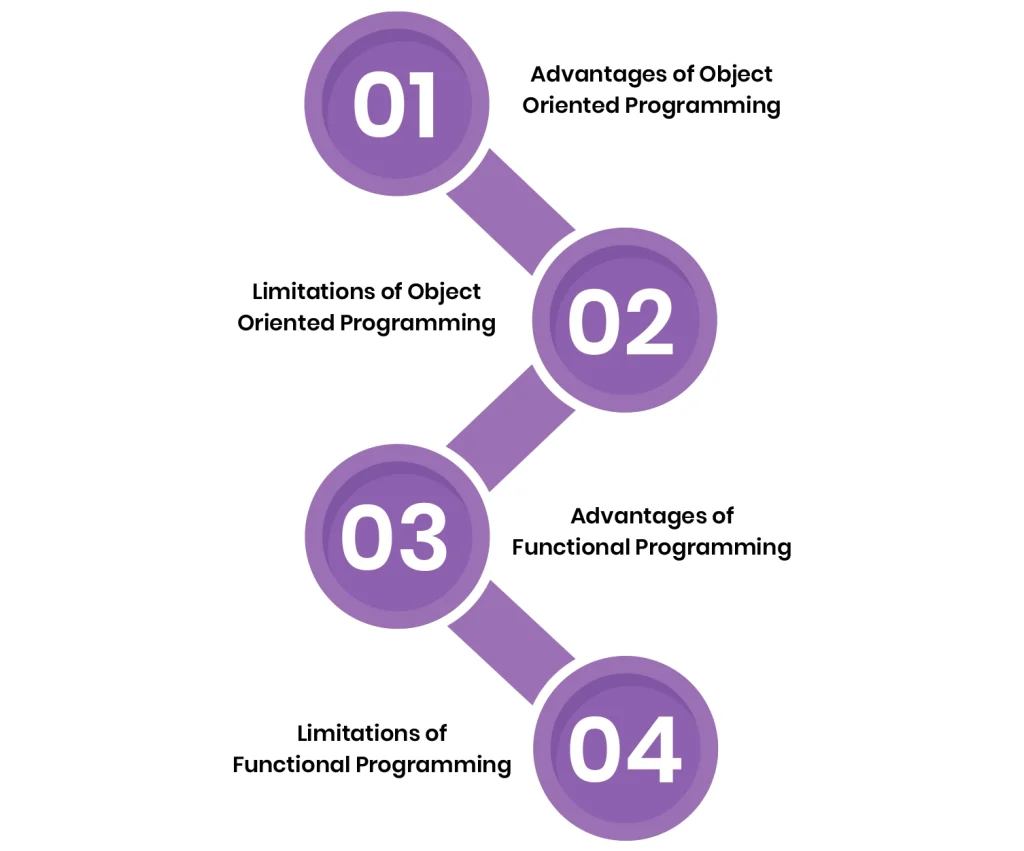
Advantages of Object-Oriented Programming
Firstly, OOP makes it easier to model complex systems by organizing code into objects. This helps break large applications into smaller, manageable parts.
Moreover, it supports code reuse through inheritance. Developers can extend existing classes instead of writing everything from scratch. Encapsulation also helps protect internal data and takes into account controlled access.
As a result, OOP is widely used in large-scale applications where structure and organization are important.
Limitations of Object-Oriented Programming
However, OOP can lead to more verbose and complex code, especially as systems grow.
In addition, since objects rely on changing state, it becomes harder to track how data evolves during execution. This can make debugging and testing even more difficult.
Furthermore, heavy reliance on shared state can create challenges when building concurrent or parallel systems.
Advantages of Functional Programming
Firstly, functional programming focuses on predictable behavior. Using immutability and pure functions, it reduces unintended side effects and makes it easier to test code.
In addition to this, functions are reusable and can be combined easily. This supports a modular approach, where small pieces of logic can build larger systems.
As a result, debugging becomes simpler because functions are deterministic and easier to reason about.
Limitations of Functional Programming
One major limitation is that functional programming can be harder to learn than OOP. Especially for developers who are more familiar with object-oriented concepts.
Moreover, working with immutable data can sometimes affect performance. This is more applicable when handling large datasets.
Lastly, heavy use of recursion and higher-order functions can make code harder to follow in more complex systems.
What the Future Looks Like for Functional Programming and OOP
Most modern programming languages today are multi-paradigm, which means they support both object-oriented programming and functional programming. Developers can use classes, inheritance, and object state, while also working with functions as values and applying immutability where needed.
Because of this, development is no longer about choosing one approach over the other. Instead, both paradigms are often used together. OOP helps structure applications, while functional programming improves how data is handled through pure functions, immutability, and function composition.
There is also a clear shift toward adding more FP-friendly features. Many languages now support better handling of immutable data, function references, and higher-order functions. These features make it easier to write predictable and reusable logic, even inside object-oriented systems.
However, combining both paradigms increases the learning curve. Developers need to understand concepts like state management, side effects, and referential transparency, which can make systems harder to follow if not used carefully.
Even then, object-oriented programming is not going away. It still plays an important role in structuring large systems. At the same time, avoiding side effects completely is not always practical, since real-world applications often depend on external interactions.
In the end, both approaches continue to exist side by side. The focus is now on using the right concept at the right place, rather than strictly following a single programming style.
Frequently Asked Questions
Which languages support both functional programming and OOP?
Many modern languages are multi-paradigm. For example, JavaScript, Python, Java, C#, and Scala support both OOP concepts like classes and inheritance, and FP concepts like higher-order functions, immutability, and function composition.
What is the main difference between functional programming and OOP?
On one hand, functional programming focuses on pure functions, immutability, and referential transparency. This means data is not changed, and functions return consistent results. In contrast, OOP is built around objects, classes, and mutable state. This is where objects manage and update their own data through methods.
How does immutability improve software reliability?
Immutability ensures that data does not change after creation. This removes issues caused by shared mutable state and makes functions deterministic. As a result, debugging, testing, and parallel processing become easier.
Do real-world applications use both FP and OOP together?
Yes, most real-world applications combine both. For example, a backend built in Java or C# may use OOP for system design, while applying FP concepts like lambda expressions, streams, or LINQ for data processing and business logic.