

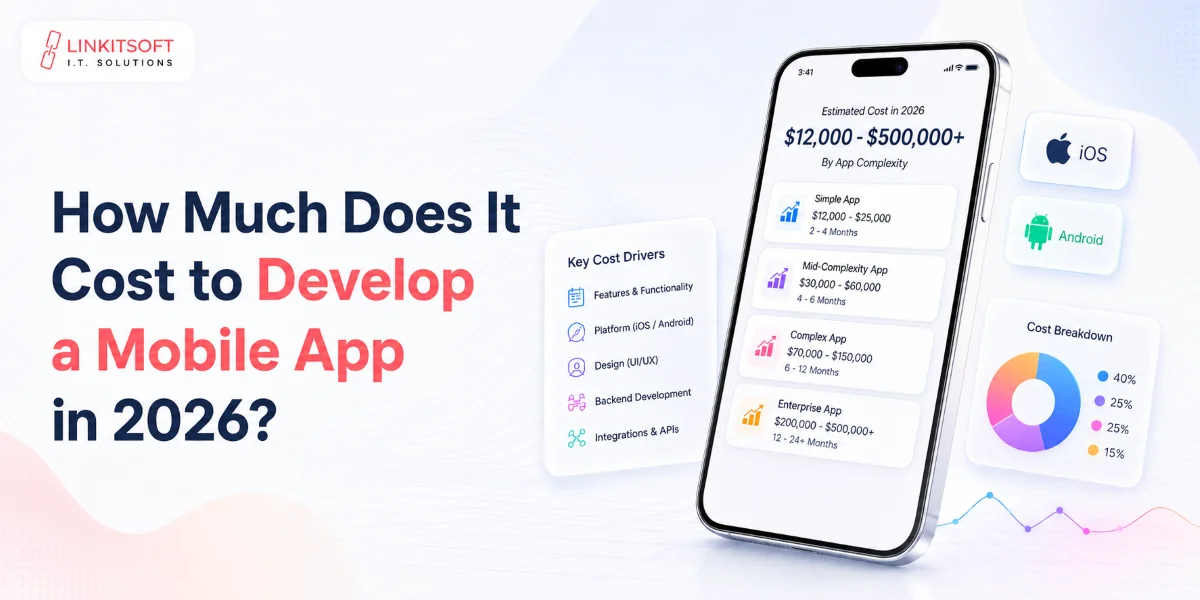
If you’re planning to build a mobile app in 2026, you should budget approximately $12,000 to $500,000+ for professional development, depending on the app’s complexity, features, platforms, backend requirements, integrations, security, design, and development approach.
A simple app can cost around $12,000–$25,000, while a mid-complexity application may cost $30,000–$60,000. Complex applications can range from $70,000–$150,000, while enterprise-level applications can reach $200,000–$500,000+.
These are planning ranges rather than fixed quotations. The actual cost of your application depends on its requirements and technical scope.
Mobile App Development Cost at a Glance

The ranges above are useful for initial budgeting. A proper estimate should be prepared after defining the application’s features, users, platforms, integrations, design requirements, backend architecture, security requirements, and launch scope.
“Pricing varies by project scope. The ranges below are general planning estimates and should not be interpreted as fixed quotations.”
What Determines the Cost of a Mobile App?
There is no universal price for mobile app development because an app is not a fixed product.
Two applications can both have 20 screens but require very different budgets. One might contain simple forms and static information, while the other might require real-time communication, payment processing, location tracking, multiple user roles, complex backend systems, and third-party integrations.
The most important cost factors are:
- Features and functionality
- Number of platforms
- Native or cross-platform development
- UI/UX design
- Backend development
- APIs and third-party integrations
- Security requirements
- Data processing and storage
- Testing requirements
- Development team
- Project scope
- App maintenance & support
- AI or machine-learning functionality
1. Features and Functionality
Features are one of the biggest drivers of development cost.
A basic application with registration, user profiles, a dashboard, simple settings, and limited backend functionality requires substantially less development effort than an application with real-time communication, payments, location tracking, complex dashboards, or advanced data processing.
Common features that can increase development effort include:
- User registration and authentication
- User profiles
- Push notifications
- Search and filtering
- In-app payments
- Subscription management
- Real-time chat
- GPS and location tracking
- Maps
- Video and audio
- Multiple user roles
- Admin dashboards
- Third-party APIs
- Analytics
- AI-powered functionality
- Complex business rules
The more functionality your application needs, the more development, testing, backend work, and project coordination it generally requires.
2. Number of Platforms
Choosing your target platforms also affects development cost.
If you need only one platform, the project can generally be scoped around that platform. If you need both iOS and Android, the development approach becomes an important cost decision.
You can choose between:
- Native iOS development
- Native Android development
- Native development for both platforms
- Cross-platform development using technologies such as Flutter or React Native
Native development uses platform-specific codebases. Cross-platform development can allow teams to share a significant portion of the code between platforms.
The right choice depends on your application’s requirements rather than simply choosing the cheapest option.
3. Native vs. Cross-Platform Development
Cross-platform frameworks such as Flutter and React Native can reduce duplicated development work when an application needs to support both iOS and Android.

This can make cross-platform development attractive for many business applications.
Native development may be more appropriate when an application requires deep platform integration, specialized device capabilities, or particularly demanding performance requirements.
The question is therefore not simply “Which is cheaper?”
The better question is:
Which development approach gives the project the right balance of cost, performance, maintainability, and functionality?
4. UI/UX Design
Design is another important part of the development budget.
A basic application may require relatively straightforward screens and navigation. A more sophisticated product may require custom interactions, animations, illustrations, prototypes, design systems, accessibility considerations, and extensive user-flow planning.
Good UI/UX can also reduce development problems later because important workflows are defined and tested before the development team builds the final product.
5. Backend Development
The mobile application is often only one part of the system.
Many applications require a backend to handle:
- User accounts
- Databases
- Authentication
- Business logic
- APIs
- Payments
- Notifications
- File storage
- Analytics
- Administration
- Third-party integrations
An application with a relatively simple mobile interface can still require substantial backend engineering.
This is one reason two applications that appear similarly sized can have very different development costs.
6. Third-Party Integrations
Integrations can significantly affect project scope.
Depending on the application, developers may need to integrate:
- Payment gateways
- Maps
- Shipping systems
- CRM platforms
- ERP systems
- Social login
- Analytics platforms
- Communication services
- Cloud services
- External APIs
- Authentication providers
Each integration needs to be evaluated for API availability, authentication, data flow, error handling, security, testing, and maintenance.
7. Security Requirements
Security becomes particularly important when an application handles sensitive information.
Examples include:
- Personal information
- Financial information
- Payment data
- Healthcare information
- Business data
- Authentication credentials
Security requirements can affect architecture, authentication, encryption, access control, testing, monitoring, and compliance.
Security should therefore be considered during planning rather than added immediately before launch.
8. Development Team Location
Development team location can affect project pricing because software-development rates vary between markets.
However, hourly rate should not be the only consideration.
A lower hourly rate does not necessarily produce a lower total project cost if the team requires more hours, has weaker communication, or produces more rework.
When comparing development companies, consider:
- Relevant experience
- Technical expertise
- Communication
- Project management
- QA processes
- Portfolio
- Security practices
- Post-launch support
- Total project scope
9. Project Scope
Scope is one of the most important factors in determining the final budget.
A project should clearly define:
- User types
- Core features
- Screens
- Platforms
- Integrations
- Backend requirements
- Admin functionality
- Security requirements
- Third-party services
- Launch requirements
Unclear requirements often result in scope changes during development.
Defining the scope before development begins makes it easier to estimate both cost and timeline.
10. AI and Machine Learning Features
AI functionality can introduce additional development requirements.
Depending on the use case, an AI-powered application may require:
- AI model or API integration
- Data processing
- Prompt or workflow design
- Backend infrastructure
- Model evaluation
- Security controls
- Usage monitoring
- Additional testing
- AI-specific infrastructure costs
The impact on development cost depends heavily on what the AI feature actually needs to do.
A simple AI API integration and a custom AI system are very different projects.
Mobile App Development Cost Breakdown
A useful way to understand an app development budget is to divide the project into major phases.
Based on Linkitsoft’s published development estimates, the approximate ranges are:

These figures should be treated as planning ranges. The actual estimate depends on the project scope and requirements.
Real Mobile App Projects We Build

What Does a Simple Mobile App Cost?
A simple mobile application typically includes basic functionality such as:
- Login and registration
- User profiles
- Basic dashboard
- Simple settings
- Limited backend functionality
- Straightforward UI/UX
Linkitsoft’s current planning range for this type of application is approximately $12,000–$25,000, with an estimated development timeline of 2–4 months.
Simple applications are often appropriate for startups validating an idea or businesses that need a focused mobile product without extensive functionality.
What Does a Mid-Complexity App Cost?
A mid-complexity application goes beyond basic functionality.
It may include:
- In-app purchases
- Real-time chat
- Custom dashboards
- API integrations
- More sophisticated backend logic
- Multiple user roles
- More advanced UI/UX
Linkitsoft’s current planning range is approximately $30,000–$60,000, with an estimated timeline of 4–6 months.
What Does a Complex App Cost?
Complex applications require more sophisticated architecture and backend systems.
They may include:
- Real-time tracking
- Multiple user types
- Advanced business logic
- Complex integrations
- Advanced security
- Large amounts of data
- Custom backend architecture
Linkitsoft’s current planning range is approximately $70,000–$150,000, with an estimated timeline of 6–12 months.
What Does an Enterprise Mobile App Cost?
Enterprise applications are designed for larger organizations and more demanding operational requirements.
They may need:
- Enterprise-grade security
- High-volume infrastructure
- Complex integrations
- CRM or ERP connectivity
- Advanced administration
- Multiple business roles
- Scalable architecture
- Extensive testing
Linkitsoft’s current planning range is approximately $200,000–$500,000+, with timelines that can extend from 12 months to 24 months or more, depending on scope.
How Much Does It Cost to Build Different Types of Apps?
The type of application affects the features and technical requirements that need to be estimated.
For example:

The category alone does not determine the price. The exact feature set and technical requirements do.
How Long Does It Take to Develop a Mobile App?
Development timelines depend on complexity.
As a general planning framework:
- Simple app: 2–4 months
- Mid-complexity app: 4–6 months
- Complex app: 6–12 months
- Enterprise app: 12–24+ months
These timelines include more than coding.
A complete project can involve:
- Discovery
- Requirements
- UI/UX design
- Development
- Backend development
- Integration
- Quality assurance
- Deployment
- Launch preparation
Changes to scope during development can extend the timeline.
What Are the Ongoing Costs After Launch?
App development does not necessarily end when the application reaches the App Store or Google Play.
Ongoing costs can include:
- Bug fixes
- Security updates
- Operating-system compatibility
- Performance monitoring
- Cloud infrastructure
- Third-party services
- New features
- Analytics
- Technical support
- Design improvements
As a planning guideline, Linkitsoft currently estimates yearly maintenance at approximately 15–20% of the initial development budget, although actual maintenance requirements vary by application.
What Are the Hidden Costs of Mobile App Development?
Some expenses are easy to overlook when preparing an initial budget.
Depending on the project, you may need to account for:
App store and platform costs
Publishing and maintaining an application may involve platform-related fees and requirements.
Cloud infrastructure
Backend systems may require hosting, storage, databases, monitoring, and other infrastructure.
Third-party services
Applications may depend on external APIs or services that have their own pricing.
Security
Security testing, monitoring, compliance work, and infrastructure can add to the overall cost.
Post-launch development
Once users start using the application, you may identify new features or improvements that were not part of the original scope.
A realistic budget should therefore consider both the initial build and the cost of operating and improving the product after launch.
How Linkitsoft Estimates Mobile App Development Cost
At Linkitsoft, we don’t treat every mobile application as the same project.
The estimation process starts by understanding what the business actually needs to accomplish.
Step 1: Understand the business and users
We identify the target users, business objectives, primary workflows, and problems the application needs to solve.
Step 2: Define the features
The idea is broken down into individual features and user roles.
Instead of estimating “a food delivery app,” for example, the team needs to understand the customer, restaurant, driver, payment, ordering, tracking, and administration requirements.
Step 3: Define the platforms
We determine whether the project requires:
- iOS
- Android
- Both platforms
- Native development
- Cross-platform development
Step 4: Define the UI/UX scope
We determine the required screens, user journeys, interactions, prototypes, and design requirements.
Step 5: Define the backend and integrations
The technical scope includes databases, APIs, authentication, third-party services, administration, cloud infrastructure, and other backend requirements.
Step 6: Estimate development and QA
The feature and technical scope is translated into development, testing, project-management, and deployment requirements.
Step 7: Plan the launch and maintenance
Finally, we consider deployment requirements and the support needed after launch.
This process produces a project-specific estimate instead of applying one generic price to every application.
How to Reduce Mobile App Development Costs Without Sacrificing Quality
Reducing cost does not necessarily mean choosing the cheapest development team.
The better approach is to control scope and prioritize the work that matters most.
Start with an MVP
MVP development focuses on defining and building the smallest feature set needed to validate the core idea.
Instead of building every planned feature at once, businesses can launch the essential functionality first and expand based on real user feedback.
Define requirements before development
Clear requirements reduce unnecessary revisions and scope changes.
The more clearly the project is defined before development begins, the easier it is to estimate cost.
Choose the right platform strategy
If the application does not require separate native codebases, a cross-platform approach may reduce duplicated development work.
However, platform strategy should be based on the application’s technical requirements.
Prioritize integrations
Not every integration needs to be part of version one.
Prioritize the integrations required for the initial product and schedule lower-priority functionality for later releases where appropriate.
Don’t cut QA
Reducing testing to save money can create more expensive problems after launch.
Proper QA helps identify usability, compatibility, security, and functional problems before users encounter them.
Plan for scalability
An MVP can be small without being poorly architected.
Planning for future growth can reduce the need for expensive redevelopment when the user base or functionality expands.
What Is the Cheapest Way to Build a Mobile App?
The cheapest approach is usually to reduce the scope of the first release rather than simply selecting the lowest-cost development provider.
A focused MVP can contain only the features necessary to validate the business idea.
For example, instead of launching with ten advanced features, a business might launch with:
- Core user registration
- One primary user journey
- Essential backend functionality
- Required payment or integration functionality
- Basic administration
- Necessary analytics
Additional features can then be added after the product has been validated.
How Can I Get an Accurate Mobile App Development Estimate?
A reliable estimate requires more information than an app idea or a list of competitors.
At minimum, the development team should understand:
- What the application does
- Who will use it
- Which platforms are required
- Core features
- User roles
- Required integrations
- Backend requirements
- Design expectations
- Security requirements
- Expected launch scope
The more clearly these requirements are defined, the more accurately a development team can estimate the project.


