

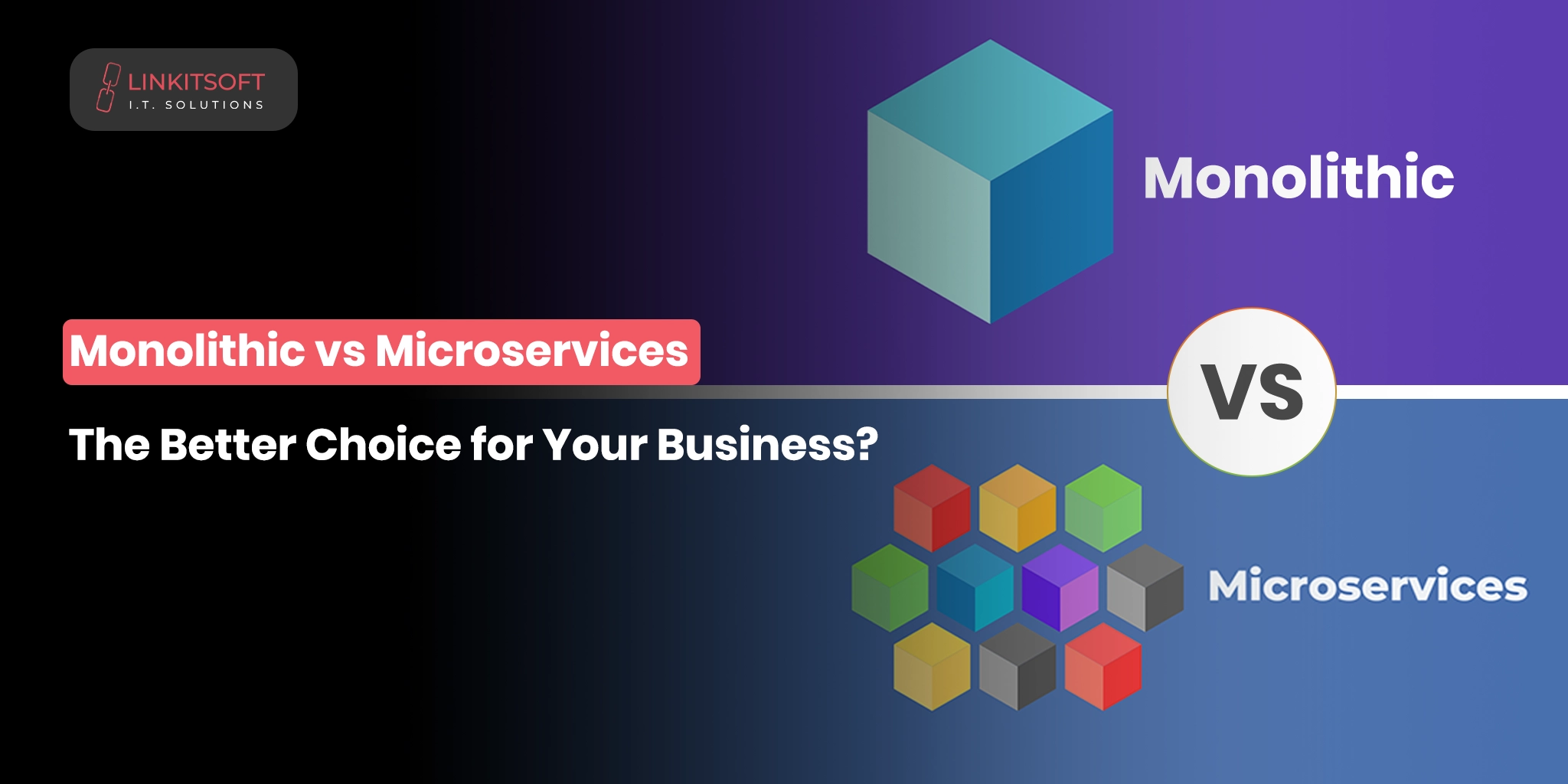
A monolithic application is built as one single system, while a microservices architecture is made up of smaller, independent services. So, which one should you choose? The answer depends on your business needs, team size, and how fast you plan to expand.
The idea of microservices became popular in 2009 with Netflix. As its streaming platform grew quickly, Netflix began facing serious performance issues. Its monolithic system couldn’t handle the rising demand. This made updates slow and scaling difficult. To solve this, Netflix moved to the cloud and broke its system into smaller, independent services, which is what we now call microservices. This shift helped them scale faster and deploy updates more frequently without affecting the entire platform.
In this blog, we will explain monolithic vs microservices, their key differences, and help you decide which architecture is right for your app.
What is a Monolithic Architecture?
A monolithic architecture refers to a traditional way of building software where the entire application is created and managed as one complete system. All the main parts of the app, including the user interface, business logic, and database, are tightly connected and run from a single codebase.
In this setup, everything works together as one unit. This means if developers want to make even a small change, they usually have to update and redeploy the whole application. Because of this, development can feel simple in the beginning, but it becomes more difficult as the application grows in size and complexity.
Monolithic architecture is often a good choice for early-stage projects. It allows teams to build and launch faster since everything is in one place and easier to understand. However, as more features are added and the user base grows, managing the system can become time-consuming.
Advantages of a Monolithic Architecture
- Development is simpler in the early stages because there is only one codebase to manage, making it easier for teams to build and understand the system.
- Deployment is straightforward since the entire application is packaged and released as a single unit, without dealing with multiple services.
- Testing becomes easier because all components are connected, allowing developers to test the full application flow at once.
- Performance can be more efficient in some cases, as there is no need for communication between separate services.
- Debugging is easier because all the code is in one place, making it simpler to track and fix issues.
Disadvantages of a Monolithic Architecture
- Development slows down over time as the application grows larger and more complex, making even small changes harder to implement.
- Scaling is limited because you cannot scale individual features and must instead scale the entire application.
- A failure in one part of the system can affect the whole application, increasing the risk of downtime.
- Adopting new technologies becomes difficult since changes often require updates across the entire codebase.
- Every update requires redeploying the whole application, which can make the process slower and less flexible.
What are Microservices?
Microservices are a modern way of building applications where the system is divided into smaller and independent services. Each of the services is responsible for a specific function, such as user management, payments, or notifications, and works on its own.
Unlike a monolithic system, these services are loosely connected. This means each one can be developed, tested, deployed, and scaled without affecting the others. In many cases, each service can even use its own database and technology, depending on what fits best.
Instead of lessening complexity, microservices organize it better. They break a large system into smaller, manageable parts, making it easier for teams to focus on specific features. This approach is often used by growing companies that need faster updates and better scalability.
Microservices also work well with modern practices like continuous integration and continuous delivery. This allows teams to introduce updates more frequently and respond quickly to user needs.
Advantages of Microservices
- Each service can be made and deployed independently, which allows teams to release updates faster without waiting for the entire system.
- Scaling becomes more efficient because only the required service can be scaled instead of the whole application.
- The system is more reliable since a failure in one service does not bring down the entire app.
- Teams have the flexibility to use different technologies or tools for different services based on their needs.
- Maintenance becomes easier over time because smaller services are simpler to manage, update, and test.
- It supports faster release cycles, allowing businesses to roll out new features more frequently.
- Teams can work more independently, which improves productivity and speeds up development.
Disadvantages of Microservices Architecture
- The system becomes more complex because multiple services need to be managed instead of just one application.
- Infrastructure costs can increase since each service may require its own deployment, monitoring, and resources.
- More coordination is needed between teams, which can slow things down if not managed properly.
- Debugging is harder because issues may involve multiple services running on different systems.
- Maintaining consistency across services, such as data handling and security, can be challenging.
- Without proper planning, it can lead to too many services, making the system difficult to control.
- It may not be the best choice for small projects, where a simpler monolithic approach can work better.
When Should You Move from Monolith to Microservices?
Most products start as a monolithic system because it is faster to build and easier to manage in the beginning. A single codebase helps small teams move quickly without worrying about complex infrastructure or service coordination.
However, as the product grows, the limitations start to show. More developers working on the same codebase can lead to frequent merge conflicts. Even small updates begin to require testing and deploying the entire application. Over time, release cycles slow down, and scaling specific parts of the system becomes difficult.
At this stage, teams start evaluating whether a shift to microservices makes sense. This decision is usually affected by real operational challenges, not just architecture preference.
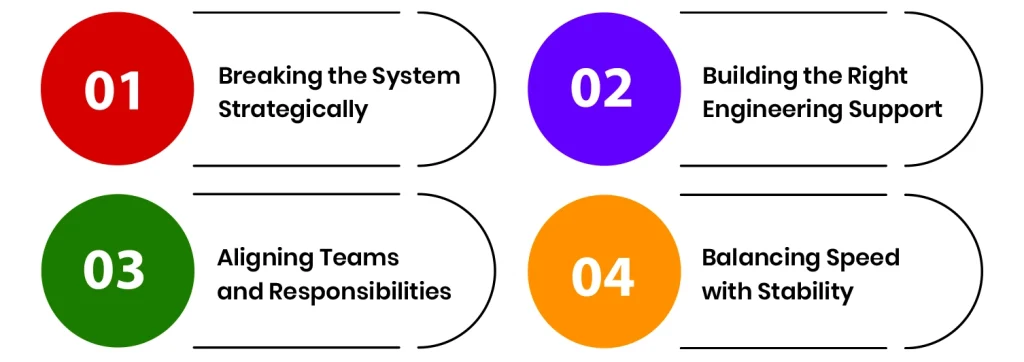
Breaking the System Strategically
Migration is not just about splitting everything randomly. The key is identifying boundaries within the system where features can be separated without breaking functionality.
Typically, teams start with less risky or more independent modules first. This allows them to test the approach, reduce pressure on the core system, and gradually build confidence before moving critical components.
A poorly planned split can create more complexity than it solves, which is why this phase requires careful technical judgment.
Building the Right Engineering Support
Microservices introduce multiple moving parts, so the supporting infrastructure becomes just as important as the services themselves. Teams usually invest in automation, service tracking, and centralized monitoring to maintain visibility across the system.
Without proper tooling, managing dozens or even hundreds of services can quickly become difficult. The goal is not just to create services. Rather, it is to make sure they can be deployed, observed, and maintained efficiently at scale.
Aligning Teams and Responsibilities
One major shift during migration is how teams are structured. Instead of multiple developers contributing to one shared system, ownership is divided across services.
This improves speed and accountability, but it also requires clear boundaries. Each team needs to understand what they own and how their service interacts with others. Without this clarity, dependencies can become complicated. This will inevitably slow down development instead of improving it.
Balancing Speed with Stability
A common challenge during migration is deciding how fast to move. While it may be tempting to migrate quickly, rushing can lead to instability in production systems.
Successful transitions usually prioritize stability over speed. And the right teams gradually move functionality while making sure that performance and reliability are not compromised. This controlled approach helps avoid downtime and reduces long-term technical debt.
Final Perspective
Monolithic and microservices architectures are both valid approaches. A monolith can work perfectly fine for many apps, especially when things are small, and the priority is building quickly and keeping everything simple. But as systems and user demand grow, scaling and updating a single codebase can start to slow teams down. That’s where microservices can help, by splitting things into smaller parts that are easy to manage independently. Still, switching to microservices is not something every product needs. If a monolith is stable and doing its job well, there is no real benefit in breaking it just because it is a modern trend.
Frequently Asked Questions
Is monolithic architecture still used today?
Yes, many applications still use monolithic architecture, especially smaller or early-stage products. It is simple to build, easy to deploy, and works well when the system is not very complex.
Why do companies shift from monolith to microservices?
Companies usually make the shift when their application grows and becomes harder to manage. Microservices help improve scalability, speed of updates, and allow different parts of the system to be developed independently.
Can a monolithic system be converted into microservices later?
Yes, many companies start with a monolith and gradually move to microservices as their needs grow. However, the transition requires careful planning because it involves breaking a large system into smaller parts without disrupting functionality.