
The Product Development Life Cycle (PDLC) is a framework that developers follow to manage the entire development of a product. It is an iterative approach based on feedback and other key factors to ensure that all stakeholders’ requirements are met.
You have probably heard of the SDLC (Software Development Life Cycle) before and may have it confused with the PDLC (Product Development Life Cycle). However, this process is completely different and has different stages. Although it shares some similarities, its differences set it apart. Let’s explore how a PDLC process works.
What is a Product Development Life Cycle (PDLC)?
The Product Development Life Cycle (PDLC) is the complete journey of a product. It helps a product go from a simple idea in someone’s mind to something real that users can actually interact with and give feedback on.
Following the PDLC properly helps shape an experience that people will actually find useful. That’s why it involves a mix of
- Strategy
- Design thinking
- Development
- Testing
- Iteration
PDLC is about building the product right by focusing on understanding the problem first and continuously improving it. This happens after validating ideas based on real user feedback. It follows in stages because until one is complete, you can’t directly move on to the other.
What are the Stages of the Product Development Life Cycle?
While the exact structure can vary from company to company, most PDLC models follow a clear set of seven stages. Each phase plays a distinct role in turning an idea into a successful product that is ready to enter the market. Let’s explore these stages below:
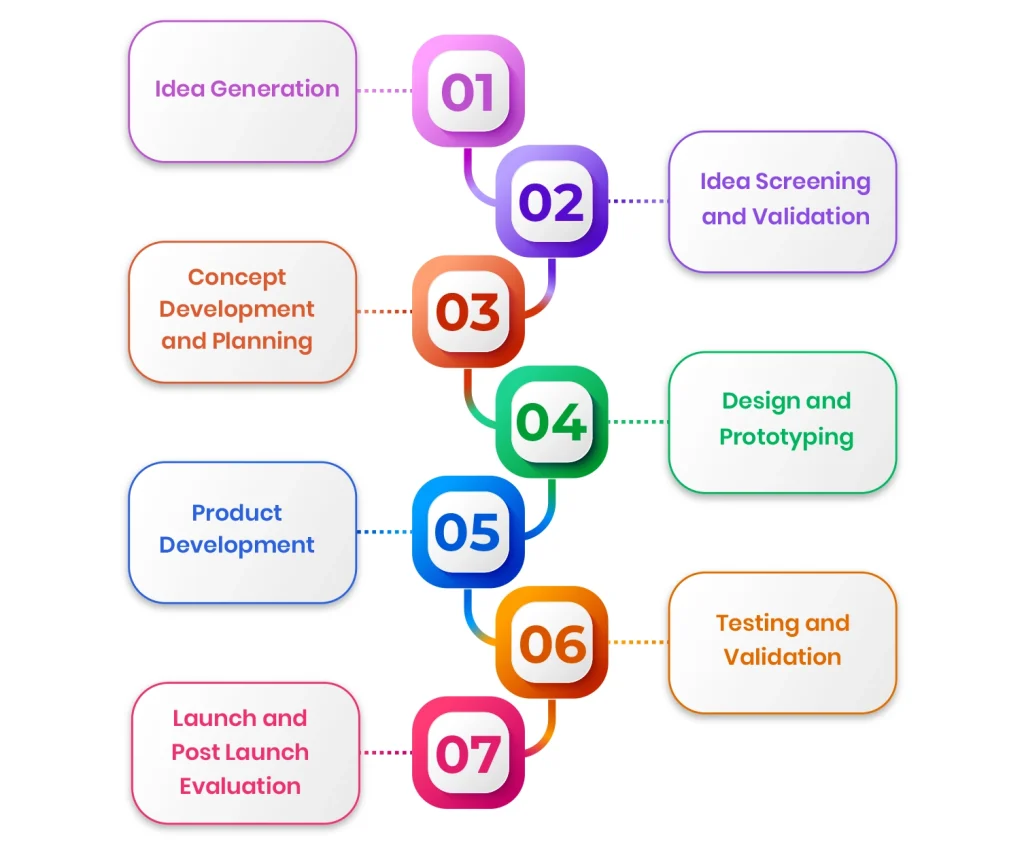
Stage 1: Idea Generation
Every product begins with an idea, but in PDLC, you’re focused on identifying real and valuable opportunities that can introduce something new in the market.
These ideas are typically derived from:
- Market gaps
- Customer pain points
- New, emerging technologies
- Competitive analysis
Businesses often rely on internal brainstorming sessions, user feedback plus industry research to generate concepts that are viable. The goal here for companies is to explore multiple possibilities and filter them based on feasibility and potential value.
Stage 2: Idea Screening and Validation
Once a set of ideas is generated, the next step is to evaluate them critically. This stage focuses on determining whether an idea is even worth pursuing.
This begins by analyzing factors such as:
- Target audience demand
- Competitive landscape
- Technical feasibility
- Alignment with business objectives.
Validation methods may include surveys and early concept testing. By eliminating weak or impractical ideas early, organizations can avoid unnecessary investment and focus only on concepts with strong potential.
Stage 3: Concept Development and Planning
After selecting a viable idea, it is improved and turned into a clear product concept. From this stage onwards, the product moves on to its journey of becoming a product. It isn’t just a concept anymore.
This involves determining factors like:
- Product’s core features
- Value proposition
- Target users
- Overall functionality
Teams also create initial documentation and product plans to establish direction and scope. Planning at this stage ensures that all stakeholders have a shared understanding of what is being built and why.
Stage 4: Design and Prototyping
In this phase, the product is now going to begin to take shape visually and functionally. Teams here visualize in detail how the product will look and feel before it becomes a real element. This stage is here to make sure that everything is aligned with user expectations before development begins
Design teams are at work here… They create:
- Wireframes
- Mockups
- User interface (UI) layouts
- Interactive prototypes
This helps represent how the product will behave. Prototypes allow stakeholders and even potential users to experience the product early, making it easier to identify usability issues or missing features. This stage emphasizes user experience (UX), ensuring that the product is accessible.
Stage 5: Product Development
This is where the actual development of the product takes place. Developers now turn designs and requirements into working software. They often do this while using iterative methodologies such as Agile or Scrum.
The product is typically built in increments, allowing for:
- Continuous testing
- Feedback
- Improvement throughout the process.
This stage improves collaboration between developers and product managers since it is critical for a product’s success. This helps ensure that the final output is fully aligned with the original concept and business goals.
Stage 6: Testing and Validation
Before the launch, the product undergoes rigorous testing to make sure of great quality and reliability. The testing phase is very important, as issues need to be solved before they go out in the real world. Oftentimes, a business’s reputation depends on it.
These tests can include:
- Functional testing
- Usability testing
- Performance evaluation
- Bug fixing
- Others (if required)
The aim is to identify and also resolve issues that could impact user experience or system stability. In many cases, businesses may also release a beta version to a specific, limited audience to gather real feedback and make final adjustments.
Step 7: Launch and Post-Launch Evaluation
The final stage involves releasing the product to the market and monitoring its performance. However, PDLC does not end at the launch. Post-launch evaluation keeps going because it is critical for understanding a few aspects.
These aspects are:
- How users interact with the product
- Identifying areas for improvement
- Planning future updates.
Different metrics are used to check them. They can be user engagement metrics, retention metrics, and even feedback. They all play a strong role in shaping ongoing iterations. Continuous improvement ensures that the product remains relevant and competitive over time.
Common Mistakes in the Product Development Life Cycle (PDLC) And How to Avoid Them
Even with the perfect PDLC in place, things can go off track pretty quickly if the process isn’t handled carefully. Most failures don’t happen because the idea was bad… They happen because of poor execution or ignoring user needs.
Here are some of the most common mistakes teams make, and how to avoid them:
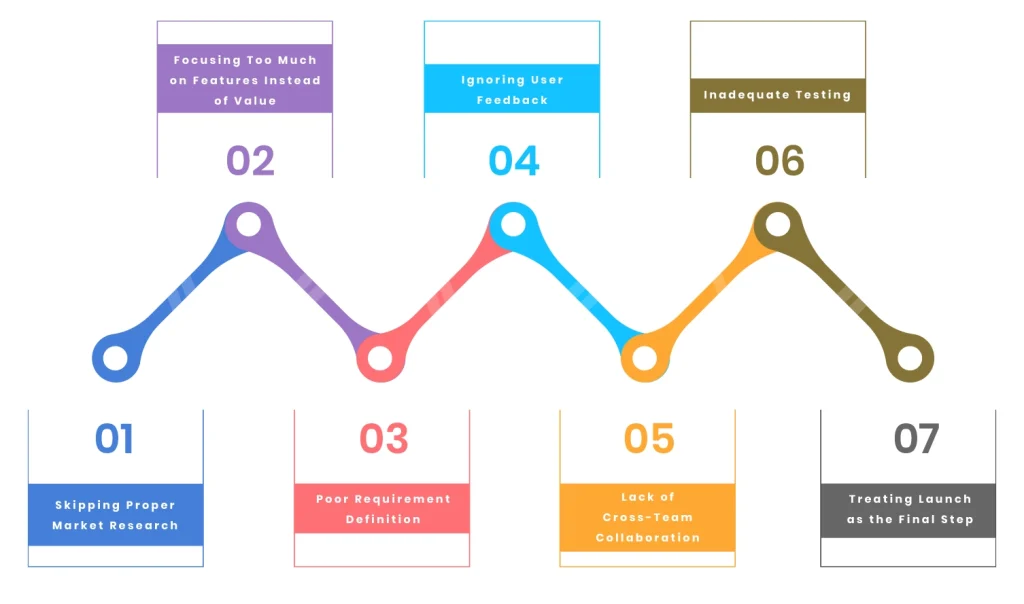
Skipping Proper Market Research
One of the biggest mistakes is jumping into development without fully understanding the market or the problem. When teams assume they already know what users want, they risk building something that solves the wrong problem… or worse, something no one needs.
How to avoid it:
Invest time in user research and validating demand before committing resources like time and money.
Focusing Too Much on Features Instead of Value
It’s easy to fall into the trap of adding more and more features, thinking it will make the product better. In reality, this often leads to complexity and a confusing user experience.
How to avoid it:
Prioritize the core functionality that delivers actual value. Focus on solving one problem really well instead of trying to do everything at once.
Poor Requirement Definition
Unclear or constantly changing requirements can slow down development and create misalignment across teams. This often results in rework and frustration.
How to avoid it:
Define clear product requirements early and ensure all stakeholders are aligned with this information. Using structured frameworks like user stories can help maintain clarity.
Ignoring User Feedback
Some teams treat feedback as an afterthought, only collecting it after launch… and some teams don’t even do this. Oftentimes, this is a red flag. This disconnect can lead to products that don’t resonate with users.
How to avoid it:
Make feedback a continuous part of the process. Gather input during each phase, but don’t overdo it. It can be used to guide improvements.
Lack of Cross-Team Collaboration
PDLC involves multiple team members, such as product managers, developers, and even marketers. This makes collaboration important because poor communication between them can create gaps in execution. This often leads to inconsistencies between the product vision and the final output.
How to avoid it:
Encourage regular collaboration through meetings and transparent workflows. Everyone should be aligned on the product goals and progress.
Inadequate Testing
Rushing through the testing phase or treating it as a formality can result in bugs and poor user experience after launch.
How to avoid it:
Implement thorough testing at every stage of development. This includes functional and performance testing… not just the QA that comes at the final stage.
Treating Launch as the Final Step
Many teams consider the product “done” once it’s launched, which can limit long-term success. In reality, launch is just the beginning.
How to avoid it:
Monitor performance metrics and continuously improve the product. A successful PDLC is ongoing and will need improvement over time.
Conclusion
The PDLC gives teams and businesses a clear direction and a structured approach to follow for a product’s success. It helps teams make smarter decisions at every stage of the product journey.
In a competitive market, the difference between a product that fades out and one that grows often comes down to how well this process is followed. Teams that stay flexible and adapt quickly are far more likely to build products that remain relevant and aligned with real needs.