
Managing wealth today is not just about tracking portfolios. Many firms still depend on spreadsheets, scattered tools, and manual reporting, which slows everything down. At the same time, advisors spend more time handling data than actually advising their clients on managing wealth. This creates gaps in both efficiency and service quality.
At the same time, client expectations have shifted. They want real time access to their investments, simple dashboards, and clear insights they can understand. They also expect everything to work smoothly across devices. Because of this, firms are now being judged as much on their technology as on their financial expertise.
This is why wealth management software development is becoming a priority. A well built platform can bring data into one place, automate routine tasks, and improve how advisors and clients interact. In this guide, we will break down how these systems work, what features matter, how to build one, and what it may cost.
What Is the Purpose of Wealth Management Software?
Wealth management software brings all key operations into one system. It connects portfolio tracking, financial planning, client communication, and compliance, so firms do not rely on scattered tools.
For advisors, it reduces manual work like reporting and data collection, so they can focus more on clients. For clients, it offers a clear view of their investments and goals in one place. For firms, it improves control, consistency, and compliance while making it easier to scale with connected systems and APIs.
What Is Driving the Demand for Wealth Management Software
The wealth management industry is shifting fast as firms move toward digital platforms to handle rising client expectations and regulatory pressure.
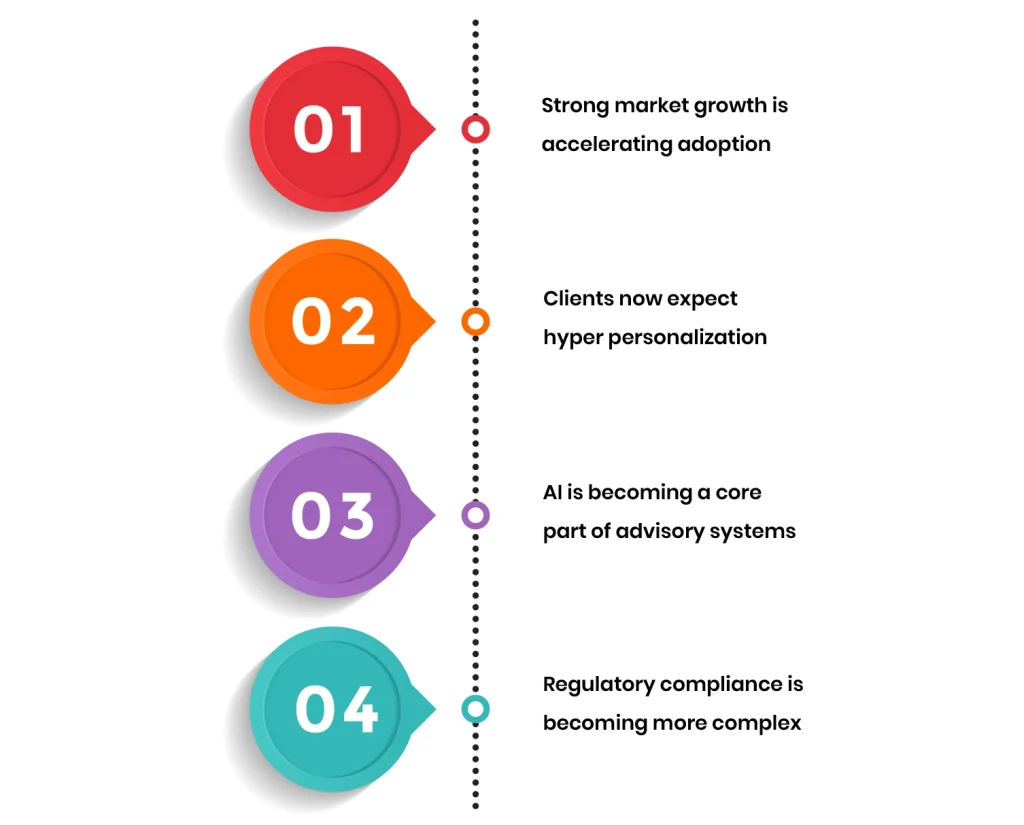
1. Strong market growth is accelerating adoption
The wealth management software market globally is projected to reach around $12.7 billion by 2030, growing at a nearly 14% CAGR. This growth is due to increasing digital adoption, rising investable wealth, and the need for automated advisory systems that reduce manual work.
2. Clients now expect hyper personalization
Modern investors want more than basic portfolio updates. They expect insights based on goals, risk appetite, and life decisions. Around 70% of clients prefer personalized financial advice rather than generic reports, pushing firms to adopt smarter, data driven platforms.
3. AI is becoming a core part of advisory systems
Artificial intelligence is no longer optional. It is now used for predictive analytics, portfolio rebalancing suggestions, and risk alerts. AI powered tools can help identify churn risks early and even highlight tax saving opportunities before advisors manually review portfolios.
4. Regulatory compliance is becoming more complex
Financial regulations are continuously evolving across regions like GDPR, SEC rules, and AML requirements. Automated compliance systems help firms lessen manual reporting errors, maintain audit trails, and stay aligned with changing legal standards without slowing down operations.
Popular Types of Wealth Management Software
Wealth management platforms come in different categories depending on what a business wants to achieve. Some focus on investments, some on planning, and others on compliance or client engagement.
| Type of Software | What It Does | Who Uses It |
| Portfolio Management Systems | Tracks investments in real time, monitors performance, and supports portfolio rebalancing based on market changes and risk levels. | Financial advisors, asset managers, and investment teams |
| Financial Planning Tools | Helps create long term financial plans, including retirement goals, education funding, and scenario-based forecasting like “what if” analysis. | RIAs, family offices, and advisory firms |
| Trading Platforms | Enables buying and selling of securities with live market data, order execution, and, in some cases, automated trading strategies. | Wealth managers, investment firms, and active traders |
| Investment Accounting Systems | Manages financial calculations such as returns, taxation, reconciliation, and compliance reporting for complex portfolios. | Accounting teams, compliance officers, and large wealth firms |
| Client Lifecycle Management (CLM) | Handles onboarding, KYC checks, document verification, and ongoing client servicing workflows in one system. | Private banks and regulated advisory firms |
| CRM and Communication Platforms | Stores client data, tracks interactions, and manages communication history to improve relationship management. | Advisory teams and client-facing wealth managers |
| Analytics and Reporting Tools | Converts financial data into reports, dashboards, and insights for better decision-making and client reporting. | Data-driven wealth firms and advisory institutions |
Key Features and Emerging Capabilities in Wealth Management Software
Wealth management platforms combine essential tools for advisors, clients, and firms in one system. Some features handle daily operations, while others focus on intelligence, automation, and better customer experience.
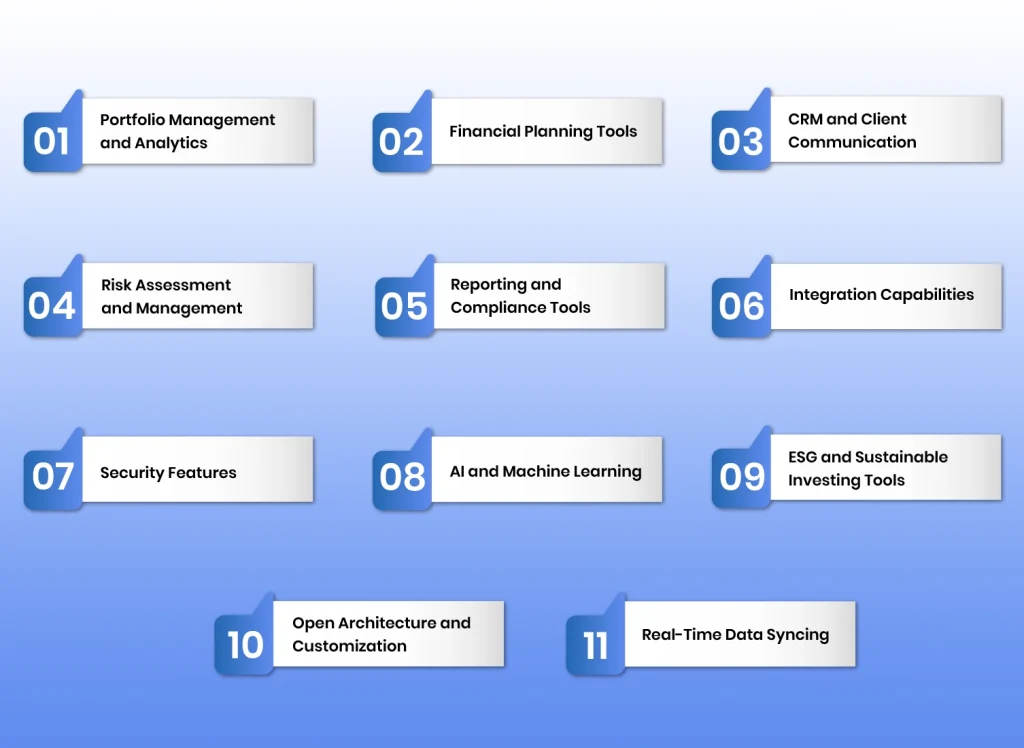
Portfolio Management and Analytics
This feature tracks investments and shows performance in real time across different assets. It helps advisors see profits, losses, and risk exposure clearly and supports rebalancing so portfolios are aligned with client goals.
Financial Planning Tools
These tools help advisors develop long term financial strategies for clients. They support goals like retirement, education, and wealth creation through scenario based planning. Clients can see how different decisions impact their future outcomes.
CRM and Client Communication
A CRM system keeps all client information, conversations, and preferences in one place. It helps advisors stay organized and respond in a more personal way. This improves engagement and strengthens long term client relationships.
Risk Assessment and Management
This feature evaluates how much risk a client can handle and checks if their portfolio still matches that level. Basically, it highlights imbalances and suggests adjustments when needed. This helps reduce unexpected losses and improves decision making.
Reporting and Compliance Tools
These tools automate financial reports and maintain audit records for regulators. They lessen manual paperwork and make sure that firms stay aligned with financial rules. This makes compliance faster and more reliable.
Integration Capabilities
Integration features connect the platform with banks, market data providers, and third party tools. This makes a single system where all financial data is updated and accessible. It removes the need to switch between multiple platforms.
Security Features
Security tools protect sensitive financial data using encryption, authentication, and access control. They also include backup systems to prevent data loss. This makes sure that client information stays safe at all times.
AI and Machine Learning
AI features help analyze data patterns, detect risks, and suggest investment actions. It supports advisors by lessening manual analysis and enhancing decision speed. Over time, it makes financial planning more accurate and proactive.
ESG and Sustainable Investing Tools
These tools help build portfolios based on environmental and social values. Clients can invest in companies that match their personal beliefs. It adds a values based layer to investment decisions.
Open Architecture and Customization
Open architecture allows firms to add or remove tools based on their needs. It supports third party integrations and flexible workflows. This makes the system adaptable as the business grows.
Real-Time Data Syncing
This feature updates portfolio data, market prices, and transactions instantly across the platform. This means clients and advisors always see the latest information without waiting for any manual updates.
Wealth Management Software Development Process
Creating a wealth management platform needs clear planning and strong system design. It also requires secure data handling and a smooth user experience. The process is divided into stages so the product stays stable, compliant, and easy to use for advisors and clients.
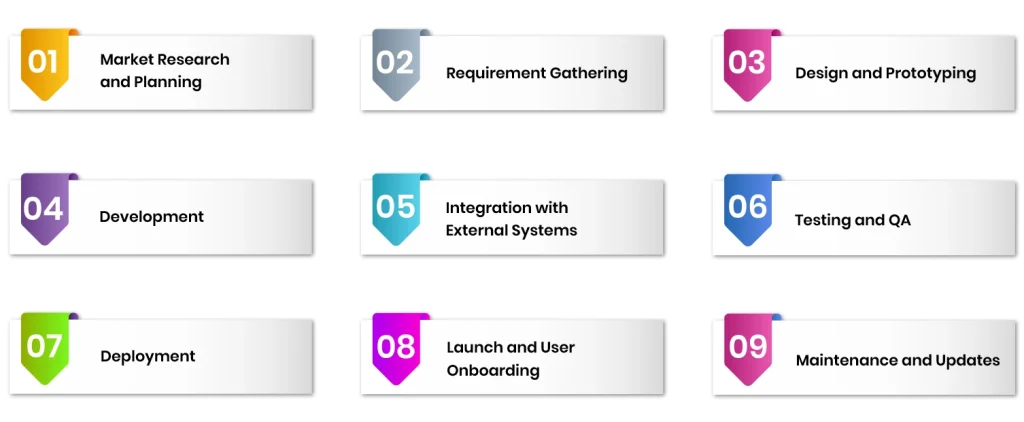
1. Market Research and Planning
This stage starts with understanding the market and user needs. Teams study how financial advisors and investors currently work and what challenges they face. At the same time, competitor platforms are reviewed to see what is already working and what is missing. Hence, the goal is to identify real gaps and define features that solve actual problems instead of adding unnecessary complexity.
2. Requirement Gathering
Once the direction is clear, detailed requirements are documented. Core features such as portfolio tracking, reporting, CRM, and financial planning are defined. At the same time, different user roles like advisors, clients, and admins are mapped out. Compliance and security requirements are also added because financial data must follow strict regulations. This step ensures everything is aligned before development begins.
3. Design and Prototyping
In this stage, ideas are turned into visual designs and working prototypes. Wireframes are created to show how each screen will function. User journeys are also mapped so navigation feels natural and simple. After that, early feedback is collected because small changes at this stage are easier to fix. As a result, the final design becomes cleaner and more user friendly.
4. Development
This is the core building phase. Backend systems are developed to manage data, logic, and APIs, while frontend teams build dashboards and user interfaces. At the same time, security layers such as encryption, authentication, and access control are added. Hence, the software becomes both functional and secure from the start rather than as an afterthought.
5. Integration with External Systems
After the core system is built, it is connected with external services like banks, payment gateways, and accounting tools. APIs are used for smooth data exchange between systems, and integration testing is performed to make sure all data remains accurate and consistent. This helps reduce manual work and improves overall efficiency.
6. Testing and QA
Before launch, the platform goes through detailed testing. Each feature is checked individually, and real user scenarios are also tested. In addition, performance testing ensures the system can handle heavy usage. Security testing is also performed to identify risks. Therefore, any issues are fixed before the product goes live.
7. Deployment
Once testing is complete, the platform is deployed to a live environment. It can be hosted on the cloud or on internal servers, depending on business needs. At the same time, backup systems and monitoring tools are set up. This makes sure the software runs smoothly and remains stable after launch.
8. Launch and User Onboarding
After deployment, users are introduced to the platform. Simple onboarding guides and walkthroughs are provided so users can understand the system quickly. At the same time, continuous support is made available to handle early questions. This helps advisors and clients start using the wealth management platform without any confusion.
9. Maintenance and Updates
Even after launch, the wealth management platform continues to evolve. Bugs are fixed as they appear, and performance is improved over time. Moreover, extra features are added based on real user feedback and market changes. As a result, the software remains updated and secure in the long run.
Common Challenges in Wealth Management Software and Practical Solutions
Building wealth management platforms often looks simple at a surface level, but real complexity shows up during development. Issues related to security, compliance, system integration, and user behavior can slow things down. However, with the right approach, each challenge can be handled in a structured way.
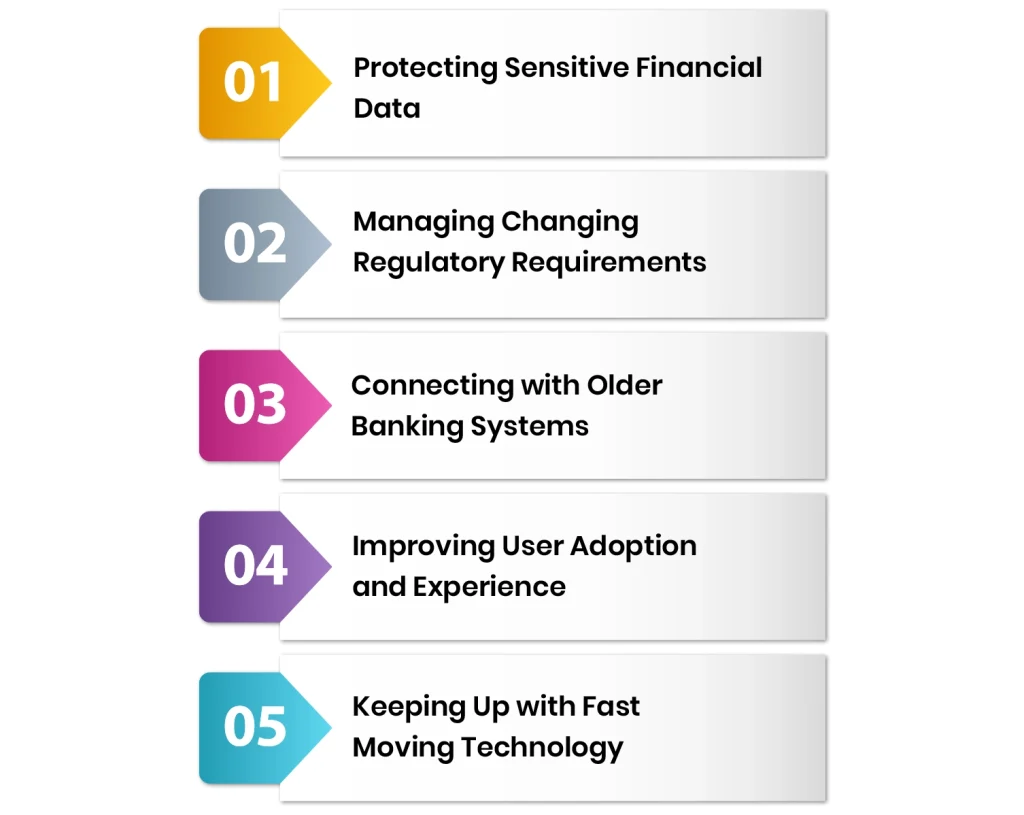
1. Protecting Sensitive Financial Data
Financial systems deal with highly confidential data such as assets, income, and client identity. This makes them a frequent target for cyber threats and unauthorized access attempts. Even a small breach can damage trust and business reputation.
To reduce risk, strong encryption is applied to protect stored and transferred data. Multi-factor authentication adds extra protection during login, and regular vulnerability testing also helps identify weak points early. This way, issues can be fixed before they get out of hand.
2. Managing Changing Regulatory Requirements
Financial regulations do not remain fixed. They evolve based on market conditions, government policies, and global standards. This makes compliance an ongoing challenge for wealth management platforms.
To handle this, systems are built with compliance automation that tracks regulatory rules in real time. Detailed audit logs record all system activity for transparency. Regular updates also ensure the platform stays aligned with new legal requirements without major disruptions.
3. Connecting with Older Banking Systems
Many financial institutions still use legacy systems that were built years ago. While these systems are stable, they are not always compatible with modern software. Direct replacement is also not practical because it can disrupt operations.
To solve this, APIs are used to create a bridge between old and new systems. Data is exchanged in a controlled and structured way. In addition, upgrades are often introduced gradually so that business operations continue without interruption.
4. Improving User Adoption and Experience
Even advanced wealth management software can fail if users find it complicated. Advisors may avoid using it, and clients may lose interest if the interface is not clear. This lessens engagement and limits the value of the platform.
To improve adoption, user interfaces are kept clean and easy to navigate. Step-by-step onboarding helps users understand features quickly, and feedback loops are also added so real user experience can guide continuous improvements.
5. Keeping Up with Fast-Moving Technology
Technology in wealth management changes quickly, especially with AI, automation, and data analytics becoming more common. The challenge is upgrading systems without rebuilding the entire thing from scratch.
To manage this, platforms are designed using modular architecture so new features can be added easily. Cloud infrastructure supports scaling without any major changes. At the same time, agile development allows continuous updates in smaller, manageable steps instead of large overhauls.
Cost and Timeline of Wealth Management Software Development
The cost and timeline of building wealth management software are not fixed. They depend on the size of the platform, the features you need, and the level of security and integrations involved. A simple tool is faster and cheaper to build, while a full enterprise system takes more time, planning, and investment. Below is a clear breakdown to help you understand what to expect at each stage.
MVP Software Development
An MVP is a basic version of the platform that covers only essential features. It usually includes simple portfolio tracking, client data management, basic reporting, and core compliance functions.
This type of solution is used to test the idea and launch quickly in the market. It is suitable if you want to start small and improve over time based on user feedback. The development cost usually ranges from $40,000 to $200,000, and the timeline is around 4 to 6 months.
Advanced Platform
An advanced platform includes more powerful features such as real time portfolio analytics, CRM tools, and integrations with external financial data sources. It may also include AI based suggestions to support investment decisions.
This type of system is designed for firms that want better client engagement and stronger automation. The cost usually falls between $200,000 and $400,000, with a development timeline of around 6 to 12 months.
Enterprise Grade System
An enterprise-level solution is a fully advanced platform built for large financial institutions. It includes full portfolio management, advanced risk analysis, customizable dashboards, and deep compliance tools. It also supports AI and machine learning for personalized financial insights and connects with multiple financial systems.
This level of software requires more planning and development effort. The cost typically ranges from $400,000 to $600,000 or more, and the timeline is usually 12 months or longer.
Choosing Between Custom and Ready Made Wealth Management Software
If you are planning to implement wealth management software, one of the first decisions you will face is whether to create a custom solution or use a ready made platform.
Custom development makes sense if:
- You run a business with unique workflows that standard platforms cannot fully support
- You need complete control over features, design, and system behavior
- You want to create a strong competitive advantage through technology
- You have a skilled technical team to manage development and future upgrades
- You are prepared for higher investment and a longer development cycle
Off-the-shelf solutions make sense if:
- Your requirements are similar to what most existing platforms already offer
- You want to launch quickly without waiting for full custom development
- You do not want to handle ongoing system maintenance or updates
- You are working with a limited budget and need a cost efficient option
- You prefer using a tested solution that already works for many financial firms
The right choice depends on how unique your requirements are, how quickly you want to go live, and how much control you want over the system in the long run.
Why Linkitsoft is Your Trusted Partner for Wealth Management Software Development?
Wealth management software is not just about features. It is about trust, compliance, and long term stability. It also plays a direct role in ROI and profitability by reducing manual work, improving decision making, and helping firms manage more clients without adding operational burden.
At Linkitsoft, we build systems with financial regulations in mind from the start. Our development approach is agile, which means the software evolves with your business needs instead of holding it back. We focus on secure architecture, practical integrations, and a clear user experience so the platform supports real, day-to-day financial operations.
If you are planning to build or upgrade a wealth management platform, Linkitsoft can help you move from concept to a reliable system built for growth.
Frequently Asked Questions
What exactly does wealth management software do in a financial firm?
It helps advisors manage client portfolios, track investments in real time, handle financial planning, and maintain compliance records. It replaces manual spreadsheets and scattered tools with one connected system for better control and accuracy.
How does wealth management software improve ROI for a firm?
It reduces time spent on manual reporting, improves advisor productivity, and helps firms manage more clients without increasing overhead. It also improves client retention by offering better visibility and faster service, which directly impacts profitability.
What security standards are used in wealth management software?
Most systems use encryption for data protection, multi-factor authentication for login security, and role-based access control. Many platforms also follow financial regulations like GDPR, PCI DSS, and local compliance rules depending on the region.
Can wealth management software connect with existing financial systems?
Yes, the custom software is commonly integrated with banking systems, trading platforms, CRM tools, accounting software, and market data providers. These integrations help keep financial data updated and reduce manual entry errors.