Across the world, farming is under pressure from water shortages, unpredictable weather, and changing crop cycles. Even in advanced countries, costs are rising. There are also fewer farm workers. This is forcing farmers to rethink how food is produced.
IoT in smart agriculture is starting to change this on a global scale. Large farms in the US now use soil sensors and rice fields in Asia use mobile connected irrigation systems. Farming is becoming more connected and data driven. They now use real-time data, which helps them make more precise decisions about land, crops, and resources.
In this article, we will talk about how IoT in smart agriculture is helping solve these problems. We will look at what it is, how it works in real farming, its key uses, benefits, and the challenges farmers still face around the world.
What is IoT in Smart Agriculture?
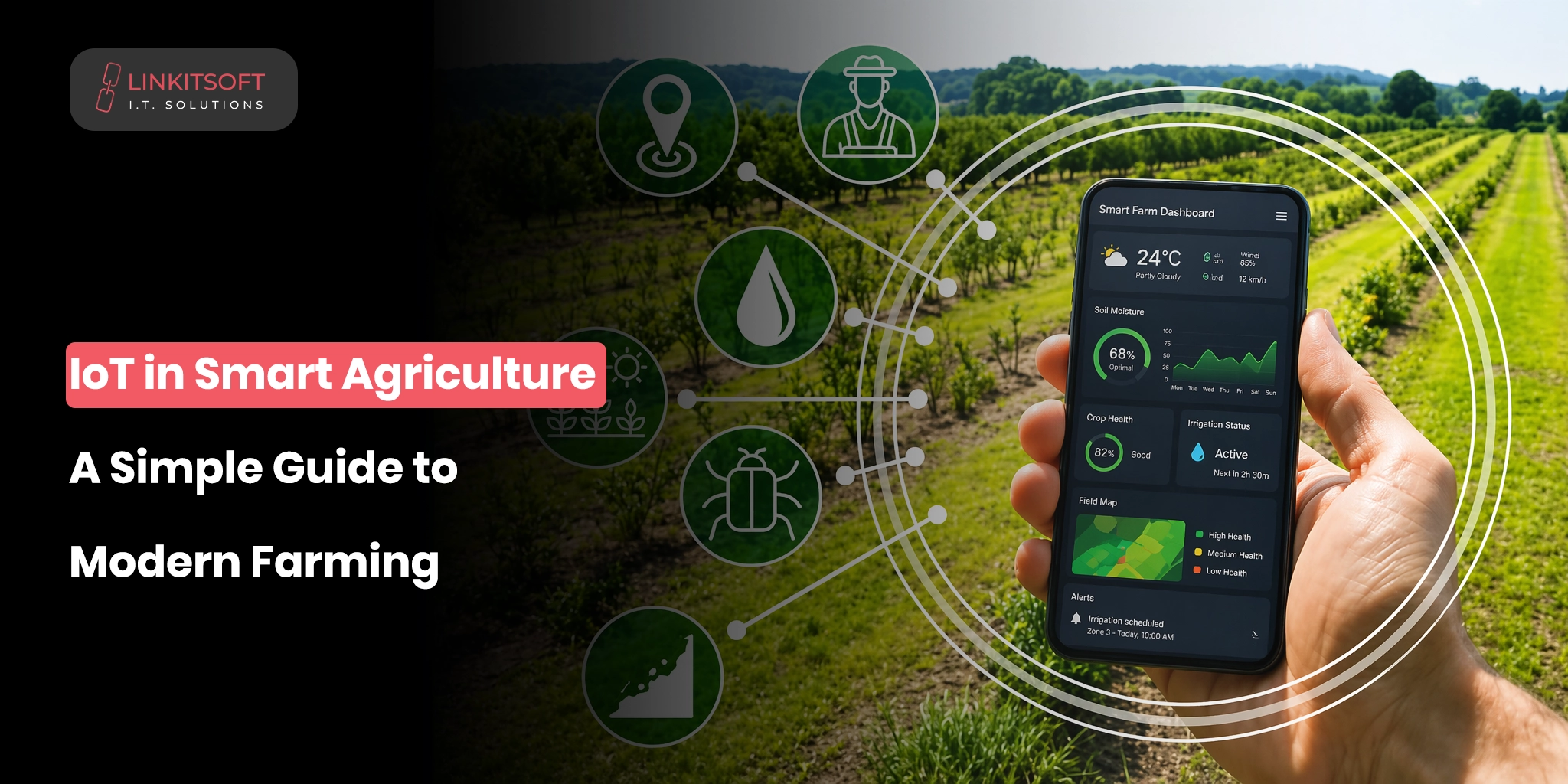
IoT in smart agriculture refers to using connected devices on farms to collect real-time data such as soil moisture, weather, temperature, and crop health. This crucial data helps farmers understand field conditions without doing the constant manual checks, because everything can be accessed on a computer/smartphone.
Based on this information, farmers can act at the right time instead of calculated guesses. Irrigation can start when the soil is actually dry, and crop issues can be detected way before they spread. In many cases, this leads to better results, including up to 50% less water use and over 90% accuracy in crop monitoring systems.
Top Benefits of IoT in Smart Agriculture
IoT is now being used in different parts of farming, from checking field conditions to managing water and other resources. Here are the main areas where IoT is used in farming today:
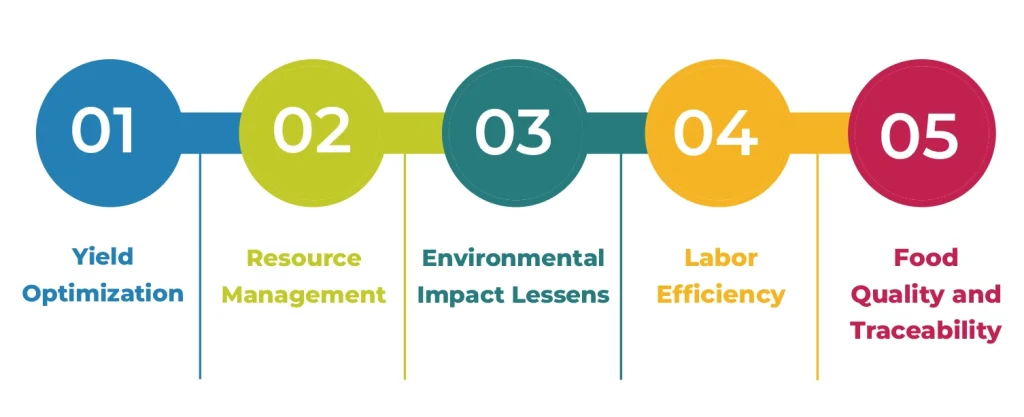
Yield Optimization
IoT systems track soil conditions, weather patterns, and crop stages through sensors placed in fields. This data is used to adjust irrigation schedules, fertilizer app and crop timing. It supports stable output across different farming cycles.
Resource Management
With IoT, raw materials of farming like water, fertilizer, and energy use are managed through sensor-based inputs. Not only this, soil moisture readings and weather data can identify irrigation levels. Nutrient delivery is also aligned with crop requirements at the field or zone level. This limits any excess usage and aligns inputs with demand.
Environmental Impact Lessens
Controlled application of water and agrochemicals limits runoff into surrounding soil systems. Soil structure remains stable because of regulated input levels. Moreover, emissions from machinery operations and overuse of resources are also kept in check through planned usage patterns.
Labor Efficiency
Farm operations such as irrigation, monitoring, and equipment handling run through automated systems. This means field data is accessed through centralized dashboards. So, manual field visits for routine checks are lessened.
Food Quality and Traceability
Storage and transport conditions are tracked using temperature and humidity sensors. Supply chain data is also recorded from production to distribution. This allows product tracking at each stage of movement.
10 Practical Use Cases of IoT in Smart Agriculture
IoT in agriculture is applied across multiple farm operations to support data-based decision systems, automation, and field-level monitoring. These use cases cover crop production, livestock systems, resource control, and supply chain tracking.
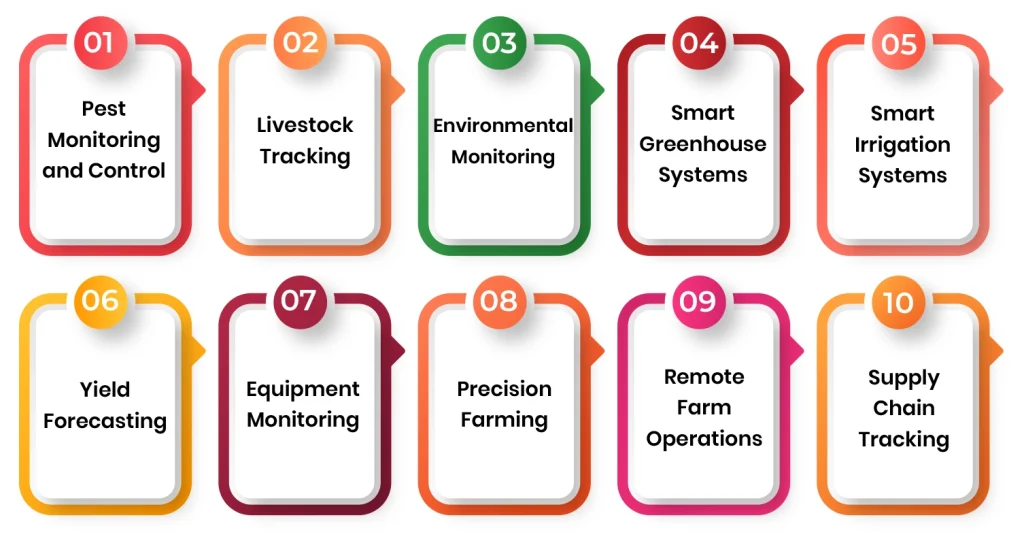
1. Pest Monitoring and Control
IoT devices track pest activity along with environmental indicators such as temperature and humidity. Data models are used to check risk patterns and trigger targeted control measures before spread occurs.
2. Livestock Tracking
Wearable sensors are used on livestock to monitor location, movement, and physiological signals. Alerts are generated for abnormal activity or health variation. This supports continuous tracking of herd conditions and asset visibility.
3. Environmental Monitoring
Sensor networks collect data on soil moisture, rainfall, air quality, and temperature variations. This data is used for field condition mapping and environmental response planning. It also supports the adjustment of irrigation and crop scheduling systems.
4. Smart Greenhouse Systems
Greenhouse operations use IoT controllers for temperature, humidity, and light regulation. So, systems are linked with automated ventilation, irrigation, and nutrient delivery setups. Environmental parameters are maintained within defined thresholds through control systems.
5. Smart Irrigation Systems
Irrigation systems operate through soil moisture sensors and weather data inputs, and water distribution is managed based on field-level readings. Some systems also use GPS tracking for irrigation equipment positioning and coverage control.
6. Yield Forecasting
With IoT in modern farming, historical and real-time field data is processed to estimate crop output. Inputs like soil health, weather data, and growth patterns are taken to support planning of harvest cycles and distribution requirements.
7. Equipment Monitoring
The technology doesn’t just focus on soil, irrigation, and yield. Now, sensors installed on machinery and storage units track performance indicators such as temperature, usage levels, and operating status. Fault detection systems generate alerts for maintenance requirements and operational issues.
8. Precision Farming
In precision farming, IoT sensors collect field data related to soil conditions, weather patterns, and crop status. This allows resource application at specific zones instead of uniform distribution on the fields. Irrigation systems, feeding systems, and climate controls in greenhouses and barns are managed based on sensor input and predefined thresholds.
9. Remote Farm Operations
Farm systems are connected to centralized dashboards accessible through mobile and web platforms. So, farmers can easily manage equipment, irrigation, and monitoring systems without physical field presence.
10. Supply Chain Tracking
IoT systems also track agricultural produce from the farm origin to distribution points. Temperature, storage conditions, and movement data are recorded at each stage. This enables full traceability across the supply chain.
What Technologies Are Used in Smart Farming?
Smart farming technologies include tools that use IoT in agriculture for field monitoring, automation, and data collection. These systems include drones, autonomous tractors, soil sensors, and weather monitoring devices. They generate real-time field data for farm use.
These systems support monitoring of farm activity. They also allow remote control of operations. Sensor data is used for irrigation control, crop tracking, and livestock monitoring. This helps manage farm operations across large areas.
Agriculture Robots and Automation
Agricultural robots and automation use IoT-based control systems and sensor input to handle farm work. These systems reduce manual work in planting, harvesting, spraying, and livestock tasks.
Robotic harvesting is used for crop collection. Weed control systems target specific areas in the field. Drone planting is used for seed placement. Automated milking systems are used in dairy farms. Precision spraying drones handle pesticide use. Autonomous tractors are used for field operations. These machines run on sensor data, GPS input, and control systems.
Drone-Based Farming Systems
Drones are used in agriculture for aerial data collection and field monitoring. They use cameras and sensors to collect field information.
They are used for land surveys, soil mapping, livestock tracking, crop checks, irrigation checks, and pest detection. Drones can scan large fields in less time. They also capture detailed data from different parts of the farm.
Remote Sensor Networks
Sensors are placed across fields to collect soil and environmental data. They measure soil moisture, temperature, humidity, and nutrient levels.
Farmers use this data to track crops, monitor rainfall, and check soil conditions. It is also used for livestock tracking through wearables, irrigation control, and greenhouse setup. This data helps in day-to-day farm planning.
Challenges of IoT in Smart Agriculture
IoT brings real value to farming, but it is not always easy to set up. Farms need proper systems, planning, and setup. There are still a few issues that affect how widely it is used.
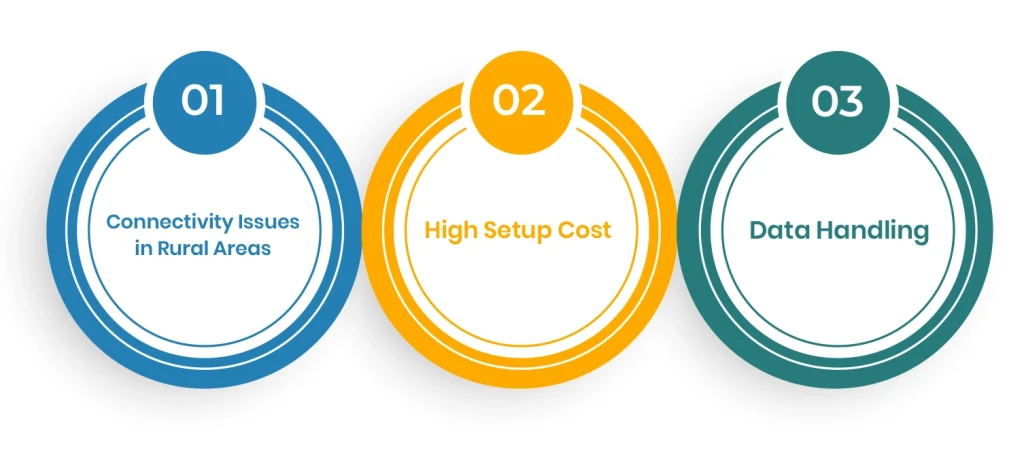
Connectivity Issues in Rural Areas
Many farms are in areas with weak internet coverage. This makes it hard for devices to stay connected. Data does not always transfer on time. This affects how the system works in real conditions.
High Setup Cost
IoT systems need sensors, devices, gateways, and software. All of this costs money. For small and mid-sized farms, this can be difficult to manage. Costs also increase when systems are used across large areas.
Data Handling
These systems collect a lot of data from different sources. This data needs to be stored and understood. Without proper tools or support, it becomes hard to use this data in real farm decisions.
Final Words
That brings us to the end of this guide. We covered how IoT is used in farming, where it fits, and what challenges come with it.
If you run an agriculture business and want to explore IoT, it is important to plan based on your farm setup. Linkitsoft works with businesses on IoT planning and system setup.
Connect with us to discuss your requirements and see how you can get started.
Frequently Asked Questions
How is IoT used in smart agriculture?
In farming, IoT is used through sensors and connected devices placed in the field. These tools track soil moisture, weather, crop condition, and livestock movement. Farmers use this data to manage irrigation, crops, and daily farm work.
What are the 4 pillars of IoT?
The four pillars are M2M, SCADA, WSN, and RFID. These systems handle how data is collected and shared. They also allow devices to communicate with each other.
What are the 5 Internet applications in smart agriculture?
IoT is used in precision farming, irrigation systems, livestock tracking, crop monitoring, and supply tracking. These are the main use cases in farming today.
What are 5 IoT devices examples?
Examples include soil moisture sensors, weather stations, RFID tags, GPS trackers, and drones. These devices collect data directly from the field.
What is the most popular IoT device?
Sensors are used the most in agriculture. Soil moisture and weather sensors are common. Most systems depend on them for basic data.